
28th week of pregnancy: baby's development, mother's physical changes & information about a possible preterm birth
Welcome to the 3rd trimester! Your baby has probably already passed the 1,000-gram mark in the 28th week of pregnancy and you can also tell that the pregnancy is slowly coming to an end. Maybe from this week you are preparing in a childbirth preparation class for the final period of pregnancy and the delivery. From now on the Prenatal check-ups every 2 weeks take place and your doctor monitors your baby's development even more closely. What else happens to you and your little miracle in the 28th week of pregnancy, you can read on this page.
Your baby's development in the 28th week of pregnancy
Eyes opening and closing: For some time now, your baby has had a sleep-wake rhythm. In the 28th week of pregnancy it closes and it also opens its little eyes accordingly. During wakeful phases, it perceives its surroundings in the warm reddish light that shines through the mother's belly.
Immune system functions independently: From the mother's placenta, your fetus at 28 weeks absorbs increased antibodies. Its immune system can now protect it on its own.
Bronchi branch out: Your baby's bronchial system becomes ever finer and the blood vessels in the lungs continue to develop. In the 28th week of pregnancy the fetus thus reaches a important developmental milestone on the way to independent breathing.
Surfactant production increases: The surface-active substance prevents the sticking of the lung's air sacs during breathing. From this week on, the fetus's body produces more and more of the protective substance. Your baby continues to diligently practice breathing in the amniotic fluid for the time after birth.
What can be seen on the ultrasound image?
In the 28th week of pregnancy, your baby weighs approx. 1.100 grams and is therefore about the size of a head of lettuce. With 100 grams more, that's already a considerable weight that you're carrying in your belly. With its ca. 38 cm, your little one has grown another 2 cm compared to the 27th week of pregnancy grown. In the ultrasound image you can now see the sweet face of your little person. Your obstetrician offers you this week a 3D ultrasound – with this you can recognize your child's nose, ears and eyes even more realistically. Only requirement: your baby has to cooperate and must not hide its face. Our note: a 3D ultrasound is not covered by health insurance. So it's best to find out about the costs beforehand.
Physical changes – what happens to the mother at 28 weeks?

The countdown is on – in the 3rd trimester it gets pretty cramped in the belly and you both notice it. The pregnancy complaints from the early period you now trade for physical strains that you'll have to cope with in a new way. The positive: you now feel your baby even more intensely through your belly and can see the arm and leg kicks through the abdominal wall. We have put together for you an overview of the physical changes compiled:
The uterus prepares itself: The walls of the uterus are now becoming firmer and thicker at the upper part. Towards the pelvis they become more flexible. As a result, the baby has less and less room at the top. The altered shape of the uterus helps it to slowly move into the proper birth position to get into. Until that happens, it can take until the 36th week – so don't stress if your baby is still kicking around a bit in the belly.
Joint pain: The pregnancy hormones also prepare your own body for the upcoming birth and loosen your joints. You will probably now feel pelvic or limb pain more often as a result.
Itchy belly: The skin on your belly is stretching more and can itch unpleasantly more often. Creams and oils help reduce the itching. Our tip: if creams and oils don't help, try baby powder to soothe the irritated skin on your belly.
Stretch marks: With increasing weight, the skin must stretch more and more. This can lead to stretch marks on the belly, breasts, or arms to occur. Creams and oils can help counteract them here as well.
Shortness of breath: Your baby now weighs over a kilogram! Therefore, you may be slightly out of breath. Because the larger your child, the more your chest cavity becomes restricted – and that leads to shortness of breath.
Preterm birth: the early start to life
It is not always possible to maintain the pregnancy until the due date. Babies that are born between the 24th and 37th week are born as so-called preemies.
What are the causes of preterm birth?
Many factors can lead to preterm birth. Often these are not clearly determined or it's an interplay of different causes. The mother's age, a multiple pregnancy, or an infection are some risk factors, that the doctor monitors particularly. In some cases preterm births can be delayed or, in the best case, prevented, but you cannot always influence nature.
What happens after a preterm birth?
Your child is placed in an incubator, because it can be monitored optimally there: The preemie's body temperature is regulated and the weak immune system is protected. If the baby is born extremely early — i.e. between weeks 24 and 28 — artificial ventilation and nutrition help it become stronger more quickly. You will then probably spend a lot of time in the hospital. As soon as the baby is stable enough, the doctors place your baby on your bare chest. Warmed by blankets and your body, the baby feels your heartbeat. With the so-called kangaroo method you strengthen the bond with your baby and support its development.
What complications can occur?
In the uterus, optimal conditions exist until week 37 to allow your child to develop and mature. If it is born after the 24th week, the internal organs are already formed but not yet sufficiently developed. Especially the lungs need more time to mature. For this reason, the baby is given an agent for lung maturation immediately after preterm birth. Besides the lungs, the preemie's kidneys are often not sufficiently developed and the electrolyte balance is disturbed. This can lead to metabolic problems.
When can a preemie go home?
Until your child may go home, it will still take some time. Preemies should by then weigh approximately 2500 grams and be able to breathe, eat and regulate their body temperature independently.
Important appointments in the 28th week of pregnancy
Visit the birth facility: Hospital, birthing center, or a home birth are usually the options for most parents as the place of delivery. Maybe you have already decided on an option? In the 3rd trimester, it's now slowly time for you to take a closer look at the planned place of delivery: How long does the journey from home to the clinic take? What does the delivery room look like? Are you on the same wavelength with the staff? If you are unsatisfied after the tour, there's still enough time to look around other hospitals or birthing centers.
Vacation preparations: Do you want to enjoy some time alone together before the birth and fly on vacation? Flying is generally possible without problems up to the 28th week of pregnancy.
More articles about expectant mothers
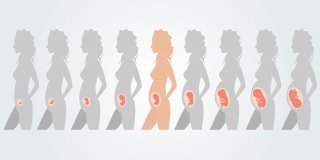
Image credits
Illustration of pregnant women © designer_things - stock.adobe.com
Couple forms a heart with their hands on the pregnant woman's belly © Syda Productions - stock.adobe.com