Easter custom in Germany: egg hunt and Easter fires
The beginning of spring and Easter — they fit together better than any other festival. In the Christian church one commemorates the death and the resurrection of Jesus and fittingly the nature around us awakens. No wonder that most of our German Easter customs revolve exactly around this theme.
The Easter fires, which blaze in many regions of Germany on Easter night, are meant to drive away the cold winter and bring warmth back to life. Also, the worldwide popular colorful Easter eggs have always stood for new life and rebirth. That people give each other boiled and colorfully painted eggs at Easter had a very practical reason in the past. During Lent, according to Christian tradition, no eggs and no meat were allowed to be eaten. But because the hens kept laying eggs, they were boiled and thus preserved. With the end of Lent on Easter Sunday there were eggs in abundance.
The custom of hiding eggs and other treats in the garden or park is not quite as old. In the 17th century in Germany for the first time an egg hunt on Easter Sunday is reported. In addition, the egg hunt is a lovely opportunity for an extended Easter walk. In and around Coburg in Upper Franconia, the Easter Bunny, by the way, already hides the eggs on Maundy Thursday.
But where does the Easter Bunny? Scholars dispute that. Depending on the region, foxes, roosters, or cuckoos used to hide the eggs. The hare, a symbol of fertility and spring, has prevailed over time.
Easter in Norway: following the snow up into the mountains
In Norway people follow the retreating snow into the mountains to celebrate Easter in cabins there. Sounds odd, and it is meant to: Allegedly after the last Ice Age the first Norwegian, instead of moving south with his clan, ran north after the retreating glaciers. With a lot of self-irony, today's Norwegians imitate their forefather.
Easter in Finland: Easter rooster & birch branches
Whoever is in Finland during the Easter days, on the other hand, could experience a 'blue wonder'. The Finns 'beat' their fellow humans — as after the sauna — in a friendly way with birch branches. That is supposed to bring luck. The Easter eggs in Finland, by the way, are laid by the Easter rooster and not the Easter Bunny.
Easter custom in Sweden: Easter witches & Påskmust
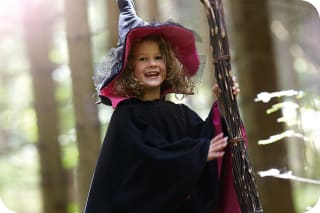
As in Finland, in the days between Maundy Thursday and Easter girls in Sweden also go from house to house as 'Easter women' or 'Easter witches' and ask for sweets. As 'payment' they receive homemade pictures or greetings from the Easter witches. The children get their chocolate eggs on Holy Saturday — and not in an Easter nest but in a large cardboard egg. For the treats they drink Påskmust, a special malty Easter soft drink.
Easter in Ireland: herring burial
Before the Irish can 'plunder' the chocolate in their Easter nests, they first have to survive Lent. And at the end of this 'hard' time a herring is buried for fun. Not infrequently such herring burials – not entirely unselfishly – are organized by the local butchers.
Easter customs in France: flying bells
As with the Irish, lamb is traditionally eaten at Easter in France too — as a roast or as a chocolate figure. Small chocolate bells, which children in Germany are more likely to nibble at Christmas. In France, 'flying bells' in general bring the eggs and sweets, not the Easter Bunny. Between Good Friday and Holy Saturday the church bells traditionally fall silent. Therefore it is said they have flown to Rome. On their way back they then have all sorts of sweets in their luggage.
Easter in Switzerland: somersaults at sunrise
In the canton of Valais in Switzerland, Easter Sunday is greeted in a sporting way: still before sunrise people march in a procession up a hill and welcome the first rays of sunshine with three somersaults.
Easter custom in Poland: the 'wet Monday'
In Poland, Easter visitors should rather take an umbrella with them. It may happen that even under blue skies and the nicest sunshine they suddenly get wet. On 'wet Monday' the Poles remember the baptism of their first ruler in the 10th century — and therefore 'baptize' all compatriots and tourists alike with water pistols and water balloons.
Easter custom in the Czech Republic: Easter switch & colorful Easter egg
When a young man and a young woman meet at Easter in the Czech Republic, a very special 'barter' takes place. He 'beats' her symbolically with an Easter switch made of braided and decorated willow twigs. This is supposed to give her some of the strength and life energy of the tree and keep her healthy and happy throughout the year. In return she gives him a brightly painted Easter egg.
Easter custom in Spain: Caramelles singers and processions
In Spain, Holy Week and Easter are a tourist magnet. When religious brotherhoods, wrapped in hooded robes, in long processions walk through the streets and carry saint figures or the symbols of the Stations of the Cross on their shoulders, one feels transported back to ancient times. That it does not always have to be so serious is shown by the Catalan Caramelles singers. Children and adults go through the streets and do not always sing only religious songs there. As a 'reward' they get eggs, sausages, and sweets.
Easter custom in Italy: Easter dove & Easter parade
Whoever celebrates Easter in Italy must bring a lot of patience. At the traditional processions the faithful sometimes move so slowly that they take hours for one kilometer. Whoever has persevered is rewarded with the 'Colomba Pasquale' (Easter dove) as a reward, a yeasted cake in the shape of a dove, which is filled with all kinds of candied fruits, raisins, and almonds.
Easter custom in Greece: red eggs & egg tapping
In Greece, Easter is perhaps even the most important festival of the whole year. Accordingly there are countless traditions and Easter dishes. Funny is the 'egg tapping': On Maundy Thursday the eggs are boiled and dyed red. At Easter, one then strikes one's egg against another person's egg. Whoever's egg remains intact has won. Anyone who wants to join in this fun should look closely at the Easter egg of the person opposite them. Some jokers even compete with red-painted wooden eggs.