What is social competence anyway?

By definition: Everyone roughly knows what is meant when it comes to the social competence of children or adults – but what does the exact term actually mean? According to the scientific definition, social competence is "the ability, in social interaction, to achieve one's own goals and satisfy needs while at the same time taking into account the goals and needs of all others."
Self-assertion and consideration: Social competence is, at its core, the connection of two seemingly opposing traits:
The ability to assert one's own interests, through clear demands, but also through refusal.
The ability to take into account the needs of other people or of a group and to cooperate with them to achieve a common goal.
Many scientists are convinced that the foundation for these abilities is formed in early childhood upbringing.
Children's social competence:
How can I create the best conditions?
Should one actively promote children's social competence or does it more or less develop on its own through the social environment? Many parents ask themselves this. Unlike, for example, a child's visual perception or sense of balance, social competence is difficult to measure and depends on many different factors.
Social competence is innate to us – at least its foundations. Even newborns intuitively pay more attention to human faces than to abstract objects. The so-called 'angel smile', the reflexive smile that newborns show in the first weeks of life, can also be understood as a social interaction. All parents will confirm that their babies try very early on to imitate parents' gestures and facial expressions and clearly show their emotions. In its basic features, social behavior seems to be innate – however, the acquisition of social competence is a learning process that continues well into adulthood. There is not really promotion in the strict sense. Rather, parents can create the right conditions from the start for their child's healthy social development:
By spending a lot of time with their child and engaging with them
By showing their own feelings and/or being willing to talk about them
By allowing and understanding the child's feelings – including anger, defiance, or sadness
By listening to their child and helping them perceive their own feelings and place them within the full range of emotions
By enabling contact with other children and adults (e.g., in playgroups, in daycare, and in kindergarten), so that the child learns to interpret the facial expressions, gestures, and emotions of others
Children first have to learn to interpret emotions. This applies to their own feelings as well as to the feelings of others. You can practice this playfully by looking at magazines or picture books with your child and asking them how the people pictured might be feeling right now. A second way to promote your child's social competence is even more obvious – through contact with other children. It is proven that children learn a lot from interaction with peers. Therefore, daycare and kindergarten provide a good foundation for the development of the social competence children will need throughout their later lives.
Checklist for parents – To-dos for social competence

Love and attention: The unconditional love of parents gives children the security and self-confidence to develop their own personality
Be a good role model: Listen, let others finish speaking, be able to apologize – parents who model this behavior shape their children's social behavior
Allow children to resolve conflicts on their own: As long as it doesn't become physical, children should be able to settle their disputes among themselves
Contact with other children: Through interaction with peers, children learn social competence and form friendships
Time for free play: When playing, children take on different roles – this trains empathy and the understanding of conflict situations
Show emotions and allow emotions: Don't pretend – and also give your child the opportunity to get to know and understand their own feelings
Discover more articles on parenting & psychology











Image credits
Standing boy pulls a small boy up by the hand © TinPong - stock.adobe.com
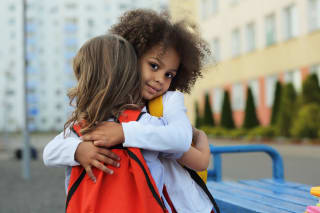
Girl of color hugs her friend © ShunTerra - stock.adobe.com
People hold each other by mud-smeared hands © banphote - stock.adobe.com