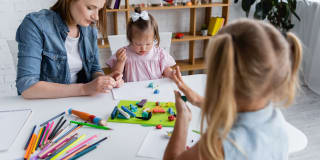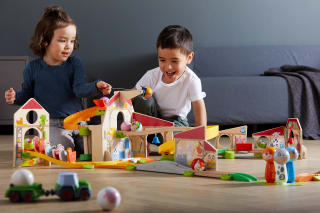
Building blocks are perfectly compatible with other toys: With dolls, vehicles and other 'ingredients', children from about four years old constantly come up with new play ideas.
You don't always have to be able to tell 'what the structure is supposed to be.' Many children simply love developing beautiful shapes or interesting constructions.
Girls often develop less enthusiasm for building and constructing. They prefer to turn to role play and dote on their doll. But it's also good for their development to enjoy playing with building blocks.
Six reasons why building blocks belong in every child's room:
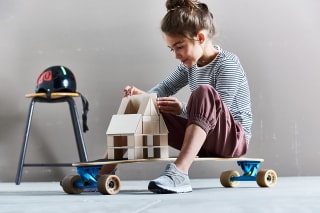
Building blocks can be anything and are suitable for any imaginary castle: they stimulate imagination and initiative.
Building blocks train forward-thinking, deliberate action, and capacity for imagination through playful experimentation and exploration: What do I want to build and what do I need to do? How can I manage to build a very, very tall tower that won't collapse? How big does the castle have to be so the king fits inside?
Building blocks introduce basic mathematical and physical principles: Why does the tower collapse when I put a large, heavy block on top? How can I insert a window into the block house? Why does a leaning tower sometimes remain standing? And if the cube-shaped blocks are already built in, can I then use triangular ones?
Building blocks give a sense of space, shapes, and proportions: with the same blocks I can build something wide and flat or something narrow and tall.
Building blocks train eye-hand coordination and fine motor skills: if I don't place the rectangular blocks carefully side by side and on top of each other, everything collapses.
Building blocks demand and promote perseverance and concentration: immersing oneself in a 'building project' and forgetting everything around makes children happy and content.
Parent tips: Which building blocks for my child?
For the youngest, a basic kit with few different but size-coordinated pieces is suitable. This way they can become familiar with the building principle best. For toddlers the 'selection' should be manageable.
Three-year-olds already need more material; rectangular blocks are especially popular. Later, longer 'beams' and special elements also become important.
If a larger construction kit is purchased for the very little ones, it makes sense to put some of the pieces away at first and only add them back gradually.
Experience with 'loose' building blocks should come before play with interlocking systems.
With growing experience, skill, endurance, and 'growing building projects', the collection can be steadily expanded so that building remains exciting.
Color is not so important for the younger ones: only five-year-olds use colors deliberately.
Templates only become interesting from school age, if at all. If the building project isn't making progress, it's better to support the child in their own inventions than to copy templates.
Children must have a place where they can leave started or finished constructions.
Why a marble run?
As early as around four years old, children like to let the marbles swoosh down the first self-built marble run made from wooden building blocks. It occupies the youngsters for many years and challenges their ambition: the constructions become increasingly elaborate and demanding. And the exciting question always remains: Is the track well built and does the marble roll down at full speed? Or is there some construction error somewhere that makes it get stuck or fly out of the curve?
Inserting, Screwing, Clamping
With loose building blocks, children can best explore what statics means. Plug systems and other construction materials for screwing or clamping should only be introduced into the children's room afterwards. Here too, experts recommend paying attention to the play value: Does the toy stimulate the imagination? Can children realize their own ideas?