Why are boots placed outside the door on St. Nicholas Day?
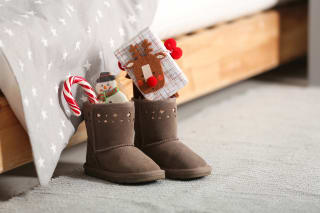
The best thing about St. Nicholas Day for children is little gifts, which Saint Nicholas fills into the boots at night. Provided that no one forgets to put the shoes out. This custom developed from the tradition of the so-called "ship-setting": In earlier centuries children crafted small ships out of paper or other materials, into which Saint Nicholas on St. Nicholas Day was supposed to put the gifts place. For according to legend the bishop had rescued sailors in distress by calming a fierce storm at sea. Thus Nicholas became the patron saint of seafarers and the ship became an attribute of the saint in art. Later the handmade little ships were replaced by shoes, stockings or a tray of gifts.
Why St. Nicholas no longer brings the Christmas presents to us
Why Saint Nicholas no longer brings Christmas presents to us
Until the Reformation, Saint Nicholas — not the Christ Child or Santa Claus — was the most important gift-bringer. He gave gifts to children on December 6. During the Reformation, however, he lost part of his power. Martin Luther found the then-popular customs of a bishop-robed Nicholas, accompanied by wild companions, abhorrent. With the Christ Child and the gift-giving on Christmas Eve he wanted to detach the act of giving from the figure of the saint and place Christ at the center of piety. With the Counter-Reformation the gift-bringing Nicholas revived.
Where Saint Nicholas Day is more important than Christmas
With our Dutch neighbors, Saint Nicholas Day is traditionally celebrated with all the trimmings, already on December 5. Then 'Sinterklaas' brings the gifts.
What does Knecht Ruprecht have to do with Saint Nicholas?
It was only from the 16th century that Nicholas no longer visited families alone: Knecht Ruprecht has accompanied him ever since. Originally the 'bogeyman' Knecht Ruprecht was intended to act as a counterpart to the friendly Nicholas. Today one would speak of the 'Good Guy – Bad Guy' principle: While Nicholas, as the gift-bringer, rewarded good behavior, the gloomy companion punished naughty children with the rod. Knecht Ruprecht no longer plays this role in Germany today. He still carries the rod, but primarily he transports in a sack or basket on his back the gifts.
Why does St. Nicholas read from a golden book?
The customs surrounding St. Nicholas Day also incorporate the "boy-bishop plays" of the Middle Ages: In monastic schools, on the Feast of the Holy Innocents on December 28, a pupil was elected as a boy bishop. He was allowed to scold the teachers on that day. Later this custom was moved to St. Nicholas Day, when the children's misdeeds were then pointed out to them.
Do children need to be told the truth about St. Nicholas, Santa Claus, and the Christ Child?
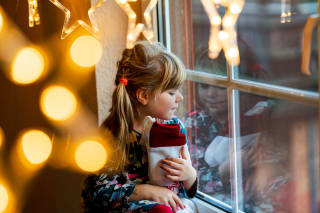
Children still surrender to the magic of Advent and the Christmas season quite naturally. The Christ Child rings the bell when all presents placed under the tree? Of course! Santa Claus provides everyone with their presents more or less at the same time on Christmas Eve? Why not, he can zip through the air super-fast!
Between the ages of three and eight, children are in the magical phase: they have invisible friends, like talking animals, and believe in everything supernatural. The main Christmas characters fit perfectly into this cosmos. Parents may join in and support their children in this magical perspective. Even if belief in the Christ Child or St. Nicholas begins to waver during primary school, the fascination remains. Children still like to believe in the mysterious.
Read more articles on this topic






Image credits:
Girl with a chocolate Santa in her hand ©sweetlaniko - stock.adobe.com
Children's boots filled with sweets ©New Africa - stock.adobe.com
Girl with a St. Nicholas boot at the window ©Irina Schmidt - stock.adobe.com