This is how children learn to deal with their emotions
Learning to control one’s own emotions is one of the most important learning processes for children — and for many adults the issue of impulse control is far from resolved: who doesn’t know someone who is prone to angry outbursts or who withdraws, offended, for no apparent reason? For children to learn to deal with their feelings, you first have to be able to recognize and classify them. That requires that even extreme emotions like anger and disappointment are not forbidden but may be expressed.
Early coping strategies:
Children develop their own strategies very early on to process frustration. They seek closeness to their parents, ask for a pacifier, or throw their toys around. Even when they can already speak, children almost always express their anger nonverbally, by pushing, throwing themselves to the floor, hitting, or stamping their feet.
Don't punish tantrums:
When children freak out, the parents' nerves suffer and most find it difficult to stay calm and not respond at the same volume. Nevertheless, you should not punish outbursts of anger or 'sulking'. Expressing anger and frustration is part of the developmental process and children should not develop a fear of their own anger.
Foster empathy:
Children first need to develop an awareness that scolding, shouting, and aggression can hurt others — for them it is initially mostly a vent to cope with their emotional world. Talk with your child about feelings — including your own — to strengthen the ability to empathize.
Aggressive behavior among children — normal?
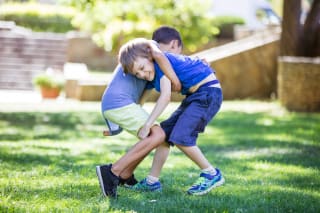
Children quickly get into clashes. The reasons are obvious: up to a certain age a physical confrontation is much easier than resolving a conflict verbally. In addition, children first have to learn to control their impulses — before a child is really aware of its feelings, it may already have hit the other over the head with a toy shovel. Even if an argument involves a lot of shouting and scuffling, in many cases it is not necessary for parents to intervene. In conflict with other children, kids practice not only managing conflicts and 'enduring' them, but they also learn a lot about their own feelings and those of others. Parents or educators should step in when there is a danger that a child will be hurt or is clearly outmatched, or when the situation obviously leads nowhere. It is important to look closely at who started the fight: the one who cries at the end is not always the victim.
Tips for parents: Managing tantrums
Don't condemn aggression:
It should be allowed to feel "negative" emotions like anger, frustration, or sadness without parents being disappointed or irritated.
Stay calm:
Even when it's difficult with a raging child - parents can support their child in exceptional situations by being a calm anchor and, if necessary, intervening.
Don't treat it as a provocation:
Try not to interpret a tantrum as an attempt to provoke - most children are as overwhelmed by their aggression as their parents are.
Let anger out:
Aggression subsides faster when a child can let their anger out - as long as nothing gets broken and no one gets hurt.
Find individual anger strategies:
Find ways together with your child to deal with emotional outbursts - e.g., hitting a punching bag, being allowed to shout loudly, tearing up newspaper, etc.
Label emotions:
Children need to learn to perceive and classify their feelings. You can help by asking your child about their feelings: Is your child angry, sad, scared, disappointed?
Recognize verbal aggression:
Children don't have to hit to hurt others - some express their aggression with mean remarks, insults, or emotional blackmail. Keep an eye on verbal aggression and make clear to your child how hurtful such things are.
Done:
For most children, it's a great relief when they've gotten their anger under control. Praise your child and take time for a calm activity together.
Discover more articles on parenting & psychology



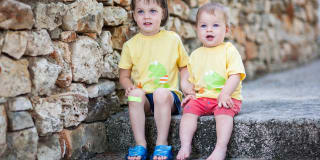

Image credits:
Two little sisters argue © MNStudio - stock.adobe.com
Two boys fight outdoors. Siblings or friends wrestle in the park © Andrey Bandurenko - stock.adobe.com