What does diaper-free parenting mean?
Diaper-free parenting is a method of toilet training – in English it is called “elimination communication” called, which in German means “Ausscheidungskommunikation”. As the name suggests, the communication between you as parents and your child plays a decisive role in diaper-free parenting. Above all, it's about recognizing in time that your child needs the toilet based on signals such as sounds, facial expressions, or physical tension. This is to give them the opportunity to do their business without it ending up in the diaper.
The term “diaper-free” is somewhat misleading, because it's not primarily about your child not wearing any diaper at all. In the long run that's of course the goal, but diaper-free parenting is less about premature potty training and more about understanding the natural bodily needs of babies and the corresponding signals and responding to them. From the first day of their baby's life, parents watch for certain signs that indicate elimination needs, and then hold their baby, for example, over the sink, a potty, or the toilet.
At what age does diaper-free parenting make sense?
It's best to start as early as possible, i.e., immediately after birth, with diaper-free parenting of your little one, but at the latest three months after birth. This way you can already accustom your child and establish the association that when it expresses certain signals it can do its business. After a time beyond three months this transition becomes more difficult and the communication or signals are no longer as easy for you to recognize.
Diaper-free parenting – advantages and disadvantages

Reasons in favor
Close bond: It is undeniable that diaper-free parenting fosters a very close relationship between baby and parents. From day one you pay attention to your child's needs and signals and rely more on your intuition.
More comfort: A wet diaper on the skin is uncomfortable. Mobility is also restricted by the bulky diaper as the child becomes more mobile. Anyone who has left their baby without a diaper for a while knows how much children enjoy that freedom.
Environmentally friendly: Diapers are not cheap – and they generate a lot of waste. Diaper-free parenting is therefore even more environmentally friendly than cloth diapers. Overall it is also more cost-effective, although diaper-free babies usually need alternative clothing without snaps at the crotch instead of the usual bodysuits. In addition, baby laundry should be of particularly high quality since it is in constant contact with the skin.
No transition: Although it's not the main goal of diaper-free parenting, babies who grow up without diapers know their elimination needs from the start and later have no problems getting used to the potty or the toilet.
Arguments against
Time-consuming: Parents must be very attentive and closely watch their child's signals. These signals are not always clear – and daily life does not always allow you to focus entirely on your child.
Not very flexible: Running quickly to the sink at home with the baby is doable – but what about when you're on the go? How do shopping trips or meeting friends work when you suddenly have to help the baby pee? Parents of diaper-free babies quickly lose flexibility and spontaneity.
Low acceptance: Not everyone can warm to the concept of natural infant care. Family and friends often react dismissively. And of course not everyone likes it when things go wrong more often – not only onto the baby's clothes, but sometimes onto the baby carrier or the parents' clothes.
Caregiving problem: For mom and dad it becomes quite normal after some time to recognize their baby's signals and act accordingly. Other people will probably find it harder. Leaving the baby with grandma and grandpa or a babysitter for a few hours is difficult – the very close parent-child relationship can thus become a stress test.
Tips & tricks: How does diaper-free parenting work in everyday life?
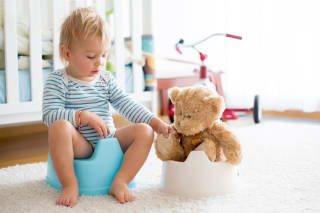
First of all it mainly requires attention from you as parents – and in that context also time and patience. You first have to develop a sense for recognizing your child's elimination needs and interpret signals such as facial expressions and sounds. It helps if you observe your child attentively. Over time you will intuitively recognize when your little one needs the potty. Moreover, it is not primarily about the child becoming dry as quickly as possible. Rather, it should learn to notice and understand the need to go to the toilet.
It helps if you bring routine and regularity into everyday life and schedule specific times for toilet visits such as after meals, after waking up and before going to bed. This rhythm quickly establishes itself in your child as well, which also facilitates diaper-free parenting.
You can hold your baby over a sink as well as over a potty or the toilet. But it's best to use a keyword (e.g. "pee") or give your child a signal that it can now do its business. This way it learns to better control the urge to eliminate and to wait until it is “safe”.
Tip: Besides actually peeing, children also have to learn everything else that belongs to going to the toilet. Take the opportunity and practice a few things like handwashing right from the start: the more independent your child is on the toilet, the harder it becomes to remind them about handwashing and co.
Does diaper-free parenting also work at night?
Even though holding during the day is somewhat easier, diaper-free parenting is basically also possible at night. But it helps if you initially focus above all on establishing the daytime toilet routine. When your little one sleeps, they usually do not yet have control over their bladder or bowel movements – that's completely normal. If you want to practice diaper-free parenting at night, in general it is easier if your baby sleeps in the bed with you. That way you notice possible signals, such as restlessness, more quickly and can also react faster. Particularly practical here are nightgowns or sleeping bags for your baby that can be opened quickly and easily. It's best to have a potty or a bowl next to the bed – and spare clothes for your little one just in case. Waterproof mattress protectors are also sensible if occasional small accidents still happen.
Important: Don't put pressure on yourselves. If you notice that holding at night is only an additional stress for you, it's enough to practice the method only during the day. Or you can try again at another time. In that case, put your baby in a diaper at night as usual.
Potties for diaper-free parenting
Image credits
Girl sitting on the bed after a bath, laughing © gpointstudio - stock.adobe.com
Four-month-old baby smiling in her mother's hands © Полина Власова - stock.adobe.com
Small child sitting on the potty with their teddy © Tomsickova - stock.adobe.com