The Origin of Waldorf Education
It began with the factory school: The esotericist Rudolf Steiner founded in 1919, at the request of entrepreneur Emil Molt, a school for the children of the workers in Molt's Waldorf Astoria cigarette factory. In doing so, Steiner implemented for the first time the new school concept he had developed on the basis of his teachings on human nature.
Steiner's teachings on human nature: Previously, Rudolf Steiner had developed his doctrine of anthroposophy, which also includes the spiritual world—not perceivable by the senses—in its image of humanity. According to this, the human being consists of a physical, a spiritual and a psychic component—the etheric body, the astral body and the 'I' (ego)—which are all interrelated.
The reform school concept: Steiner's new type of school stood for the principle of social justice and opposed separation based on academic achievement and social criteria. Today, Waldorf education, which is associated with reform pedagogy, is widespread and is also applied in kindergartens, playgroups and special needs institutions.
Education for freedom - the idea of Waldorf education

Anthroposophical pedagogy understands itself as "education for freedom": this refers to the free development of the child's personality and their perceptual and experiential abilities. Principles implemented in all Waldorf institutions include, among others:
Individual support instead of selection
Free child play instead of guided group activities
Natural play and craft materials as well as "non-representational" toys are intended to stimulate imagination and initiative
Time and space for free development
Regular rhythms in daily and weekly routines and a close connection to the yearly cycle should provide security and orientation
Educators observe each child carefully in their development and personality and support them individually
Waldorf education in practice – the Waldorf school
Waldorf schools differ significantly from conventional schools and school concepts in many areas – from organization to curriculum.
Is Waldorf education the right choice for me and my child?

Many parents are completely convinced by the Waldorf concept and appreciate the holistic support of their child as well as the extensive participation rights. Others do not agree with all the assumptions of Waldorf education, but are convinced by the creative focus, the action-oriented instruction or the aesthetics of the buildings and schoolyard architecture. Still others fear that their child would not be well looked after in the regular school system.
But can you send your child to a Waldorf institution even if you do not conform to the anthroposophical doctrine? While Waldorf schools, kindergartens and playgroups are united in their anthroposophical worldview, in practice they differ significantly, precisely because each Waldorf institution is shaped by the involvement of parents, carers and teachers. Therefore it makes sense to visit the institution with your child and ask many questions to get an impression — only then should you decide whether Waldorf education is the right choice for a family.
Discover more articles on parenting & psychology











Image credits
Children play on the floor with Waldorf wooden toys © natalialeb - stock.adobe.com
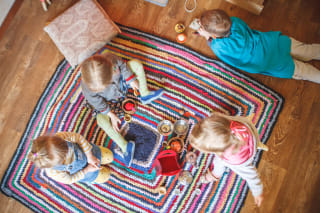
Four young children play tea party on the carpet on the floor in the Waldorf kindergarten © iamjura - stock.adobe.com
Children play with Montessori wooden rainbow © Joaquin Corbalan - stock.adobe.com
Girl climbs on wooden play equipment in the garden © soniaalmudevar - stock.adobe.com