Early cognitive abilities
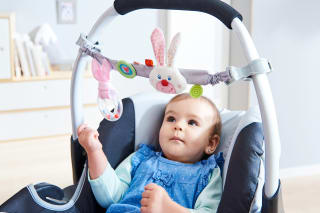
A baby’s mental development does not progress linearly but in leaps. In the first three months a baby cannot yet understand that it can make things happen, nor that its caregivers are still there even when it cannot see anyone. However, it already recognises voices and turns towards them.
Between three and six months the next big steps in mental development occur: the baby realises it can move things. Toys are therefore examined more deliberately and individual effects are noticed consciously. Babies are then also able to recognise objects. Surprisingly, even at this age the capacity for abstract thought is present: babies can already group and categorise different sensory impressions and, for example, classify a cat, a dog and a cow as animals.
Making plans and anticipating consequences

From seven months babies can deliberately set out to do something. They may decide to crawl across the room to their favourite toy or to throw a spoon onto the floor. The same actions are then imitated in different situations. Babies also begin to recognise their own name. By their first birthday children can better predict what will happen when they choose certain actions. They now produce deliberate sounds that are meaningful to them and which then become their first words.
Developing and training concentration
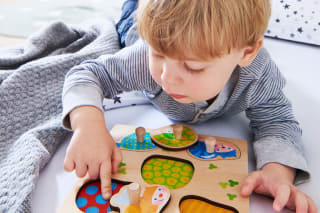
For many big and small tasks in their everyday lives toddlers need one thing above all: concentration. Keeping it for a period is not easy, because younger children have only a fairly short attention span. It is hard for them to concentrate on a particular activity for a long time. Nonetheless, concentration can be trained well. In a calm environment a toddler can focus better on a single activity than in a noisy one. Strengthening concentration works best when playing, outdoors in nature, or with small tasks in everyday family life. Children generally find it easier to concentrate when they are encouraged with praise and when they see a purpose behind their task – for example when setting the table!
How a toddler’s cognitive development can be supported
Promoting cognitive skills with shape-sorters, stacking and sorting toys
Through age-appropriate toys it is possible for even toddlers to occupy themselves for short periods. Particularly suitable are various shape-sorters, stacking or sorting toys. With these children can learn to recognise and match different shapes and, alongside concentration, also develop fine motor skills and an understanding of colour.
Promoting cognitive skills with lacing games
Even with lacing games logical thinking and concentration are wonderfully practised: the colourful motifs are threaded on one after another or discovered during free play.
Promoting cognitive skills with children’s puzzles
Puzzling is often popular with children from a very early age. At first they try simple grasp puzzles that show motifs from their everyday lives. Recognition, naming and matching can be practised very well with these!