Right-handers and left-handers – how does that happen?
Functional asymmetry: In almost all people one of the two hands is dominant, i.e. it is preferred for all hand movements. This dominance is innate and is referred to as functional asymmetry, because the main nerve tracts of one side of the body are each connected to the opposite hemisphere of the brain: It has long been known that in right-handers the left hemisphere is more active, and in left-handers accordingly the right.
Innate handedness: Estimates are that 10 – 15 percent of all people are left-handed. However, particularly in older generations there are many innate left-handers who were raised to be right-handed. Fortunately, forced retraining to the right hand no longer exists in today's upbringing, since the left hand has long since lost its reputation as the 'bad hand'. Studies have also shown that left-handers who are retrained to be right-handed more often suffer from reading and spelling difficulties and concentration problems.
For a good start at school
When starting primary school it should be clear whether your child is right-handed or left-handed. Writing with the 'innate' writing hand is directly linked to learning success. Left-handed children who, perhaps through ignorance, learn to write with the right hand sometimes have great difficulty later readjusting to the left hand. For most children, left- or right-handedness is sufficiently developed by primary school age that parents and teachers are aware and can deal with it accordingly.
How to make everyday life easier for your left-handed child
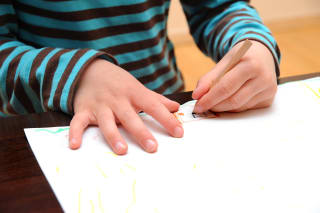
Right-handed parents in particular can pay attention to their own behavior to make everyday life easier for their left-handed child. For example, when setting the table they can place the fork for their child on the right side of the plate, or pass toys and objects into the center of the body instead of specifically to the right side. In addition, there are some special left-handed products that help the child develop motor skills without frustration.
Scissors are one of the biggest challenges for left-handers. Stationery stores also sell children's scissors for left-handers
Left-handed fountain pens are a great help from primary school onwards
A sharpener for left-handers makes drawing and crafting easier in kindergarten; in primary school it should be in the pencil case
With a paring knife for left-handers the child can help independently in the kitchen
Discover more articles on parenting & psychology









Image credits:
Child drawing on a white sheet of paper © K.-U. Häßler - stock.adobe.com