Forest kindergarten – What exactly is a forest kindergarten?
History:As with many educational concepts, the origin of the forest kindergarten also lies in Scandinavia. Since 1892 there has been an organization in Sweden that followed a nature-education approach and offered activities for children of all ages. Neighboring Denmark soon followed this direction. The first forest kindergarten there was founded in the 1950s. Following this example, the first forest kindergarten in Flensburg was established in 1993. Today there are well over 1000 institutions in Germany that operate as nature or forest kindergartens following the Scandinavian model.
Concept: Nature and forest kindergartens are based on the concept that children find the best conditions for development in nature. There is ample space to move, all senses are stimulated, and an ecological awareness is instilled from an early age. The children spend the whole day outdoors. A heated and covered retreat such as a converted wagon is only used when bad weather makes it necessary. Conventional toys that serve a specific purpose are usually not present.
Legal form: In most cases, forest kindergartens are registered associations (e. V.) supported by government subsidies. In addition, many forest kindergartens rely on donations and parental contributions. They are often founded as independent parent initiatives.
The advantages of forest kindergarten pedagogy
Imagination: Nature offers a wide repertoire of stimuli; there is always something new to discover. When playing with natural materials, the little ones can give free rein to their creativity and imagination.
Health: Those who are outside in all kinds of weather develop a strong immune system and are more resilient to infectious diseases. At the same time, fewer accidents occur in forest kindergartens, which is also due to the fact that the children learn to move more safely in a more challenging environment.
Ecological awareness: The children are outdoors in nature every day and experience it up close. Incidentally, they learn to treat living beings of all kinds responsibly and with care.
Language development: Because the children do not play with pre-determined toys, they have to discuss the use and meaning of objects in the forest while playing. This supports language development.
Stress-free: Since daily life in a forest kindergarten takes place outdoors, noise levels are significantly lower than in enclosed spaces. As a result, both the children and the educators are exposed to less stress.
Plenty of space: Forest kindergartens are set up so that children have plenty of room to play, romp and explore. Because daily life takes place outdoors, forest kindergartens are often referred to as "kindergartens without roofs and walls".
The disadvantages of a forest kindergarten
Integration: Most forest kindergartens are open and positive about integrating children with disabilities. Depending on the type and degree of disability, admission may not always be possible.
Illness: If a child becomes ill or tired during the day, there is no real opportunity to rest.
Parental involvement:What is a plus for some parents is a real drawback for others: parental involvement is usually mandatory in a forest kindergarten. Tasks for parents include, for example, running errands or cleaning tasks.
Getting there: Especially for families living in urban areas, getting to and picking up the children is often time-consuming, since forest kindergartens are usually located somewhat outside in nature.
Checklist for the forest kindergarten
If you decide to have your child cared for in a forest kindergarten, you will certainly receive a list from it outlining what your child needs for everyday life there. Since the children are outdoors in all weather, the basic equipment for the forest kindergarten includes:
Outdoor jacket, preferably in a 3in1 design
Outdoor pants
Rain pants or Mud pants, preferably in two pairs and lined
Rain jacket, ideally in a 3in1 design for all seasons and in duplicate
Waterproof, warm and comfortable shoes
Hats in various styles to protect against cold, sun and wind
Gloves for winter, if necessary unlined mud gloves
Underwear such as underpants, undershirt and socks as spares; for the cold season, additionally long underwear
Slippers for the accommodation
A set of clothing for the accommodation
Light backpack
Shatterproof Water bottle
Washable seat cushion
Latest articles









Image credits
Tree trunks © focus finder - stock.adobe.com
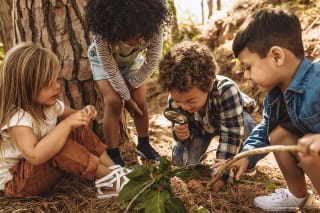
Children with a magnifying glass examine a leaf © Jacob Lund - stock.adobe.com