Why is English instruction in kindergarten beneficial?
Linguists agree that Children between the ages of 3 and 5 are most uninhibited with a language. They babble away happily and become creative. At this age, foreign languages are stored in the same brain region as the native language, laying the foundation for learning correct prosody and pronunciation.
Children quickly learn to distinguish languages Even if at first the occasional sentence comes out with mixed vocabulary, children quickly learn to keep the languages separate. For this reason, it can make sense to start learning English already in kindergarten.
Other languages promote openness to other cultures Children who come into contact with another language early on become more open to otherness and foreign cultures. As a result, they also pick up intercultural skills incidentally.
Beware of performance pressure However, the foreign language at this age should always be fun and never compulsory. In a world where more and more is expected earlier and earlier, children in kindergarten should mainly be allowed to play and romp.
Learning English playfully in kindergarten: How to do it
English in daycare sounds good at first. But how can learning English in kindergarten be playful and completely pressure-free? Here are a few tips on what to pay attention to:
By native speakers: Kindergartens that offer English either employ native speakers or educators with a very high level of language proficiency. Only in this way can the little ones learn the correct pronunciation and intonation. Moreover, teaching feels much more natural this way.
Immersion principle: In the so-called "language immersion" the children simply immerse themselves in the foreign language, meaning: English becomes the language of everyday interaction in the daycare, instead of learning individual vocabulary or sentences. The rule here is: one educator per language. A native speaker speaks exclusively English with the little ones and the children deduce from context what is meant – just as they learn their native language.
Extra time for English: As an alternative to immersion, there is also the possibility of setting certain times during the week when only English is spoken in kindergarten. However, this makes language learning feel much more unnatural and gives it a certain classroom character.
Songs & rhymes: At first contact with English it is primarily about the children getting used to the melody and pronunciation of the language. This works best playfully with children's songs or short rhymes. When singing, the little ones not only have fun, the language also imprints itself incidentally.
Learning English in daycare: What you as parents should look out for
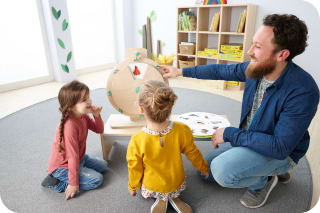
Find a kindergarten with English instruction nearby: The non-profit association "fmks" stands for "Early Multilingualism in Daycares and Schools". Here you can find multilingual kindergartens in your area sorted by federal state. That can save you from having to drive a long distance to an English program every day. And your child benefits from it too. If the friends from the daycare group live too far away, it becomes more difficult to arrange playdates.
Can I afford that? A kindergarten that offers English does not necessarily have to be more expensive than German-language childcare. However, the costs of individual kindergartens often vary greatly. Don't be put off by the English offering. Asking costs nothing.
Support, don't overwhelm: If your child is already growing up bilingual, you might consider skipping an English kindergarten. Growing up with three languages can quickly be overwhelming. You may also notice that your child still has problems with motor skills or the German language. Then you should first support them in these areas before approaching another foreign language.
Don't build up pressure: Memorizing vocabulary or texts? That's not necessary in kindergarten. Your child should have fun with the language. Instead, find out which songs and rhymes your child already knows. Then you can sing along when it starts singing in English.
Primary school with English instruction? A kindergarten offering English only really makes sense if your child then attends a primary school where the concept is continued. Otherwise, alongside learning arithmetic and writing, your child easily forgets the English vocabulary.
Books, audio plays or films: If your child enjoys the language and feels comfortable in English, you can incorporate a few English toys and media into family life. It is also important that your child does not feel forced and listens to and learns the foreign language voluntarily.
Learning English in kindergarten – yes or no?
What are the arguments for and against English instruction in kindergarten? Here is an overview of the pros and cons.
Pros
The age between 3 and 6 years is the ideal window for learning languages.
English as the everyday language in kindergarten leads to natural language acquisition.
A second language also promotes language competence in one's own language.
Children learn playfully without pressure and grades.
Foreign languages learned early help children at school.
Other languages promote openness to other cultures.
Cons
Some children feel overwhelmed by a second language and react by withdrawing or rejecting it.
Parents' ambition can turn into pressure for the children.
For children who speak a language at home other than German and English, confusion can arise
English-speaking kindergartens or English lessons tend to be more expensive.
Kindergartens with English-language offerings are often further away from home, resulting in long commuting distances.
If the educators do not have native-level proficiency, the children will also learn the languages incorrectly.