Learning to tell the time supports children's development
For a well‑ordered daily routine, agreements and keeping to times are essential. While for the little ones mum, dad or other adults make sure they are always in the right place at the right moment, older children increasingly take on this responsibility themselves.
Being big and independent fills children with pride – and the new skill also benefits their emotional development. Your children learn to be in the right place at the agreed time and thereby naturally develop more a sense of responsibility and independence. By keeping to times and appointments on their own, children experience themselves as more independent and self‑determined. The new ability to read the clock just like the grown‑ups empowers the children, gives them self‑confidence and is good for their emotional well‑being.
At what age should children learn to tell the time?
There is no blanket rule for when your child should learn to tell the time. Some children already show an interest in clock‑reading from the age of five or six and are then able to grasp the idea of hands and the dial. Others take their time, and that is absolutely fine. At school age children’s days are automatically organised around lesson times and timetables. Children have to be up and out at the same time each day by now at the latest. That is why starting school is a popular reason to buy the first children's watch, wristwatch or children's alarm clock. From about Year 2, children also learn at school how to deal with times in a focused way.
What should you look for when buying the first watch?
Analog children's watches are best, as they let children practise reading the time again and again. The ideal children's watch has a clearly readable dial with minute markings and hour, minute and second hands. Without minute markings it is difficult to tell the exact time – and too many elements on the dial confuse children.
A wall clock for the children's room or a children's alarm clock for the bedside table should be as quiet as possible so that your children can sleep well at night and are not disturbed by ticking. Above all, wristwatches for children should be robust and low‑maintenance and stand up to the odd bump or fall. Colour and design are of course just as important! Whether a little fan of horses, space or football – there’s the perfect watch design for every taste.
Tips for learning to tell the time
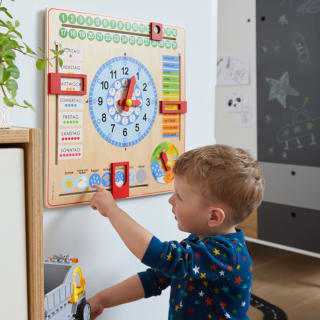
Every little mind handles information differently and naturally has different interests. But at some point all children are ready to understand how a clock works. What helps you and your children on that journey:
Develop an early sense of time spans: Your children will already, in toddlerhood, want to know how long they must wait for big events or how much playtime is left. Be creative and find child‑appropriate ways to describe time that your little ones understand, such as “how many more sleeps” or “until the sand in the hourglass is all the way down”.
Learning clock and season clock: Children are fascinated by the seasons and are often interested in who has a birthday in which month. A learning clock or a play calendar are fun and show children in a playful way what time means.
Stories and books for learning times: With stories, books and games about reading clocks, children practice by themselves and will soon become true time‑telling pros.
Apps for learning the clock: Specially developed learning apps help children understand the clock step by step and, with fun exercises, make learning a breeze.
A child's first understanding of time
Even the very youngest are fascinated by the seasons, calendars and illustrated timetables. A teaching clock and a learning calendar are popular toys in kindergarten and at home. What day is it today, what is the weather like outside, which trees belong to autumn and what is the month of my birthday?
From about the age of four, children learn to tell today from yesterday and tomorrow and develop a sense of what happens in the morning and afternoon or when the day turns into evening. But what does it really mean that it will soon be eight o'clock and therefore it’s far too late to set up a marble run? Children usually only understand that later. How can we make time graspable for kindergarten children until then?
How many sleeps to go: For generations children have learned with this magical phrase how long they still have to wait for a special event or a big day. And it works just as well as ever!
As long as driving to Grandma's twice: Using familiar situations, children can better judge time spans and imagine how long that period will feel.
Until the sand timer runs out: Making time spans visible helps children see how much time has literally passed and how much remains. As a modern version of the hourglass, a timer with a visible countdown is helpful.
Learning to tell the time in 5 steps
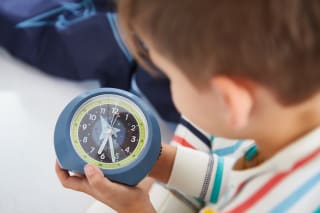
When your children start to read the clock, they will already know the numbers one to twelve. But what about the hands on the dial? Discuss with your child beforehand that there are two hands which always turn in the same direction (clockwise) and which, as a team, show the correct time. And then off you go:
Hour hand: Explain to your child that the short hand is for whole hours. The short hand is the 'decider'. As soon as it stands on a number, that hour begins.
Minute hand: Now your children learn how the long hand shows a half hour and a quarter hour. Practise different time settings with “quarter to”, “quarter past” and “half past” expressions.
Minutes: It is best to use a teaching clock with minute markings. The long hand is responsible for this too and helps the short one describe the time exactly.
Time intervals: Children who can already do sums may now practise time intervals. How much time passes between hours and half hours? And how do we express small intervals in minutes?
Practice, practice, practice: Whether on the teaching clock, the kitchen clock or their own children's alarm clock – ask your children the time every now and then – they will be proud to tell you and will thereby anchor their new skills
Tip: For the time being use time indications from 1 to 12 o'clock and avoid 24‑hour notations like 15:00. This makes learning easier.
How you can easily make your own learning clock
You'll need:
Cardstock or photo paper
Pencil
Scissors
1 split pin
Pens or colours for decorating
Here's how:
Cut a circle out of the cardstock. Tip: It's easiest if you draw the circle with a compass first. Alternatively, you can place a plate on top and trace around its rim with a pencil.
Cut two clock hands of different lengths out of the cardstock. Note: The hands should be at least 1-2 cm thick so there's enough room to push the fastener through later.
Write the numbers 1–12 on the clock face. Tip: Write 12 at the top, 6 at the bottom, 3 on the right and 9 on the left. Then write the two missing numbers in between each.
Decorate the clock face as you like with colours or stickers.
Punch a hole in the centre of the clock face and in the underside of both hands.
Push the split pin through both hands and the clock face and secure the fastener on the underside so the hands can turn easily. Your learning clock is ready. Have fun exploring the wonderful world of time!