Your baby's development in the 30th week of pregnancy
Fetal position: Your little miracle no longer makes very large movements anymore, as the space in the uterus is slowly getting tighter. Even if your baby doesn't yet have to assume its final birth position, it is usually in the fetal position in your belly. In doing so it has the knees drawn up and arms crossed over its chest.
Right- or left-handed?: Even in the womb it can be seen whether your baby will later prefer the right or the left hand. Many babies suck their right thumb significantly more often and thus give an indication of their later preference.
Smooth and rosy skin: In the last weeks of pregnancy your baby is mainly busy growing and gaining weight. It eagerly swallows the amniotic fluid, which stimulates digestion. The additional fat deposits ensure that the skin is now increasingly smooth and the skin folds are gradually filled in.
Independent temperature regulation: Your baby can completely regulate its own temperature in week 30 of pregnancy.
Ability to feel pain: Your baby has become increasingly sensitive in recent weeks and responds to your caresses. At week 30 it can also feel pain. This finding is relatively new and very important. Until the 1970s doctors were convinced that babies could not feel pain before and even some time after birth. The refutation of that assumption led to a rethinking in prenatal diagnostics and in interventions in the uterus before birth.
The 3rd major ultrasound examination is coming up
As expectant parents you can probably hardly wait: The last basic ultrasound examination is due. If you don't have an appointment yet, it's best to ask your gynecologist. Because the 3rd ultrasound takes place between the 29th and 32nd week of pregnancy. In doing so, the doctors check the health of your miracle and measure it from head to foot. They also measure the amount of amniotic fluid in the amniotic cavity, which steadily decreases in the third trimester.
Your baby is now about 38 to 40 cm long, weighs approx. 1,400 grams and is storing increasingly more fat reserves – you can roughly imagine its size as a cabbage. You can also already recognize the fetal position on the ultrasound image: with little arms and knees drawn up it now stays in your belly. Your little miracle is in the middle of preparing for the world. You can especially see this in that now in week 30 the lanugo hair – the fine down that covers your fetus's body – is slowly coming off. You will hardly notice any of it at birth. Instead, your baby's scalp hair is now sprouting.
Physical changes – what happens to the mother in week 30 of pregnancy?
"Your bump is growing and growing! And you probably can't look at yourself in the mirror often enough. But with the growing belly in week 30, more and more Pregnancy complaints such as circulatory and digestive problems as well as back pain occur. Here you'll get an overview of the physical changes in the 30th week of pregnancy.
Getting out of breath quickly: Many women more often run out of breath in the 30th week of pregnancy. Climbing stairs or a longer walk becomes increasingly exhausting. The large uterus takes up a lot of space, so the lungs cannot fully expand. So you can't take in as much air. Take it easy and preferably hand over strenuous tasks.
Quickly tired and exhausted: In the 8th month of pregnancy you have less oxygen available and gain about 400 grams per week. The additional body weight makes your movements more difficult and you probably feel quickly exhausted and tired. Treat yourself to relaxing breaks and put your feet up more often. Only a few more weeks and you will be on maternity leave. Then you will have enough time to relax and prepare for the strenuous time before and after the birth.
Lying down becomes tiring: Your belly is growing and even lying down becomes strenuous. Lie on your left side, that's the most comfortable. Additionally, it relieves pressure on your organs. Our tip: Grab a small pillow and place it under your belly – it provides pure relief.
Practice contractions begin: In week 30 the so-called Braxton Hicks contractions set in and cause a hard belly. But don't worry: These are not labor contractions, your body is just practising and preparing for birth with these practice contractions.
The position of the placenta: natural birth or cesarean section?
In the 30th week of pregnancy your doctor checks in the last major ultrasound examination the exact position of the placenta. Only at the end of pregnancy can it be definitively determined where the placenta lies, which is why it plays an important role in the last ultrasound examination. From a medical point of view, it may be advisable to perform a cesarean section. Perhaps you will have to reconsider your decision for a natural birth now – this can be disappointing at first. But for you and your baby there are fewer risks in this case. Since a cesarean section is nowadays usually performed under local anesthesia, you can still see your child immediately after birth and hear it cry. Your partner can also stand by you in the operating room, so that you experience the birth together.
How does the position of the placenta affect birth?
The placenta is basically located at the spot in the uterus where the fertilized egg implanted at the beginning of the pregnancy. If the implantation occurs in the lower part of the uterus, it is called placenta praevia. If it only touches the cervix but does not cover it, your baby can be born vaginally. Due to the expansion of the placenta, it can happen that it partially or completely covers the cervix. Then your baby cannot easily glide into the birth canal and must be delivered by cesarean section.
Important appointments in the 30th week of pregnancy
Packing the hospital bag: In the middle of the eighth month the home stretch is slowly in sight. Our tip: If you are not planning to give birth at home, now is a good time to pack the first things into the to pack the hospital bag. Take your time and also discuss with your midwife what you will need in the first days for the baby and yourselves. Place the packed hospital bag within easy reach – it gives you security and if things have to happen quickly later, you can immediately drive to the hospital or birthing center.
Baby starter kit: By the 30th week of pregnancy at the latest you should have completed your checklists for the baby starter kit so that you can calmly prepare for the birth of your child. In case of a premature birth you will then be well prepared. But otherwise you'll have less stress and can calmly enjoy the last weeks of pregnancy.
2nd dentist appointment: In week 30 the 2nd check-up appointment at the dentist. Here your teeth and gums will be examined again and you will receive tips on dental hygiene during pregnancy.
More articles about expectant mothers
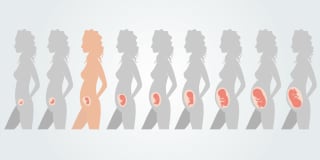
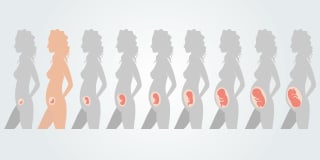
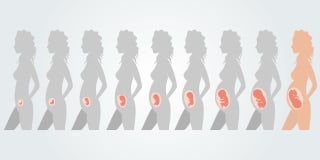
Image credits
Pregnancy silhouette, 8th month © designer_things - stock.adobe.com
Doctor during an ultrasound examination of the lower abdomen of a pregnant woman © serhiibobyk - stock.adobe.com