Your baby's development in the 33rd week of pregnancy
All senses at work: By the 33rd week of pregnancy your baby has been actively developing and training its senses. Except for the sense of smell, it can already use all of them in the womb. Shortly after birth it will not only see, taste, feel and hear, but will also perceive the smells in its surroundings for the first time.
Bones are hardening: Your baby's skeleton is growing stronger. One exception is the skull bones, which remain soft. The brain still needs enough room after birth to grow and expand. The soft skull bones can overlap as the baby passes through the narrow birth canal, helping to ease the delivery. These deformations usually resolve after birth and are generally not dangerous for your baby.
The head is growing: In the 33rd week of pregnancy your baby's brain continues to develop and functions in an increasingly refined way. For this it needs more space and it grows. The skull bones stretch with the brain's growth and the head circumference increases again this week by approximately 1.3 cm.
Survival chances at 33 weeks: If your baby is born now, it would be a preterm infant. But the likelihood that it will continue to develop healthily and survive is high. Doctors will usually place preterm infants born at 33 weeks in an incubator because the baby cannot yet fully maintain its body temperature.
What is visible on the ultrasound?
The pineapple is now the fruit you can use to estimate your baby's size and weight. At about 44 cm and around 1,900 grams it is very similar to the tropical fruit. If you think that's heavy already, wait a few more weeks. Babies weigh on average 3,500 grams at birth and are 51 cm long. And don't worry: after birth babies always lose some weight at first; that's completely normal.
Physical changes – what happens to the mother at week 33?

The navel may protrude: In the 33rd week of pregnancy your skin is already very stretched to make room for your baby. In many women the navel therefore pops out towards the end of pregnancy. After birth, when the tension on the skin eases, your navel will return on its own.
The first lightening contractions: Particularly women who are pregnant with their first baby feel lightening contractions in week 33 that help move the baby further into the pelvis. Usually these contractions are not particularly painful and are felt by many only as a pulling sensation toward the pelvic floor. In a second or third pregnancy the lightening contractions generally occur a little later.
More room to breathe: If your baby now sits deeper in the pelvis because of the lightening contractions this brings relief to your lungs. They have more room to expand and you can breathe more deeply again.
The 'show': A mucus plug seals your cervix during pregnancy. This prevents germs from entering your uterus and thus protects your little one. Already in the 33rd week of pregnancy the plug can loosen and come away as a slightly bloody, mucoid discharge, the so‑called "show". If the discharge occurs together with stronger, regular contractions, call your doctor, because this can be a sign that birth is imminent. Most often the show is triggered by the lightening contractions and it can still be some time before birth.
Your bump is growing: Your baby is thriving – you can particularly see this from your perfectly round baby bump. As long as the large bump only affects your mobility, everything is normal. If you suddenly experience pain in your upper abdomen in week 33, it is best to see a doctor. This can be a sign of gallbladder problems or an increase in blood pressure, which can be dangerous.
Gum growths: Your gums may now show growths that are hormonally induced and appear as small lumps. Only a dentist can treat these. If you only have small blisters, a mouth balm can help.
Tips for coping with worries and impatience
Talk about worries: With the approaching birth your anticipation will certainly increase. But of course worries and fears can mix with the joyful feelings. If you are becoming parents for the first time, you do not yet know how your relationship as a couple will change with a baby. If another child is on the way, you may be worried whether "the older ones" will welcome the new family member as lovingly as you hope. Your partner will also undoubtedly be thinking about the forthcoming birth at this time. So far they have only been able to feel the baby kicking or see it on the ultrasound and have not yet had the chance to build a strong bond with your child. Our tip: Talk openly about your worries with one another. Through shared conversations you can prepare for the time ahead and increase your excitement for the birth.
Stay calm: Many women become increasingly impatient towards the end of pregnancy: On the one hand you want to finally hold your child in your arms, on the other hand the growing discomforts also create the desire to have your own body back to yourself. The bump gets bigger and movement becomes restricted. A comfortable sleeping position is also harder to find. Try, however, to remain calm and enjoy the final weeks before birth. Perhaps treat yourself to a haircut or a visit to a wellness salon. Give yourself sufficient breathing spaces and consciously take time for yourself and with your partner. Only a few weeks remain until the birth and then you will finally be able to hold your baby in your arms.
More articles about expectant mothers
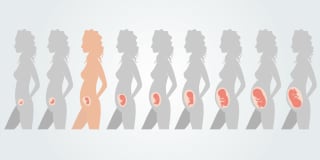
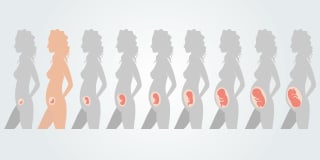
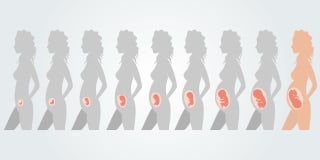
Image credits
Silhouette of a woman 9 months pregnant © designer_things - stock.adobe.com
Pregnant woman lying on a black leather sofa © LeslieAnn - stock.adobe.com