Your baby's development in the 39th week of pregnancy
Baby teeth are forming: Under your baby's gums, in the 39th week of pregnancy, there are already clearly visible grooves . The foundations for the first baby teeth are now being formed. However, for most babies it takes until about the 6th month of life before the teeth appear.
Hormone production increases: Your baby's body already produces increased amounts of hormones before birth that help it at the start of life. Cortisone ensures that the lungs can expand easily at the first breath and stabilizes the breathing rhythm. Additionally, increased stress hormones are released that help your child's body function independently of the placenta.
Amniotic fluid becomes milky: In week 39 more and more vernix peels off your baby's skin and collects in the amniotic fluid. Also many dead skin cells now discolor the fluid, because the outermost layer of skin renews itself again before delivery.
What can be seen on the ultrasound image?
It's that time: Now you are literally carrying a watermelon around with you – if you assume your baby's proud weight of up to 3300 grams and a length of about 51 cm as a result. In the last weeks of your pregnancy, your abdominal circumference is now about 1 meter, unbelievable, isn't it? And since your little wonder's energy stores can never be big enough for the strenuous birth, it continues to build up fat reserves in week 39.
Physical changes – what happens to the mother in week 39?

With your 1-meter bump in the 39th week of pregnancy, many things are harder and you often don't feel very fit. Everyday movements are now exhausting and you often rest. Don't stress and listen to your body – it will tell you what it needs. Your Pregnancy complaints are similar to those in the 38th week of pregnancy. Your baby is pressing quite far down in your belly, which is why you may continue to feel a pulling sensation in the lower abdomen, diarrhea, nausea, and back pain can perceive. What else is happening in your body, you'll find here at a glance:
Inner restlessness: In the 39th week it is completely normal that you are emotional and your feelings run wild. Between anticipation for your baby, fear and excitement, you will probably notice an inner feeling of restlessness. Instead of exhausting yourselves now and cleaning the apartment, you should take it easy. That will certainly be hard for you, but overly vigorous movements can trigger labor. Take the time your body needs.
First contractions: Now you are certainly paying special attention to how your body feels and whether contractions are already on the way. If your belly becomes hard and you feel a pulling sensation from the vagina to the back, these can be signs of labor. Whether they are just practice contractions or actual labor contractions can be determined by the first signs of labor from the 37th week of pregnancy determine.
Circulatory problems: If you are now in the last weeks of pregnancy more often accompanied by fainting spells and dizziness these can be caused by the vena cava compression syndrome be the cause. Because especially when lying on your back your uterus presses on important blood vessels and can thereby impair your circulation. Our tip: Lie on your left side, this relieves pressure on your vessels.
A natural birth: What can you expect?
A natural birth typically proceeds in four consecutive phases . How long you are in each phase and how long the birth lasts overall is difficult to predict. In most cases first-time mothers need a bit longer, but of course there are exceptions to the rule.
Latent phase: In the first phase of labor most women stay at home in their familiar surroundings, take a bath and rest. The contractions are already stronger and begin to open the cervix, but usually it still takes a while before the regular contractions announce the impending birth.
Opening phase: When contractions come about every 5-10 minutes and become more painful, the opening phase begins. The cervix is about 4 cm dilated. Most parents now make their way to the way to the birthing center or hospital. The amniotic sac usually also breaks in this phase. But it can still be several hours until birth.
Expulsion phase: Now the cervix is about 10 cm dilated. Your baby presses more strongly into the birth canal and by now the amniotic sac usually ruptures. You as expectant mothers now feel a strong urge to push. With strong and regular pushing contractions that last about a minute and occur every 2-3 minutes, you deliver your baby through the birth canal.
Afterbirth phase: After the baby is born, you can hold it in your arms. Placed on the chest and warmed with blankets, it experiences the first moments of its life. The midwife will check whether the placenta detaches from the uterus. The afterpains then push it out of the body as the afterbirth. The first breastfeeding can also stimulate afterpains through hormone release.
Tips to shorten the wait for your baby
Togetherness: Your main occupation as parents in the 39th week of pregnancy is waiting. If your partner has taken time off before the birth to support you, then let them care for you once more. A massage or a relaxed evening for the two of you is a good idea.
Household tasks: The restlessness you feel while waiting for the first contractions can be alleviated by cleaning or cooking. Watch your body and don't overexert yourself.
Create distraction: As expectant mothers close to giving birth you are reluctant to go far from home. That's not a problem, because even at home you will find plenty to distract you from waiting: the favorite series, a relaxing bath, or a short walk, to get your circulation going, can help to shorten the time until the birth.
More articles about expectant mothers
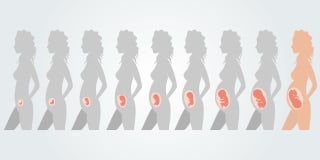
Image credits
Illustration of pregnant women © designer_things - stock.adobe.com
Pregnant woman in front of a sunset with hands on her belly © Maya Kruchancova - stock.adobe.com