The development of the baby in the 6th week of pregnancy
The little heart is beating: In the 6th week of pregnancy, your baby's heart makes its first beat. Although it is initially somewhat sluggish, it soon beats a solid 100 to 120 times per minute. That is about twice as fast as your hearts.
Head, mouth opening and neck visible: Compared to the Weeks 1-5 of pregnancy, in which the embryo more resembled an elongated tadpole, it now takes on a slightly curved shape like a little worm – now the first body parts can already be seen. Thus, in the 6th week of pregnancy the baby's head, although disproportionately large compared to the rest of the body, is clearly visible. Also the beginnings of eyes, ears and the brain are discernible. The neck can be identified as an extension of the head and continues into the rounded dorsal cord, from which the baby's spine later develops. As the 6th week progresses, the mouth opening as well as the lower jaw and vocal cords now begin to form.
First signs of arms and legs: On the ultrasound in week 6 you can at best make out small, knobby buds in areas of the embryo's body, where the arms and legs will later grow. The rudiments for them are already present, as is the cartilage structure that later transforms into solid bone.
Evidence of evolution: In the sixth week of pregnancy the embryo appears to have a 'tail' on the ultrasound image. The dorsal cord extends beyond the primordia for the legs, a clear indication of the evolutionary development of humans. In the following weeks this extension, however, fully regresses. Also nerve pathways, the inner ear, the intestine, the lungs, liver and thyroid begin to form. Stomach and kidneys are already functioning and produce gastric juice and urine. The umbilical cord now leads directly from the embryo's belly to the chorionic tissue, from which the placenta has been developing since the 4th week of pregnancy. Until birth, the now fully developed placenta and the umbilical cord take over the baby's supply.
This is what the ultrasound image shows
In the 6th week of pregnancy the baby is now clearly visible. The size of the embryo now measures a proud two to four millimeters – this corresponds to the size of a pomegranate seed. You can see a small, slightly curved worm-like shape, with the beginnings of arms and legs visible. If you're lucky, you may even see your baby's beating heart. However, it is usually only clearly visible in two to three weeks. If you do not yet notice the changes mentioned on the ultrasound, there is no reason to worry: often the little miracle is well hidden.
Week 6: Physical changes in the mother

Right at the start of your pregnancy it is normal that the woman's hormones go haywire.From the hormonal adjustment to the resulting pregnancy symptoms – now it's really getting started and the physical signs and changes will no longer go unnoticed
Hormonal adjustment: The entire hormonal balance adjusts to protect mother and baby: The "Pregnancy hormone" hCG prevents another ovulation, Relaxin already makes the tissue of the pelvic floor and cervix softer and more elastic and progesterone secures the development of the embryo. At the same time the estrogen levels increase to prepare milk production. As a result, the breasts are even more sensitive and the areolas are usually darker.
Progesterone increase causes constipation: The belly is bloated and hard – many women already feel quite pregnant in week 6. The reason for this is constipation, which is very common at this early stage of pregnancy. The cause is the rising progesterone levels in the woman's body: the corpus luteum hormone causes the entire metabolism to slow down, so more energy is available for protecting and developing the embryo. The result is extreme fatigue and constipation, often until the end of the third month of pregnancy.
Inevitable pregnancy symptoms:The accompanying symptoms of pregnancy vary from person to person – some women experience throughout the entire pregnancy neither nausea nor food cravings, others feel tired and unwell well beyond the first trimester. Some expectant mothers even have the impression that their tongue and oral mucosa are swollen. This does not necessarily indicate illness, but is also to be classified as a pregnancy symptom – as is a bitter taste in the mouth.
What helps with the symptoms of pregnancy?
Unfortunately, the classic pregnancy symptoms cannot be avoided. But there are many ways to relieve them: Whether with homeopathy, tried-and-tested home remedies or in severe cases also with stronger medications – be sure to discuss taking them with your gynecologist.
For symptoms such as nausea, vomiting and tiredness, especially the following tips for relieving the accompanying symptoms proven effective, but should not be seen as a cure-all:
Take the first meal of the day while lying in bed (for example, rusk and peppermint tea). Maybe it helps you if you prepare the food the night before. Otherwise, it can be helpful if your partner, the expectant dad, takes care of preparing breakfast.
Eat preferably several smaller portions throughout the day. This way you make sure you eat enough and still don't overwhelm yourself with a large portion or have to force it down.
Season your food lightly. You can always add more seasoning later. It helps your taste buds if you don't immediately surprise them with a flavor explosion – your body will react with less nausea.
Avoid carbonated drinks, sour juices and raw onions.
Eat Ginger or drink it in your tea. It soothes your stomach.
Give yourselves, especially at the beginning of pregnancy, sufficient and deliberate rest breaks.
For circulatory problems, it helps if you drink plenty of fluids and move sufficiently and slowly.
Why is the maternity record so important?
As soon as your doctor confirms the pregnancy, he or she will give you a maternity record. This serves on the one hand as the documentation of the entire pregnancy up to the birth, and on the other hand it provides all important information about any conditions or risks during pregnancy. In this way, any midwife or treating doctor can see at a glance what needs attention for the pregnant woman.
In addition to the physical development of baby and mother, all data on the woman's general health collected, including:
Blood type
Antibody tests, e.g. for HIV, rubella and toxoplasmosis
Test for chlamydia
Medical history (anamnesis)
Information on pregnancy counseling
The most important information about the birth (date, length and weight of the child, vaginal birth or cesarean section, possible complications, etc.) are also recorded in the maternity record – as are all subsequent pregnancies.
Don't forget: What you should keep in mind in the 6th week of pregnancy
Inform your employer: As a woman in permanent employment, you should already inform your employer about the pregnancy so that maternity protection and the subsequent parental leave can be taken into account in future planning.
For self-employed people: Check your entitlement to sickness benefit! Self-employed women can also apply for maternity pay for the six weeks before and eight weeks after the birth. The prerequisite is that you are insured with a statutory health insurer and entitled to statutory sickness benefit. If you are self-employed and pregnant, you should check your entitlement to sickness benefit as soon as possible and, if necessary, take out additional coverage to receive maternity pay.
More articles about expectant mothers
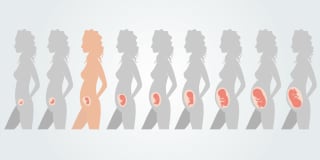
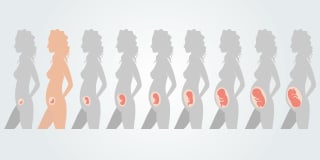
Image credits
Illustration pregnancy progression, 2nd month © designer_thing - stock.adobe.com
Pregnant woman sits cross-legged on sofa and holds her belly © Maksym Azovtsev -stock.adobe.com