"I want my peace and quiet"
Factors to consider when sharing a children's bedroom
Age difference:
A significant factor in the success and usefulness of a sibling bedroom is the age gap. If this is too large — say from around four years upwards — the children's interests are often too far apart for them to benefit from one another. Their daily routines are usually too different as well. If the age gap is too small — for example only one year — this can lead to rivalry between the children. In the long term a shared room often works with a middle ground in the age difference. Then the children can play together and, if they wish, still maintain sufficient separation from one another.
Room size:
A small room that provides little space for beds and cupboards is not ideal when siblings are to share a children's bedroom. It's best to ensure the room can be organised with room dividers or the like so that each child has their own area. In any case, two separate beds should be able to be set up.
Temperament:
Some children enjoy having their sibling around and sharing a room with them. Others often need time to themselves and can only thrive and develop with sufficient personal space. Take into account the personalities of your children and take it seriously if they resist sharing a room.
How long can siblings share a children's bedroom?
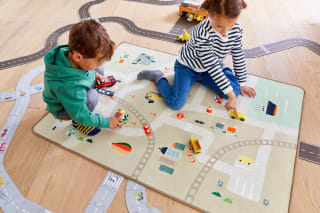
Besides factors such as age difference, room size and temperament, the children's age plays an important role in whether a shared sibling bedroom is sensible. Depending on their age, children have different needs that you as parents should consider.
Babies and toddlers:
In the first six years of life a shared children's bedroom has the advantage that the little ones always have a playmate nearby. They learn to play together, resolve conflicts and be considerate.
Primary school age:
Although siblings at primary-school age can learn together and help one another, they also need more personal space and places to retreat because of the pressure to perform that can arise. Children often develop differently and find different friends and interests.
Prepuberty:
Between the ages of 11 and 14 hormones begin to influence children. Irritable behaviour is common in many families and can often lead to arguments. In many cases separate rooms are the saving solution to preserve family peace. In some families the children still get on well at this age. The insecurity associated with changing to secondary school can sometimes be cushioned by a shared bedroom.
Puberty:
With puberty children enter a phase of self-discovery and much changes psychologically and emotionally. This not only means adolescents are often easily irritable. Above all they now need the possibility to withdraw. Also considering the discovery of sexuality, children should by now have their own space. Children should, by this stage at the latest, have their own realm.
How to make a shared sibling bedroom work – tips for arranging the room
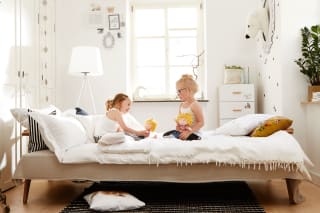
Not always do the housing conditions permit every child to have their own room. If only one room is available or siblings are to share a room in the early years, you should ensure the space is arranged so that each child still has an opportunity to withdraw. There are different ways to divide the space:
If the room is large enough and has windows on multiple sides, you might consider installing a lightweight partition. However, this would also require an additional door.
An open shelving unit as a room divider provides additional storage for books or toys and at the same time allows light to pass through.
A light or an opaque curtain at the bed separates the sleeping areas from one another and provides privacy. If desired, the children can draw the curtain.
By the way: Using room dividers makes sense not only in sibling rooms. Even in a children's room where only one child lives, it can be useful, for example, to separate sleeping and study areas. That gives the room structure and calm.
Discover more articles about everyday family life










Image credits
Girl sitting in front of a laptop and another girl sitting on the windowsill © Halfpoint - stock.adobe.com