Painting a child's room – What should I consider?
The Blue Angel: Besides the shade, when buying wall paint you should look for the Blue Angel. The seal indicates that the paint contains only a small amount of solvent and formaldehyde and less than 0.1% plasticizers. This way you can paint the child's room and other indoor spaces with as low emissions as possible.
Light rather than bold: Most children prefer it to be as colorful as possible. But since a child's room is not only for playing but also for relaxing and sleeping, toned-down and pastel shades are usually more suitable than very garish wall designs.
Accents rather than all-over: So that your child is not overwhelmed by the wall color or quickly tired of it, you should avoid painting all the walls in one shade. More suitable is decorating one or two walls or a paint finish that only covers up to half the room height.
Wall paints for the child's room: What effect do the colors have?
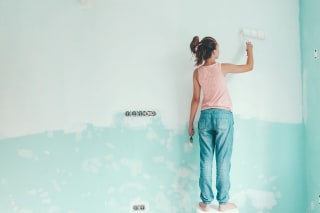
Colors are known to come in many different shades and standing in front of a paint rack with numerous palettes can feel overwhelming. To help you choose a color family more easily, we have summarized the effect of the basic colors for you.
Blue & Green: If you want to bring some calm into the child's room, you should choose a blue or green paint. These colors have a balancing and relaxing effect and are particularly suitable for creating a cozy and inviting atmosphere.
Red: Especially at a young age many children are drawn to red things. It is believed that this color reminds them of the time in their mother's womb. On walls the color is very stimulating. If your child is rather excitable and often restless, you should avoid bright red.
Yellow & Orange: Citrus colors appear cheerful and friendly and immediately bring good mood into the child's room. Psychologists believe that these wall colors stimulate thinking. In addition, rooms painted in yellow or orange immediately appear somewhat larger and brighter.
Purple & Pink: Rather delicate tones like violet or lilac are very popular with children as wall colors. They create a pleasant ambience and have a balancing effect.
Alternatives to wall paint: Our tips for children's room walls
Magnetic paint & chalkboard paint: This lets you design the child's room individually and change it again and again. You can attach hand-painted pictures to the wall with a small magnet or draw directly on the wall with chalk. The special wall paints are available in different shades, so you can easily adapt them to the color concept.Extra tip: If you live in a rental apartment and are somewhat restricted in decorating the walls, you can apply the colors to a wooden board and attach it to the wall at child-friendly height.
Borders: Borders in different colors are particularly well suited as colored accents on a light wall. You can either paint these on the wall or – for example in the form of a garland – attach them to the wall with small nails.
Wall decals: If you want to decorate the child's room quickly and easily, wall stickers are an excellent choice. Thanks to their special adhesion they do not damage the wallpaper or paint and can be easily removed at any time. The selection of decals is huge: from funny and cute children's motifs like cars or animals to sparkling stars or colorful flowers.
Curtains & accessories: If you want to keep the walls white, you can still bring some color and individuality into the room with a few colorful cushions, a patterned rug and matching curtains. It's best to decide on a color scheme together with your child and then decorate the room with different patterns or tones within that spectrum.
Discover more articles about everyday family life










Image credits:
Toddler girl painting the wall with yellow paint in a new house © Irina Schmidt - stock.adobe.com
Girl paints the wall in turquoise © Alena Ozerova - stock.adobe.com