Baby hat – yes or no?
You often hear that babies should basically wear a little hat because most body heat is lost through the head. When you're out with your child outdoors, that's true, especially in the first months of your child's life. In heated indoor spaces, however, your baby usually does not need a hat. On the contrary – our modern, well-insulated living spaces are usually somewhat warmer than necessary, so a head covering could hinder your baby's natural temperature regulation.
When going for a walk and outdoors - what clothing does my baby need?
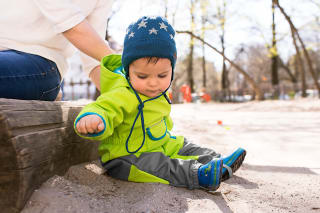
Hat: In its first months of life, your baby should always wear a hat outdoors. For hot weather, a lightweight cotton cap or a sun hat with ties is suitable; in winter, a woolen hat with earflaps.
Jacket, Snowsuit or Blanket: In winter a warm jacket or a snowsuit and a blanket are just right. In spring and autumn you can do without a blanket; if necessary you can use a footmuff for the stroller. On warm days a onesie or a shirt and pants are enough.
Booties or thick woolen socks: Babies who do not yet walk should not wear hard-soled shoes yet – in the cold season, lined baby shoes or two pairs of woolen socks under a blanket are completely fine. When it's warmer, baby socks or a onesie with built-in feet are sufficient.
Scarf: A scarf is more for toddlers – for babies, scarves and large cloths slip over the mouth and nose too easily. Triangle scarves with Velcro fastenings are better – they protect a baby's neck when it gets really cold.
Gloves: Some baby overalls have attached pull-over gloves – practical when it's very cold. Baby mittens in very small sizes are hard to find. But knitted baby socks pulled over the hands keep them just as warm.
Basic rule for dressing a baby: the onion look
Surely you've heard that babies should ideally be dressed according to the multi-layer principle. But what is the 'onion technique' and how does your baby benefit from it? When several thin garments are worn on top of each other, ultra-thin air pockets form between the individual layers. Over time these air layers take on approximately body temperature and act like an insulating layer that retains body heat. Therefore multiple layers of thin clothing warm more effectively than a thick sweater or lined trousers. This is especially true for babies who move little at first and release hardly any heat. Important, so that the onion look does not lead to overheating:
Put on thin garments, e.g. bodysuit, undershirt, cardigan, tights, romper pants
Use natural materials where possible: cotton and linen are ideal; silk even has a temperature-regulating effect
To a certain extent this technique also helps prevent overheating. If it's really hot, however, you should avoid dressing your baby in multiple layers.