Gear up with Terra Kids for your next outdoor adventure:
Everything you need to know to make your family event in the garden the perfect outdoor experience.
Campfire in the garden
What is allowed?
This is not regulated uniformly. Anyone who wants to make a fire in their own garden should check with their municipal or city administration. Be sure to point out that you do not want to burn garden waste, but plan a campfire with clean, dry wood.
In most cases, a campfire in your own garden is allowed. The conditions: The fire pit must be secured. Only dry wood may be burned and the smoke must not bother anyone. Then there will be no trouble with the neighbors.
For fire bowls up to a diameter of one meter, no permit is required. For campfires in the open countryside different regulations apply in the federal states.
Preventing fires
What to keep in mind at a campfire?
To trees, tents and buildings a distance of at least five, preferably ten meters should be maintained.
Never leave the fire unattended.
Always keep a bucket of water, a fire extinguisher, or a connected garden hose ready for extinguishing.
Do not jump over the fire and do not throw objects or liquids into it. Do not use gasoline, kerosene, methylated spirits or similar accelerants. There is a risk of explosion with severe burns!
Never light a fire during very dry and windy conditions. Finally, completely extinguish the fire with water or sand.
Making a campfire: step-by-step guide
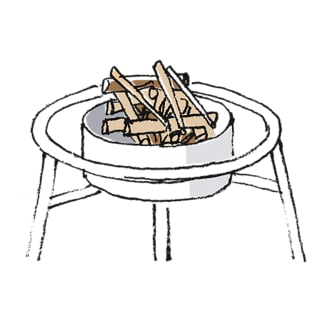
A day in nature is simply wonderful. A Night by the campfire can top that! Because the campfire is the place where young and old gather as soon as the evening cools the day. We'll explain to you step by step, how to make the campfire a success.
By the way: With our Terra Kids fire pit you're perfectly equipped for the campfire adventure! It is infinitely adjustable, height-adjustable, compact, stable and lightweight. Includes six stick holders on the outer ring for forked branches – for example for grilling bread on a stick, sausages or marshmallows. Simple and safe handling guaranteed.
Step 1: Collect wood
The search for wood is especially fun for children, because they are natural enthusiastic gatherers. Basically: The wood must be dry. Wet, rotten or decayed, but also too thick and too large wood will not be successful. Best suited is standing deadwood, that is trees that are still standing and have no green leaves, which have already died and contain only little moisture. They are often slightly tilted, so you can easily break off branches.
Looking for wood in the forest, makes the campfire adventure even more authentic, but collecting firewood is not allowed everywhere or sometimes you simply can't find suitable wood in nature. The easiest and most promising approach is therefore to bring dry firewood from home. Birch, beech or ash are particularly suitable.
Caution: Walnut or oak develop a biting, pungent smoke. Softwoods do burn very well, but also very fast. In addition, resin-rich wood is not suitable for grilling or for bread on a stick, as it can be harmful to health.
Step 2: Stack the wood
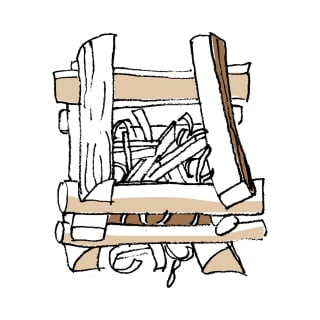
Stacking wood is with the right technique very easy.If the wood is stacked in the shape of a tipi, the structure often collapses when lighting and the fire frequently goes out. It is better to stack the wood into a tower. Before lighting, you should have enough dry wood ready to add
at hand.Our tip: When replenishing, there are two simple rules of thumb: First add smaller, thinner twigs; add larger logs later. And: better to add more often and in smaller amounts than a lot at once. This prevents unnecessary smoke.
Step 3: Find the right tinder
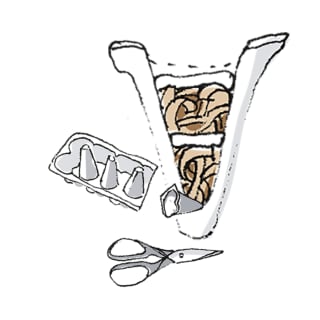
The better the tinder, the better the fire burns. The best tinder you can find in nature is young birch bark. It even burns when it's wet. Another great way to get the fire going are homemade fire starters made from egg cartons.
Here's how:: Cut out the cones, fill them halfway with wood shavings, and pour wax over them. The shavings should be pressed down a little. Then fill the cones to the rim with wood shavings and seal with wax – finished!
Our tip: It's best to make several of these starters in advance and try at home whether they work. Also particularly practical are commercial firelighters made from compressed wood shavings, which are soaked in wax. You should avoid petroleum products because they smell strongly and produce a lot of smoke.
Step 4: Light the fire
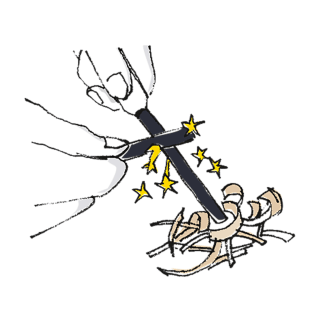
With matches and a firesteel, children - under adult supervision - can learn the proper and responsible handling of fire.However, it's difficult to light a fire with matches, especially in wind. It's easier with a firesteel
Our tip:. To produce a decent shower of sparks
the metal piece must be pulled over the magnesium rod with sufficient pressure and speed. It's best to place the end of the rod directly on the tinder. That way the sparks hit it directly and don't fly away.
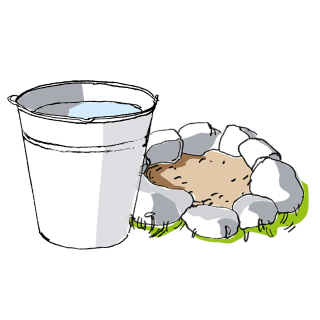
Step 5: Extinguish the fireIf the fire was lit in a bowl or in a mobile fire pit, extinguishing is relatively easy. It's a bit more complicated with ground-based fire pits: Here you must first extinguish with plenty of water. Then mix wood remains, ash and soil and pour water over again – until even larger logs are completely extinguished. If the logs are still hot to the touch, you must again douse
them.Warning: When extinguishing with water a hot steam cloud
. Therefore, a sufficient safety distance must be maintained.
Campfire food
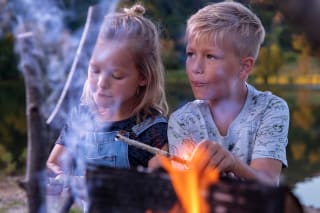
Of course, grilled over the campfire: bread on a stick, vegetables, and marshmallows. The most important thing is: it should be quick and easy. And above all delicious! That's what matters when it comes to campfire recipes for kids goes. And what could be nicer than a family meal under the open night sky? To make sure nothing gets in the way, here are the best recipes for your next campfire with kids:
Campfire recipes
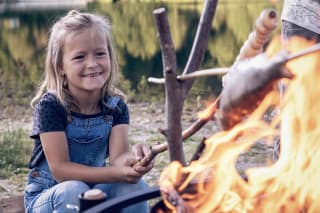
Bread-on-a-stick recipe
Our recipe is flexible: The dough can be kneaded shortly before baking or several hours earlier.
Ingredients for about 15 bread-on-a-stick
1 kg wheat or spelt flour (type as desired)
500 ml lukewarm water
1 teaspoon salt
2 tablespoons oil
1 packet fresh yeast or 2 packets dry yeast
optional pizza herbs for a more savory flavor
Preparation of the bread-on-a-stick
Dissolve fresh yeast in lukewarm water. First mix all ingredients with the dough hook, then briefly knead by hand into a smooth yeast dough. With wholemeal flour, a little more water may be needed.
Now either let it rise in a cool place for about 6 hours or, if it needs to be faster, keep it warm for 30 minutes.
Shape the dough into elongated, preferably thin rolls and wrap spirally around a stick.
Turn and rotate it over the open fire until the bread-on-a-stick is baked through and smells aromatic.
Baked potatoes
With a bit of butter and some salt, the hot potatoes fresh from the embers taste irresistible. That's how parents and children love them. Our recipe for baked campfire potatoes is quite simple:
Ingredients for 6 baked potatoes
1.5 kg preferably small potatoes
a few sprigs of rosemary or thyme, to taste
Aluminum foil
coarse salt
Butter
Instructions
Brush the potatoes clean under running water.
Wrap each one individually in aluminum foil with a small sprig of rosemary or thyme, if desired.
Place them into the embers of the campfire.
Depending on the size of the potatoes, they will be cooked through after 30 to 60 minutes.
Open the foil parcel, top the hot potatoes with pieces of butter and enjoy sprinkled with salt.
Tip for the impatient
: For larger potatoes, parboil them on the stove for about 20 minutes first, then they'll cook faster over the fire.
Roasted corn on the cob
Children like corn not only as popcorn and cornflakes. As a vegetable, corn is also popular. The cobs can be wonderfully nibbled all around.
Ingredients for 6 roasted corn cobs
6 ears of corn
Butter
Salt
Sugar
Instructions
Clean the raw cobs and simmer them in a little water with sugar for 15 minutes. Do not add salt to the cooking water — it would make the kernels hard.
Skewer them on long skewers or sharpened sticks and cook over the embers for about 15 minutes, turning frequently.
Serve with butter and salt.
Tip: If you get corn cobs in their husks, you can place them raw into the embers. They need about 30 minutes to cook and should be turned occasionally. Then remove the husks and nibble the flavorful kernels.
Colorful vegetable skewers
The ingredients can be varied as you like so that everyone gets what they want. This way, even children enjoy vegetables. Promise!
Ingredients for 6 vegetable skewers
2 bell peppers
3 zucchinis
1 eggplant
200 g mushrooms
150 ml rapeseed oil
2 garlic cloves
Salt
Oregano, thyme, rosemary
Instructions
Clean the vegetables and cut them into bite-sized pieces. Finely chop the garlic cloves and herbs, mix in some salt and stir the oil into the herb mixture. Put the vegetable pieces into a bowl and mix with the herb oil.
At the campfire, everyone skewers one or more pieces of vegetables and cooks them — not too hot — at the edge of the fire.
As a variation, diced grilling cheese or pieces of sausage taste delicious when skewered and sizzled over the campfire.
How to grill marshmallows properly
Ingredients
Marshmallows, preferably large. Smaller marshmallows burn too easily.
Instructions
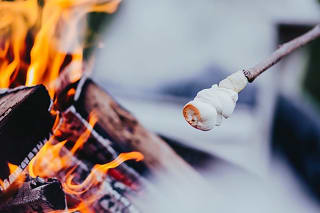
Skewer the marshmallows on long fondue forks or sticks and rotate them evenly over the campfire.
They taste best when the marshmallows are toasted golden brown.
Marshmallow fruit skewers
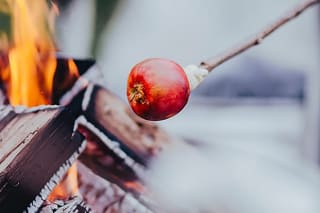
Actually, after bread on a stick, potatoes, and vegetable skewers everyone is full, but something sweet is always welcome. Marshmallows and fruit taste good grilled, and even better together.
Ingredients
Marshmallows
Fruit as desired, for example peaches, nectarines, pineapple, figs
Instructions
Cut the fruit into bite-sized pieces.
Skewer fruit pieces together with a marshmallow and grill over the fire until both are lightly caramelized.
10 campfire games
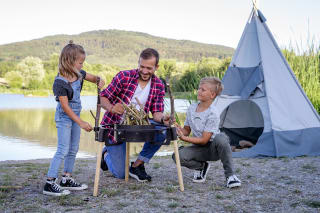
Sit cozily by the fire, watch the flames, eat and have fun with entertaining games. No equipment is necessary, but parents' and children's brains and imagination are needed:
1. Around the world with the ABC
A player starts with the letter A and says a sentence that includes a country, an activity and a thing (or an animal or a person).
For example: "I am going to Australia and work on an apple plantation." The next player continues with B: "I am going to Belgium and visit a candy factory." The game becomes easier if cities can be used instead of countries.
2. Who can master the tongue twisters?
The tricky sentences are a challenge and have been fun for generations. Here are a few examples to try:
Fischer's Fritze catches fresh fish. Fresh fish are caught by Fischer's Fritze.
Brushes with black bristles brush better than brushes with white bristles.
Bridal gown stays bridal gown and red cabbage stays red cabbage.
Between two plum tree branches, two chatty swallows twitter.
When flies fly behind flies, flies fly after flies.
Ten tame goats pulled ten hundredweights of sugar to the zoo.
3. "I'm packing my suitcase"
A player names an item that they put in their suitcase. The next person names that item and another. The next person in line names the already mentioned items and one more. Whoever makes a mistake is out. Who has the best memory?
4. The evil seven
Take turns counting from 1 to 100. All numbers that start with 7 or are divisible by 7 are omitted and replaced by "Brr". Younger children don't need to count. They only skip the numbers containing 7 and instead say "Brr". Whoever makes a mistake is eliminated or gets penalty points.
5. Who are you?
A person names any letter, e.g. "M". All questions must now be answered with words that begin with "M". The questions are asked in turn, e.g.: What's your name? Mattis Magel. Where are you from? From Münster. What do you do? I'm a mouse catcher. Where are you going? Home.
6. Your name means ...
For each letter of the name of the person sitting next to you at the campfire, the person whose turn it is names a positive quality. For Elias, for example: eager, funny, interesting, extraordinary, awesome.
7. Word chains - completely harmless
A player starts with a any compound noun, from the second part of which a new word is formed. Example: car window, window cleaner, cleaning bucket, bucket factory, etc. Creativity is allowed!
8. Boom and Quack: guess the sounds
A player imitates a sound, which the others must guess: e.g. lawnmower, alarm clock, screeching car brakes, galloping horse, roaring lion.
9. All wrong?
A player chooses someone that everyone present knows, e.g. a neighbor, a relative, a teacher. Then theydescribe the person with the opposite of their actual appearance and characteristics, e.g. short instead of tall, dark-haired instead of blond, serious instead of funny. Who guesses the chosen person first?
10. Who am I?
A person chooses a childhood character from books, films or games that everyone knows. The others have to guess it. The questions can only be answered with yes or no. Everyone may ask as long as they hear "yes". Once someone hears "no", the next person is up. Whoever guesses correctly wins and may think up the next character to guess.