Piku wants to know!
What is Advent?
The word 'Advent' goes back to the Latin word 'adventus' for 'arrival' back. It referred to the arrival of a visitor, especially of high dignitaries such as kings and emperors. Christians adopted the word to the coming of the Lord, that is of Jesus Christ,to celebrate. In the Middle Ages, people fasted to prepare for the feast of Jesus' birth – except on Advent Sundays. That's hard to imagine today: the waiting time until Christmas is sweetened with many kinds of cookies, stollen and chocolate.
What is an Advent wreath?
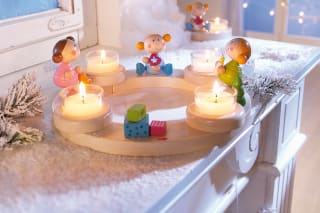
Already in the early Middle Ages, Pope Gregory set the number of Advent Sundays to four – in contrast to the Eastern Church, which to this day celebrates six Advent Sundays. The custom of lighting an additional candle every Sunday as a symbol that Jesus Christ brings light into the world, goes back to the Protestant theologian Johann Hinrich Wichern. In 1839 he set up a candlestick with 23 small red candles for the weekdays and 4 large white candles for the Sundays on it.
After the First World War the Catholic Church also adopted the custom. Originally still as an Advent lamp, then mainly as the Advent wreath as we know it today. Since then nearly all churches at Christmastime are decorated with Advent wreaths made from fir branches.And in most families there are wreaths in a wide variety of designs – but always with four candles.
Which branches are suitable for an Advent wreath?
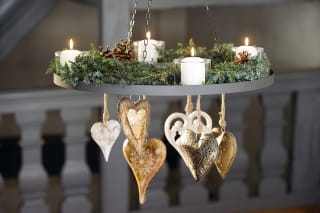
Various materials are suitable for the Advent wreath. Classic are conifers such as fir, pine or spruce, which, however, sometimes shed needles relatively quickly. Here the branches of the Nobilis fir are particularly recommended, as these do not shed as quickly as, for example, the Nordmann fir. A good alternative are cypress family plants such as juniper or thuja, which lose their needles very slowly. For variety evergreen shrubs, such as boxwood, ivy or holly. It's especially nice if you use a mixture of different branches for the Advent wreath so that different shapes and shades of green alternate.
Make your own Advent wreath: Here's how
Besides branches of your choice, you'll need a base made of styrofoam or straw – this forms the basis for the shape of the Advent wreath and is in the first step wrapped with green crepe paper. Then you wrap the wreath in bundles with your collected fir or leafy greenery, which you trim further with garden shears if necessary. Tip: Arrange the branches like fish scales arranged, that is always slightly offset and pointing in the same direction. This ensures that the wreath is evenly covered with greenery. Fix everything with green floral wire.

Now the classic four candles are still missing on the Advent wreath, which you should best attach with four candle holders that you push firmly into the wreath. The candle holders traditionally also have a spike at the top onto which the candle is placed so that it cannot fall down.
The classic Advent wreath is finished at this stage – beyond that you can decorate the wreath for Christmas as you wish. Small stars, Christmas baubles, cinnamon sticks, pine cones or wooden figures can be attached either with wire or with a hot glue gun.
Craft instructions: the Advent wreath "to go" for your pocket
An Advent wreath doesn't have to be elaborate to spread traditional Christmas magic. Our Advent wreath 'to go' is just the thing and is guaranteed to bring a smile as a small gift. You only need a matchbox, construction or colored paper, four birthday cake candles including candle holders as well as additional decorations as desired – and then you're ready to go!
Are there any other Advent customs?
Oh yes, so many that we can't list them all here!
One of the most beautiful is probably the Schwibbogen from Thuringia. To this day, the often magnificently carved wooden arches are placed in windows and the candles on them are lit. The Schwibbogen also symbolizes the idea of bringing light into the darkness: the miners, who themselves had to work underground in winter, set off in the dark during this time and only returned home in the dark, so they never saw daylight. If all the lights on a Schwibbogen were lit, it meant that all the miners of the family had returned home safely.

A German Advent custom that became something of an 'export hit' is the Advent calendar: Until December 24th, children receive a small gift each day to shorten the waiting time.
Numerous Advent songs such as 'Macht hoch die Tür, die Tor macht weit', 'Es kommt ein Schiff geladen' or 'Wir sagen euch an den lieben Advent' testify to the joy for the upcoming Christmas celebration. Because when it's dark and cold outside, there's nothing nicer than singing together.
To the latest articles from this topic area






Image credits:
Sisters are sitting in the living room and looking at the Advent calendar © Natalia - AdobeStock