What does creativity mean for children?

With the term creativity we primarily associate artistic abilities. Creative people are musicians, painters and all those who implement their own ideas in a variety of creative ways.
In child-rearing, creativity is defined much more broadly. It's not so much about teaching artistic techniques, because a creatively designed everyday life should introduce children to different ways to express their feelings, to test their abilities and limits, and to create something new.
Reading aloud and finger rhymes, singing, dancing, painting and crafting — all of these are small creative exercises for children. By the way, coercion and high expectations have no place here, because however important creativity is for a child's development, it should above all be fun.
Reading and storytelling – the most beautiful form of language development
Basic need: language:
Even in the womb, babies listen to their mother's voice and recognize familiar voices, like those of the father or siblings. The human voice is one of the first and most formative sensory impressions and will for the rest of your child's life always be the first way to make contact with other people and communicate.
Storytelling promotes creativity:
Reading aloud and storytelling not only stimulate children's imagination, they also make them more articulate. Without noticing it, children absorb new words from the bedtime story or the funny poem and over time develop an instinctive sense for the use of language, how stories are constructed, and linguistic subtleties such as puns or irony. Children who are read to a lot usually find it easier to invent their own stories and play with words.
Listening — an underestimated social skill:
It is well known that reading aloud and singing promote children's language skills even in infancy. What is often forgotten: storytelling, rhymes and songs train not only speaking but also listening. This seemingly passive skill is as fundamental to social interaction as speaking itself. Stories, finger rhymes and poems teach children to listen attentively to their interlocutor, to pay attention to details and to recognize linguistic nuances.
Storytelling and listening for children — tips for everyday life

Bedtime story:
A bedtime story or lullaby is part of the bedtime ritual in almost every family. If your child is not too tired yet, you can take a few minutes after reading to talk with your child about the story. This way they learn to put things into their own words and to recall impressions or memories. From about five years on, you can also read one or two chapters of a continuous story each evening. Before that you can briefly recap together with your child what happened in the story the previous evening.
Goofing around:
Children love fooling around. This also applies to linguistic silliness of all kinds. There are a variety of simple wordplays and language games you can use in everyday conversations. For example, try finding rhymes for all the items on the breakfast table or make up crazy stories where each person adds one or two sentences. Speaking in different voices, singing or whispering sentences are also creative ways of using language that excite children.
Rhymes and poems:
Reading poems is not everyone's thing. But there really is a large selection of cheerful and playful poems for children. A good idea to incorporate simple rhymes and poems into everyday life is, for example, before meals: each family member may choose a funny table rhyme, as is often done in kindergartens. Or you can choose little poems appropriate to the season, for example for Easter and Christmas, and recite them together with your child.
Now it gets loud: Singing and making music with children
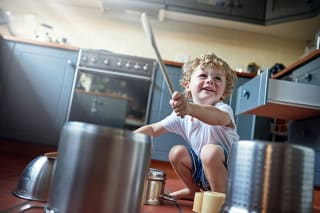
Most parents notice early on that singing and music have a special effect on their children. They calm down faster when they hear a familiar lullaby, they dance along to certain songs or try out their own voice by singing absentmindedly. Singing together is one of the most immediate ways to be creative, for example when your child claps in time, accompanies a sung song by drumming on the table or perhaps changes the melody or lyrics. Enjoyment of music cannot be forced, but if singing and music accompany your child naturally from the start, they will find many ways to express themselves musically.
Crafting with children: playfully training creativity and fine motor skills

Painting, crafting and modeling are a fixed part of the educational work in most day cares and schools. Is it still necessary to craft at home? Joint crafting with your child is of course not a must. But crafting is not only about finishing a pretty window decoration. Crafting is time spent together. It is an opportunity for your child to implement their own ideas and to show certain skills or techniques in a playful way. And not to forget: cutting, folding and gluing are simply fun — for moms and dads too.
When and where should I craft with my child?
Crafting is not tied to schedules, that's the beautiful thing about it. Craft according to mood or whenever a good idea comes to you. It's best to have a basic set of crafting materials at home: simple things like construction paper, paints, craft scissors and glue, etc. A special workspace is not necessary. The kitchen table, the coffee table or sometimes the floor are great for most craft projects. However, it's sensible to have, for example, a PVC-coated tablecloth at home that you can lay down for crafting.
Coloring templates and crafting instructions
Today there are downloadable coloring or cut-out templates for every crafting idea. That's practical, because many of the motifs can be used not only for one but for many different craft ideas. You can use our craft motifs and coloring templates for window pictures and mobiles, as cheerful motifs for book covers, greeting cards and much more. For those who want to know the details, we offer many detailed crafting instructions on a variety of craft topics, for example felting or making your own candles.
Crafting with the seasons
Of course crafting is even more fun when it's cold and dark outside and you can make yourself comfortable together at the craft table. But there are also lots of great ideas in the warm season for how your child can be creative. Felting yourself or working with clay is even more fun when you can get messy outdoors. We have put together creative craft tips and instructions for you throughout the year.
More articles about leisure & creativity



Image credits
Child drums on pots with cooking spoons © peopleimages.com - stock.adobe.com
Mother pulls her child in the laundry basket through the apartment © ABCreative - stock.adobe.com
Dad and daughter lie on the sofa with outstretched arms © opolija - stock.adobe.com
Dad and daughter dance in the kitchen © Halfpoint - stock.adobe.com