These types of kites — models and variants at a glance

In autumn the wind conditions are ideal, um mit euren Kindern auf der Wiese einen Drachen steigen zu lassen. Schon bei Windstärke 3 (12-19 km/h) kann der Spaß beginnen. Ob selbstgebastelter Drachen oder gekauftes Modell — das autumn game outdoors is fun for all children and likely also evokes childhood feelings in parents when the kite rises into the air.
We show you which variants of kites exist and what special features the different models have.
Single-line kite
The single-line kite is one of the classic flying kites. As the name already suggests, only one line and is ideal if your child doesn't yet have much experience in kite flying.
Steerable kites
Classic steerable kites have two control lines, with which experienced kite pilots take over the control. The frame usually consists of break-resistant fiberglass and carbon fiber rods and withstands crashes and rough landings well.
Steerable foil kites
Similar flying acrobats to steerable kites are steerable foil kites. These also have two lines, however no frame. The frameless kites are ideal for beginners and are easy to fly. Initially it's best to choose a small model without much pull so that your children can steer the kite on their own.
Which kite suits my child?
So that the fun is the priority when flying kites, pay attention when buying or making one to an age-appropriate model. This avoids frustration and your child can later steer the aircraft independently.
Younger children should never play with a kite alone. In the heat of the moment the kite string can quickly wind around the neck and there is a risk of strangulation. For this reason always keep a watchful eye on your children and help the little hobby pilots with the controls.
Single-line kites are already suitable for children from three years old. Even in light winds they take to the air and are, thanks to the single kite string, easy to hold and to guide. Unlike steerable kites, single-line kites cannot be steered quite as precisely — but younger children in particular cope better with a single kite line. Here the fun is paramount and your child has the opportunity to steer on their own.
The entry-level models come in many different shapes, colors and variants — from funny clown faces to printed theme kites to colorful rainbow kites there is a lovely favorite model for every child. Further down on this page you will also find instructions for making the beginner model.
Steerable kites are for children aged eight and up suitable for those who are more practiced and can handle kite flying safely. If your child is a little older and has the hang of it, they can fly maneuvers with a steerable kite and control it independently.
Good to know: The more control lines a kite has, the faster but also more uncontrollable it flies. Therefore always pay attention to the pull force of the kite and decide together whether your child is ready for this model.
Well prepared, nothing stands in the way of a lovely afternoon with your kite and exciting physical games outdoors.
Flying and wind kites
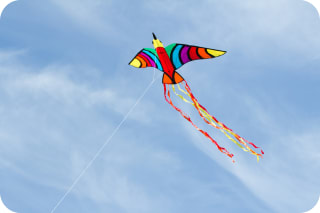
Making kites with children — materials you'll need
Tissue paper or transparent paper
Crepe paper
two round rods with 4 mm diameter (one 60 cm and one 44 cm long)
Kite string (5 m long)
Control line with handle
Natural fiber tape; optionally a kite cross
Key ring
Folding ruler
Pencil
Glue
Adhesive tape
Ruler/set square
Scissors
Needle
Small saw
Instructions for making a kite: How to build a flying kite successfully
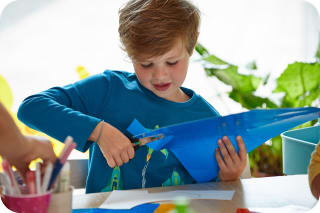
What could be more beautiful in autumn than flying a homemade, colorful kite? To put your plan into action right away, we show you below how to make a classic kite with a stretched sail on a wooden frame.
Craft instructions: How to build a flyable kite
Making a kite is not difficult at all — if you follow these instructions you will soon have your very own flying device in your hands. The advantage of crafting: your children can design their kite exactly as they want it: multicolored or plain, with a face or without, with a name and pattern or very simple. Just grab the pens and tools and let the big crafting fun begin.
Step 1 - preparation

Check whether you have gathered all the materials and tools for crafting listed above and lay them out first. It's best to build your kite on a large table.
Use a protective cover so you don't damage the surface. Now you can get started.
Step 2 – measuring the wooden frame
Spread the transparent paper out in front of you and take the ruler. Draw a longitudinal line of 60 cm in the middle of the paper. Using the set square, measure at a height of about 48 cm a right angle of 90 degrees to draw the cross line.
At this point draw a line 44 cm long on the paper. The kite frame will later be placed on the drawn cross.
Step 3 – cutting out the kite shape
Now connect the endpoints of the drawn lines — the kite shape will appear on the paper. Carefully cut it out with the scissors. With younger children, mom or dad provide assistance so that the kite later has straight edges.
Step 4 – determine attachment points for the kite string
Carefully poke two balance points into the kite with the needle. These will later indicate where the kite string is attached. The first point is located exactly in the middle of the cross, the second about 4.5 cm from the lower tip of the longitudinal line.
Step 5 – cut and insert the wooden rods
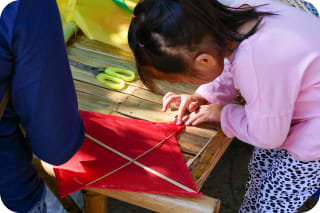
Now it's time to build the kite frame. If the rods are not yet the right length, shorten them with the craft saw to 60 cm and 44 cm respectively and file the corners if necessary to avoid wood splinters.
To ensure the frame holds securely, bind it with natural fiber tape, by winding and knotting it around the kite frame in a criss-cross. If you have a kite cross at hand, insert the rods into the cross — in this case place the rods so that they are balanced in the middle and slot them under tension into the four openings.
Step 6 – covering the wooden frame
If the kite frame is stable enough, place it on your cut-out kite and poke two holes with the needle into the outer corners on each side next to the rods. It's best to use adhesive tape to reinforce the transparent paper so that the holes don't tear later. Now thread the natural fiber tape through the holes and tie the frame to the sail with the string — your kite is now fully covered.
Step 7 – attach the kite string
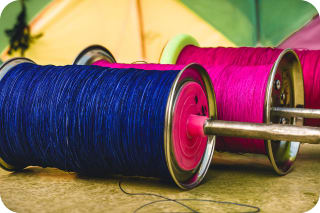
Now it's time to attach the kite string. It is tied under the rod cross to the longitudinal rod. After you've tied several secure knots, thread the kite string through the upper cross hole, which you made in step 4 of these instructions, to the front. Also attach a string to the lower balance point hole of the long rod. Once the knot is secure, also lead this string through the hole to the front side of the kite.
Turn the kite over and pull the upper string along the crossbar to the left corner and the lower string along the slanted edge to the left corner so that they roughly follow the kite's shape. Tie both strings together to form a loop. Excess strings are simply cut off.
Step 8 – attach the control line
This crafting step is easiest with a Key ring .loop knot to the key ring. This is very easy: first pull the loop of the kite string through the key ring and then pull the loop over the ring and through until it reaches the end of the string. Now also tie your kite's control line securely to the key ring.
Step 9 – make the kite tail
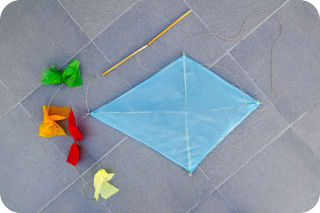
For your kite to fly, it still needs a colorful kite tail as a counterweight. Make lots of colorful bows from the crepe paper. Simply cut a small square and wrap a thread around the paper in the middle — a bow is created. When the kite tail is finished, tie it with a knot to the bottom of the kite's longitudinal rod.
Step 10 – final construction steps
You are almost there. Before you conquer the next meadow with your homemade kite, check that everything is well secured and ideally adjusted.
Hold the kite by the key ring so that the lower tip touches the ground. Does the longitudinal rod now form an angle between 15 and 25 degrees to the ground? Perfect, your kite is ready for takeoff. Otherwise, tighten the strings a little until the kite is at the correct angle.
Firmly glued: craft glue for building the kite
To ensure your homemade kite can withstand even the strongest winds, use a good craft glue for construction.
Safety tips for kite flying
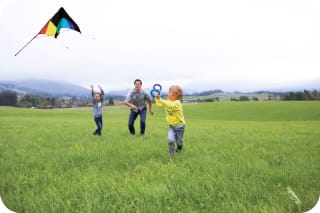
After crafting the kite, your children will want nothing more than to finally fly it with you. Before the fun begins, here are a few safety tips for unspoiled fun while kite flying.
Choose the right location
Make sure that the field or meadow is large enough so your children can run freely and without worry. There must be no high-voltage lines, power poles, dangerous roads or railway tracks nearby. It is also forbidden to fly kites near airports.
Protect hands
The kite string can injure little children's hands while steering. It's best if your children wear light gloves so the string doesn't cut into the skin.
Pay attention to the weather
If a thunderstorm approaches, reel the kite in immediately. Never fly a kite during a thunderstorm—there is a risk to life!
Keep enough distance
If there are other people or animals on the meadow, keep a sufficient distance to avoid injuring anyone.
Take the right position to the wind
Stand with your back to the wind and launch the kite from the air. Hold it flat on the ground and face the top tip into the wind: now your child can run and pull the kite up.
Frequently asked questions about crafting kites
From what age can children make a kite?
How difficult is it to build a flight-worthy kite?
Where do dragons actually come from?











Image credits:
Child holding a kite in the air © DREAM INSPIRATION - stock.adobe.com
Many kites in the sky © NikonArt - stock.adobe.com
Father and son with kite in a field © JenkoAtaman - stock.adobe.com
Kite-making accessories © Racle Fotodesign - stock.adobe.com
Child inserts wooden cross into kite © rattik - stock.adobe.com
Colorful kite string © abhishek - stock.adobe.com
Blue kite lying on the ground © lunamarina - stock.adobe.com