When do babies start crawling?
And how can you ensure safety during the crawling stage?

Non-slip:
Learning to crawl on slippery floors is a real challenge for babies. Especially in the initial attempts, when muscle control and coordination of the arms and legs are not yet so developed, knees can slip quickly on parquet and tiled floors. To avoid frustration, you can let your baby make first attempts on a carpet or a large blanket to make first attempts. There are also special "ABS"-tights, which have a non-slip coating on the feet and knees.
Secure the environment:
From the first wobbly four-point stance to crawling, often only a few days pass and before parents realise it, their baby is suddenly on the move and explores everything that is visible and within reach. Fragile, wobbly or sharp-edged objects should now disappear from the floor, for example freestanding vases or electrical appliances. You should also safely store dog and cat food bowls. Securing sockets and power strips is vital – your child should learn from the start not to touch sockets (despite childproofing).
Stair gate:
At the latest when your baby starts to crawl, a stair gate is mandatory. But the stairs shouldn't be completely off-limits: let your baby, in your presence, climb a few steps up and down. On the one hand it trains muscles and coordination. On the other hand, it gains confidence on the stairs and learns, for example, to go down steps not forwards but backwards.
Be careful with cabinets and doors:
Opening and closing doors fascinates many babies and so most try during the crawling stage to open all available doors and flaps. To avoid accidents, you can use door stoppers for room doors and fit cabinet doors with safety locks. In any case, you should ensure that cleaning agents and sharp objects are stored in cabinets out of your baby's reach.
How can I support my child in learning to crawl?
My baby isn't crawling yet:
In the playgroup the first babies are already happily crawling around, while your own child is still quite content on their play mat and at most rolls onto their stomach – in such situations many parents feel a bit uneasy: shouldn't my child also slowly start to crawl? You can't force crawling:
Of course parents compare their child's level of development with that of their peers; after all, you eagerly await each next developmental step. The fact is, however, that learning to crawl, like almost all other milestones of child development, cannot be accelerated. So the question of how long it takes to learn to crawl cannot be answered in general. Babies learn to crawl when the physical prerequisites are there and when they are ready for it.
Skipping crawling altogether:
Some babies skip crawling entirely. They move, for example, by scooting or "rolling" forward and then go straight to walking. Don't try to force them to crawl; let your child develop according to their abilities.
Encouraging crawling:
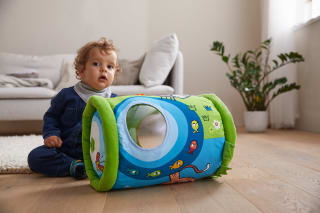
Even though you can't speed up learning to crawl, parents can support their child by, for example, frequently placing them on their tummy. A toy placed out of reach provides additional motivation, as does generous praise from the parents.
More help and tips on how to best encourage your baby's crawling can be found here