What significance do fairy tales have in today's world?
The original meaning of fairy tales
In their original form, fairy tales were told among adults – as accounts of events that were said to have really happened. In doing so, the fairy tales not only served as entertainment while people sat together, but also reinforced the notions of morality and proper conduct – in fairy tales, after all, everyone who does evil gets their just punishment. In a time when illnesses or crop failures often meant a death sentence, fairy tales offered comfort and also helped to make the inexplicable understandable.
Are fairy tales still relevant today?
The idea that every problem in the world ends in a happy wedding at the king's castle may seem somewhat unrealistic to many parents. But that's precisely what fairy tales are about – it is not the familiar but the inexplicable and enchanted that make the appeal of fairy tales. Children create their own mental images of the story and find in them many motifs that also play a large role in today's society: friendship and civic courage, respect for nature and 'proper' behavior regardless of what others do. This characteristic – the blending of the fantastic with the everyday – makes fairy tales timeless for children and adults.
Grimm's Fairy Tales – the best-known German collection of fairy tales
Grimm's fairy tales are well known throughout the German-speaking world and far beyond. To this day, the brothers Jacob Ludwig Grimm (1785–1863) and Wilhelm Karl Grimm (1786–1859) are perceived as the creators of the tales. In fact, however, they did not compose the tales themselves, which they published in their 'Collection of Children's and Household Tales' in three volumes between 1812 and 1822, but painstakingly gathered and wrote down orally transmitted stories. The two brothers were not only concerned with fairy tales as well as German and international legends. Jacob and Wilhelm Grimm were primarily linguists who published important works on linguistics and the development of the German language. To this day the Brothers Grimm are counted among the founders of German studies as it is taught today.
Are Grimm's fairy tales suitable for children?
Fairy tales for children? It was only with the Brothers Grimm and their famous 'Collection of Children's and Household Tales' that the orally transmitted stories became children's tales. Before the 18th century they were primarily told among adults. Even today many parents doubt whether fairy tales are really suitable for telling to children. Many scenes seem too eerie and too brutal: the wolf has his belly slit open and filled with stones, the prince who wanted to free Rapunzel pokes out his eyes on sharp thorns and wanders for years blind and miserable – similar events occur in most of Grimm's tales.
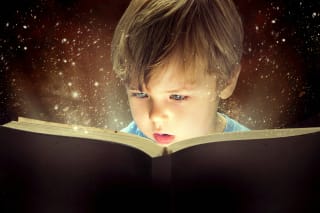
Personal conception of the fairy tale: When children hear fairy tales, they do not imagine the action in realistic images as adults might. They create their own picture world inspired by the tale, in which the supposedly grisly details of the story are without terror. That is the great difference between orally told or read fairy tales and fairy-tale films, in which the evil witch suddenly appears very realistic and frightens many children.
Fairy tales fit into children's everyday life:The Children's and Household Tales address not only the magical and unexpected but also feelings every child knows: fear and perplexity, courage, joy and relief. In addition, the stories are easy to understand because good and evil are generally clearly separated. All this makes the fairy-tale world easy to 'grasp' for children and encourages them to form their own picture of a story.
More fairy tales: Tips for delightful children's tales
Andersen's fairy tales: The fairy tales of the Danish writer Hans Christian Andersen are world-famous. Among the best-known are 'Thumbelina', 'The Ugly Duckling', 'The Little Mermaid' and 'The Snow Queen'.
Russian fairy tales: Many Russian fairy tales became known through the legendary fairy-tale films of the GDR, for example 'Father Frost'. Russian fairy tales often feature animals or nature as their theme.
Fables: The short animal stories also appeal to children who do not yet fully understand the moral behind the fable.
More articles about leisure & creativity







Image credits
Father, mother and child cuddling on the sofa and reading a book © Fxquadro - stock.adobe.com
Child looking at a book © konradbak - stock.adobe.com