“Faster!”, calls Elise as she cycles to kindergarten with her mum. “I mustn't be late.” “Don't worry, we'll be right on time. I promise!”, her mum calls after her. But Elise pedals like mad: today her kindergarten group is going on a trip to the forest and she is very excited, because the children will meet her dad there. He is a forester and has promised to explain everything about the trees and the animals to the children.
When Elise arrives, the children in her group are already gathering on the square in front of the kindergarten. “Good morning, children. Please pair up in twos so we can set off in five minutes!”, says kindergarten teacher Nina. Elise hops to the end of the line. In front of her stand Imke and Mali. Matze and Felicitas are further up. Milla is already there and is helping a little girl fasten her jacket. Then someone tugs at Elise's sleeve. “Can I walk with you?”, asks Lilli, who has just arrived too. “Of course!”, Elise answers and takes Lilli's hand.
The children walk with teachers Nina and Saskia to the bus stop. The ride out to the outskirts is exciting because there is activity everywhere on the streets. They pass a construction site with big diggers and see an ambulance. Before they know it they're there and get off. Now the children only have to walk a short way and they will meet Elise's dad, who is waiting for them at the forest edge.
“Hello, children!”, he greets the group. “Have you dressed warmly? Warm jackets, boots and long trousers?” The children nod. “You know, if you spend a lot of time in the forest like I do, you need weatherproof clothing.” “Are you in the forest all day then?”, asks Felicitas. “No, I also work at our forestry office at a desk. I have to write letters and reports, draw up lists and plans. That's part of being a forester, although that's not so exciting for you. But I also spend quite a lot of time in the forest. Let's set off and I'll tell you on the way about the other tasks a forester has.”
And off they go. The path leads between tall trees. “Prick up your ears”, Nina tells the children. “Can you hear the birds chirping?” The children listen. Suddenly another, rather loud noise can be heard. “Those are our forest workers who are felling some trees,” explains Elise's dad. “That is an important part of my job: I organise all the forest work, for example which trees are felled and where new trees are planted. I also check whether the paths in the forest are in good condition. A healthy forest is important for our environment because the trees help keep the air clean.” Soon afterwards the children can also see the forest workers. They are wearing high-visibility protective clothing.
The group walks a little further and then reach a clearing. Here stands a small hut with benches and a table in the middle. “Time for a breakfast break!”, says Saskia and helps the children open their rucksacks. “Why are the trees being cut down?”, asks Milla. “The wood from the trees is an important resource,” explains Elise's dad. “It is used as building material, but also for toys or for heating. Here with us very different trees grow. There are conifers such as spruce, pine and fir. Alongside these there are beech, oak and a few birch trees. Birches are easy to spot because they have white-and-black bark. You can recognise beeches by their grey bark. Now in autumn the leaves are slightly tinged with red.”
“When you've finished eating, you may look around the clearing and collect different leaves and twigs that lie on the ground. See what interesting things you can find,” Nina tells the children. Immediately everyone rushes off. “Look, Elise,” says Lilli, “over there are a few small birches, aren't they?” “That's right,” she replies, “and that's an oak.” Elise points at the tree beside it and picks up a few acorns from the ground. “I especially like those little caps from the acorns. They're so smooth inside,” she tells Lilli. They find other little cups too: beech nuts have a soft down inside and are rough and a bit scruffy on the outside.
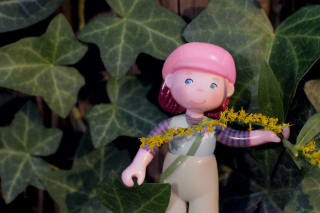
Soon afterwards the children come back together and spread out their forest treasures. Matze and Felicitas have collected huge branches and dragged them together to the picnic spot. The two are pretty filthy, but they are grinning from ear to ear. Milla, Mali and Imke have found lots of different cones and twigs from conifers. Lilli and Elise show the acorns and beech nuts. “The fruits and seeds of the trees are important for the animals that live here in the forest,” explains Elise's dad. “I've even seen a fox before,” Elise says. “But that was when Dad and I were out in the forest early in the morning.” “That's right!”, her dad says. “Foxes, but also wild boar, roe deer and red deer are shy animals that you can only observe when the forest is very quiet. Smaller forest-dwellers such as badgers, martens, mice and wild rabbits are also rarely seen. But I'll show you a wild rabbit's burrow on the way back.” Imke and Lilli are thrilled because they both particularly like rabbits. “If you keep your eyes open, you might even see a squirrel. And of course there are birds and loads of insects living here: beetles, ants, spiders and many more.”
The group makes its way back. And indeed they first pass a large anthill and then the wild rabbit's burrow. The earth in front of the hole in the ground is all churned up and if you look very closely you can see little paw prints. At least that's what Imke and Lilli think. “Nonsense!”, says Matze. “I don't see any prints. You'd see dino prints, but not those from such small rabbits.” “Psst, look up there!”, Elise's dad suddenly whispers, pointing upwards with one hand. The children look up and see a squirrel with a bushy tail running along a long branch. It hops to the tree trunk, scurries up it and is gone. “Oh, that's a pity,” says Mali, “I would have liked to watch it for longer. Maybe squirrels will be my new favourite animals from today.” “Exactly!”, agrees Lilli, “squirrels are simply much better than silly dinos. They don't even have fur.” That makes Matze laugh too: dinos with fur really is a funny idea. Giggling, the children walk back to the bus stop. They can hardly wait to go on another trip to the forest. “Who knows”, says Imke, “maybe next time we'll see the wild rabbits too!”
Explorer sheet
With the downloadable explorer sheet it's really easy to record your experiences. Mum or Dad will be happy to help you fill in the destination of the outing. You can fill in the rest yourself, tick boxes, stick things on or draw.
We wish you lots of fun and exciting discoveries!