The benefits of finger games for babies

promote Language development
strengthen the Self-confidence and self-esteem
strengthen the father- or mother-child relationship
stimulate children's imagination
promote fine- and gross motor skills in a playful way
improve concentration and sensory perception
Easy – Tips and ideas for finger games with young children
It should be cozy
Make yourselves comfortable with your baby: Take your little one onto your lap for the finger game or cuddle up with them in bed – this way your child can fully focus on your voice and the touches.
No pressure
Don't apply pressure: Don't force your baby if they are in a bad mood or distracted — maybe there will be a better time for the finger game or perhaps they simply prefer a different rhyme.
Let them imitate
Give your baby space: Your child may soon try to copy the finger game. Let your little wonder try in peace, but overlook it if they don't quite manage the rhyme or movements yet — fun always comes first.
Which finger games do babies and toddlers like?
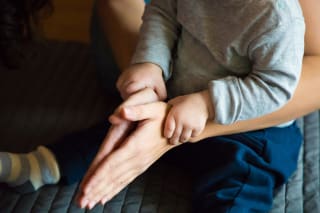
What makes finger games appealing is the combination of movements and funny, child-friendly rhymes. Babies and toddlers like finger games in simple language, which they can quickly remember and join in right away. The most important thing, of course, is the "punchline" at the end — almost all popular finger games end with a surprise or a small joke, which children eagerly await. We have compiled a few classic finger games as inspiration for you:
The 5 most popular finger games for babies and toddlers
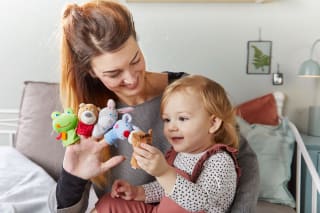
Whether funny wriggling men and women, sweet bunnies or fantastic dwarves – there are lots of verses and rhymes for finger games. So you can start playing with your babies straight away, we've listed the five best movement guides for great finger rhymes and finger games where you can use all your fingers. The best part: you don't need any materials, just a big dose of good humour and your hands – let the fun begin!
The classic for the littlest ones: This is the thumb
Almost everyone knows this simple finger game – and even babies follow the playful touching of their tiny fingers with fascination while the rhyme is spoken. Starting with the thumb, the fingers are tapped or gently bent one after the other, naming each finger as you go:
"THIS is the thumb, HE shakes the plums, HE picks them up, HE carries them home, and THAT little rascal eats them all, all, all."
The little finger is not tapped but gently shaken in time with "all, all, all".
Clapping and tickling: There you go, a coin
This finger game for small children is very well known, even though the individual fingers don't actually come into play in the strict sense. Take your child's little hand in yours and clap gently on your baby's palm with your other hand, speaking the following rhyme in time:
"There you have a coin, go to the market. Buy yourself a cow, a little calf with it, the calf has a little tail, kille, kille, kille goslings!"
On the last line, "kille, kille, kille goslings", you tickle your baby on the tummy and neck. Your child will quickly learn the funny rhyme and eagerly await the punchline with the little tickle. Many children insist on taking turns doing the finger game and will happily tickle Mum or Dad in return.
All together: Himpelchen and Pimpelchen
Himpelchen and Pimpelchen is an "interactive" finger game in which each player moves their fingers independently to match the rhyme. You can even play this game with several children in a group, which is why it is very popular in kindergartens and at children's birthday parties.
For the game both hands are made into fists, only the thumbs are stretched up and "wiggle". The children say the rhyme together:
"Himpelchen and Pimpelchen climbed up the mountain. Himpelchen was a little gnome and Pimpelchen a dwarf." (While saying this the hands are slowly moved upwards.)
"They sat up there for loooong and wiggled their pointy caps." (The thumbs wiggle up and down.)
"But after 33 weeks they crawled into the mountain." (Now the thumbs are pushed into the fists so the "pointy caps" are no longer visible.)
"There they sleep in peaceful rest. Be quiet now and listen carefully! Chrr-pphhh, Chhrr-pphhh..." (The fists are held to the ears and the children make soft snoring noises.)
Finger game for several children: The tower that wobbles
Children can play this finger game again and again – and especially very young children enjoy it just as much as older kids.
One child makes a fist and sticks their thumb up. The next child wraps their fist around that thumb and sticks their own thumb up. Another child adds their fist and so on, until all fists form a tower. Then the children say the rhyme together:
"The tower that wobbles, the tower that wobbles, the topmost tip falls off, click-clack."
At "click-clack" the child whose hand is on top removes their fist; the other children must keep holding the tower together. This continues until all the hands are released.
Animal finger game: Imse Bimse Spinne
This international finger game about a little spider is equally popular with babies and children. From the English "Itsy Bitsy Spider" it becomes "Imse Bimse Spinne" in German. If you want to play this finger game with several children, sit in a circle and move your fingers along to the following lines:
"Imse Bimse spider, how long is your thread?" (Both index fingers symbolically show a long thread.)
"Along came the big rain, swish — the thread snapped." (With your fingers you mimic lots of raindrops falling down.)
"Along came the lovely sun, it soaked up the rain." (Form with your fingers the large circle of a shining sun.)
"Imse Bimse spider, climbs up again." (To imitate the little spider climbing up, alternate touching the left thumb to the right index finger and the right thumb to the left index finger.)
More articles about leisure & creativity




Image credits
Young mother plays finger games with her baby © Alena Ozerova - stock.adobe.com
Little boy plays with his mother's hands © dtatiana - stock.adobe.com