Before the flight – what you should know about flying with a baby
A relaxed start to the holiday is important for everyone involved. A few things can help make flying with a baby or toddler as relaxed as possible.
Check-up: Before the flight you can make an appointment with the pediatrician to check whether your baby is allowed to fly. With a cold and a blocked nose or sinuses, your baby may have trouble equalizing pressure in the cabin. If necessary, mucolytics or nasal sprays can help temporarily; otherwise the trip should be postponed. Depending on the destination, the pediatrician can also tell you whether additional vaccinations are advisable for your child.
Additional seat: Children up to two years of age are not entitled to their own seat. They then travel with an extra belt on the parents' lap. Additional safety during takeoff and landing or on long-haul flights is provided by a bassinet that airlines offer and that can be attached to certain seats. If you need a separate seat for your baby, you will usually have to pay for it in full.
Passport: By law, every child needs a passport for international air travel, even newborns. Applying for a child's passport can take 1-2 weeks. Therefore plan your visit to the authorities and to the photographer (for the passport photo) early.
Pre-boarding: As a rule, families with children are given priority when boarding. This means they do not have to wait in line, avoid the rush and jostling when boarding, and have time to settle in at their reserved seat.
Reserving seats: If you didn't reserve your seats during the online booking, an early check-in is recommended to get child-friendly seats. Airlines often take the needs of families with small children into account when assigning seats – for example, the first row usually offers more legroom and space for children to move around.
Tips for flying with babies and toddlers
Clothing: Am besten im Zwiebellock. At the airport and at your holiday destination it may be warm, but in the air-conditioned cabin it can quickly get cold. Several layers of thin clothing and a few extra socks are optimal so your baby neither sweats nor gets cold on the journey. A change of clothes is also sensible in case of an accident.
Drinking: For babies and toddlers, regular drinking on the flight is even more important than for adults, because the air-conditioned air in the plane is very dry. Parents with children under three years are allowed to take large water bottles in their carry-on luggage to ensure an adequate supply of fluids.
Food: Breastfed babies always have their food with them anyway. For bottle-fed babies or toddlers who already eat solid food, you can bring bottles or jars on board. The cabin crew will help you prepare or warm the baby food. Swallowing while feeding also supports pressure equalization, so a small meal during takeoff or landing can be helpful.
Changing diapers: If it becomes urgent, you may not want to disturb the other passengers with a diaper change. Airplane toilets often do not have much space. In such cases, the cabin crew often make the business class restroom available.
Buggy and stroller: If the stroller is checked in as baggage, it counts as oversized baggage. Some airlines then offer a loaner buggy that you can use to get to the gate. However, you can often take your own buggy all the way to the plane and hand it over to the staff. That way you have it ready again immediately when you disembark.
How can toddlers stay calm during flights?
Long flights are tiring, especially for children. For longer routes, night flights are therefore an option, which the little ones mostly sleep through. Often the cabin crew provide small toys or drawing materials to keep them occupied; on long-haul flights there are also kids' movies and audio stories offered. A cozy blanket, a favorite toy, or a new book in the carry-on can also help pass the time. Most important is that you stay reasonably relaxed – that will help keep your baby calmer too.
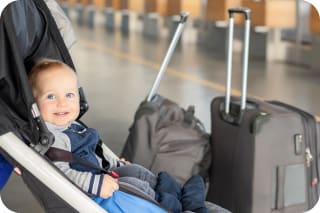
Some airlines offer coloring supplies or small toys, and on larger carriers you can also watch movies and TV series on long-haul flights. It's best to check in advance which entertainment program you can expect.
Depending on the length of the flight, you can, with varied travel games prevent boredom from setting in. These can complement the existing entertainment program.
During the flight, a book about the destination is also a great way to keep children calm and in good spirits – and as a bonus it also increases anticipation for the vacation.
If your child is interested in technology, you can certainly spark enthusiasm with specialized information and books about airplanes and flying. Now you can show them the individual parts of the airplane in detail.
More articles about leisure & creativity


Image credits
Small child, baby boy, plays at the airport while he waits for his plane © Tomsickova - stock.adobe.com
Baby boy sits in the stroller near luggage © Kirill Gorlov - stock.adobe.com