Appointments – What's coming up in month 2?
U3 (4th to 5th week of life): Usually the U3 is carried out in the fifth rather than the fourth week of life. Babies develop so quickly at this age that the difference of one week can be huge. Write down everything that concerns or unsettles you in everyday baby life so you can ask your pediatrician targeted questions at the U3.
Hip screening: As part of the U3, a second hip ultrasound is also required. The hip is examined with ultrasound for possible misalignments. The pediatrician does not always perform the scan – you will often receive a referral to an orthopedist of your choice. Perhaps parents you know can recommend a good, child-friendly practice so the hip screening goes as smoothly as possible.
Vaccination against rotaviruses: Perhaps your pediatrician has already mentioned the oral rotavirus vaccine, which is possible from the 6th week of life. Rotaviruses are the most common cause of gastroenteritis. Their symptoms are unpleasant, but only very rarely life-threatening. The STIKO recommends the vaccination because it greatly reduces the risk of severe diarrheal illness in babies, at least during the first year of life – ultimately, however, it is a subjective decision for the parents alone.
Registration on the income tax card: Surely your baby already has a health insurance card and perhaps even a tax number by now. But also remember to have your child registered on your income tax card by the tax office so you can claim the tax allowances.
Important developmental milestones in the 2nd month
Hearing: Even though hearing is not yet fully developed, your baby consciously perceives sounds and listens attentively to voices or melodies. It recognizes voices and increasingly experiments with its own voice. Pay attention to whether your baby reacts to sudden sounds like clapping – if not, you should have a hearing test done by your pediatrician.
Reactions: After the spontaneous 'angel smile' of the first weeks, your baby begins in the second month of life to deliberately smile at you and to communicate with you through sounds. It often kicks its arms and legs as an immediate reaction when it is happy.
Vision improves: In the second month of life, babies can already distinguish colors and clear patterns – bright red in particular fascinates many babies. Don't worry if your child occasionally squints. Although it can see more clearly each day, it still does not have full control over the eye muscles.
Motor skills: The reflexive grasping decreases, so that your baby can partially 'take objects into its hand' in the second month. Its movements become somewhat more controlled and it no longer seems as fragile as it did as a newborn. A baby massage is both stimulation and enjoyment for your baby at this age.
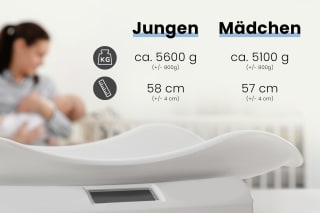
How much should my child weigh in the 2nd month?
In the second month of life you will notice that bodysuits or rompers are becoming a bit tight and thus possibly the first change in clothing size is due. At HABA you will also find many Grow-with bodysuits, which can be adjusted at the crotch – so they grow with the baby and fit longer. Babies in this developmental phase are about 57 to 58 centimeters tall and weigh between 5,100 and 5,600 grams. A baby's physical development is individual, so these are primarily guidelines.
Discover more articles on parenting & psychology












Image credits
Mother holding baby in her hands © GTeam - stock.adobe.com
Modern baby scale on the table © New Africa - stock.adobe.com