Appointments – What is coming up in the 3rd month?
U4: From the end of the third month of life, the U4 is due. The time windows for routine check-ups are now getting larger, also to accommodate your baby's individual developmental pace. Often the first vaccination is also administered together with the U4.
Vaccination: The so-called primary immunization can begin from the ninth week of life. As a rule, combination vaccines are used today, so your baby does not have to be 'pricked' unnecessarily often. The first sixfold vaccination against tetanus, diphtheria, pertussis, polio, HIB (Haemophilus influenzae type b) and hepatitis B is boosted about one month later with a repeat vaccination.
Plan a postnatal recovery course: Postnatal recovery courses are recommended from the fourth to fifth month. However, the courses often fill up quickly — so it makes sense to register early at the hospital with a midwife or at the adult education center.
Important developmental milestones in the 3rd month
The third month is full of surprises for many parents – little by little the helpless newborn becomes an alert little person who watches everything attentively and contentedly 'babbling' to themselves.
Seeing and hearing: Your baby sees more sharply, can follow objects with its eyes and, for example, turns its head toward its mobile on the changing table. Hearing also sharpens every day. Your little one attentively looks for sources of sound or turns toward familiar voices. Many babies respond to songs when you sing them in recurring situations.
Day-night rhythm: By the third month most children have become accustomed to a regular day-night rhythm – which does not mean that they sleep through the night. You have surely already received tips on how your baby will 'definitely' sleep through. Don't put too much stock in that – when babies sleep through varies greatly and does not necessarily depend on you.
Increasing body control: Your baby can hold its head increasingly well and can already briefly lift it from the tummy position. Slowly it also learns to move its limbs more controlled and independently of each other. Some babies may even unintentionally roll from their tummy onto their back.
Grasping and holding: At three months your baby no longer grasps reflexively but can control whether it reaches for and holds something – now grasping toys, rattles or everyday objects become increasingly interesting.
Communicating: Your little one now experiments more with its voice and produces a wide variety of sounds. Answer it with the same sounds – almost all babies really enjoy that.
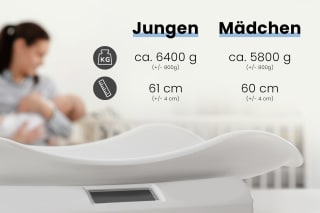
How much should my child weigh in the 3. month?
In the third month of life your baby weighs between 5.800 and 6.400 grams and is approx. 60 to 61 centimeters long. Weight gain and physical changes become more noticeable during this phase. Your offspring gets a rounder face, fuller cheeks and also small rolls of fat on the arms and legs are completely normal. Baby fat primarily has a protective function and is a cause for uncertainty, even if other children of the same age are a bit slimmer. If in doubt, have this examined by your pediatrician and have them give you an assessment.
Discover more articles on parenting & psychology












Image credits
Modern baby scale on the table and out-of-focus woman with child in a house © New Africa - stock.adobe.com