





















At a glance: How your baby develops in 2 years

Height and weight
The average length of newborns is 50 to 52 centimeters. Length at birth depends on the parents' height, the timing of birth, the course of the pregnancy and the child's sex – girls are often slightly smaller than boys. By the end of the 24th month most children are about 87 centimeters tall – so they have grown quite quickly. The average birth weight is about 3,400 grams. Within the first two years of life the weight almost quadruples. Girls then weigh on average 11.8 kilograms, slightly less than boys at 12.2 kilograms.
BMI percentile chart for children aged 0-2 years
Data from the World Health Organization (WHO) are used by doctors during well-child checks and provide parents with a rough guide when assessing their child's body mass index (BMI) – nothing more and nothing less. Variations occur, for example, often due to slightly early or late growth spurts and should not immediately be a cause for concern. Whether a serious deviation actually exists can only be determined by the pediatrician. The percentage values given are percentiles. The curves indicate what percentage of babies and toddlers have a lower BMI value than the respective percentile.
Example
The 15% percentile curve means that 15% of babies and toddlers of the same age and sex have a BMI below this curve and 85% are above it.
Sleep
In the first three months of life your baby will sleep a lot – about 16 to 18 hours, spread over several sleep phases. Even though it is very exhausting for parents, it takes quite a while before babies sleep through the night. At 12 months almost half of all babies still wake their parents twice a night. The amount of sleep needed decreases over the months – but don't worry: the lost sleep is usually made up during the day. At two years old, babies on average still need 13 to 14 hours of sleep.
Sight
When babies are born they can only distinguish light-dark contrasts. Visual ability develops quite quickly: already by five months most babies can perceive colors, contours and distances. By one year visual acuity is about 50% developed and continues to develop in the following years.
Hearing
The hearing of full-term babies is already fully functional at birth, but auditory ability develops mainly during the first years of life. Through auditory impressions from the environment the baby learns to decode stimuli and eventually interpret them meaningfully. However, toddlers do not yet hear like adults: localization in particular remains difficult for children until about the age of eight.
Facial expressions
As early as the second month many babies smile at their parents consciously for the first time. They imitate your facial movements and expressions. With just a few months they can convey their mood, for example by frowning or smiling. In the first two years of life facial expressions are an important means of communication between baby and parents, since the child cannot yet express itself in words.
Motor skills
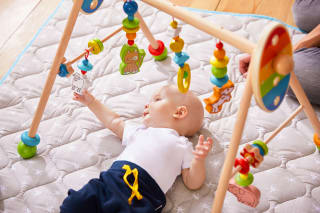
After birth babies are still very clumsy when it comes to coordinating their body parts. The lack of muscle also contributes to newborns not yet being able to stabilize their head on their own. But within a few months your child learns to reach deliberately, hold objects, and use body parts in such a way that it can eventually move around by crawling and walking.
Fine motor skills
Your baby also learns fine and precise hand movements in the first 24 months of life. While newborns' hands are still mostly clenched into fists, they open during the first months. At first the fingers usually go into the mouth before being used to grasp objects. Small-scale movements like drawing or playing with clay are then no problem for most two-year-olds.
Language development
All parents are waiting for this – their child's first words. Language development begins much earlier: already at the age of four months many children respond to their parents' voice. Language development really progresses after the first birthday. After the first words are spoken, new words usually don't take long to follow.
Discover more articles on parenting & psychology











Image credits:
Young family with two small children indoors in the bedroom reading a book © Halfpoint - stock.adobe.com