What does visual perception mean?
Developing the sense of sight – in the first year of life: When babies are born, their vision is still very blurry and they can, for example, hardly distinguish colors. Over the course of the first years of life their sense of sight develops until the eyes finally function just like those of an adult. Beyond this purely physical development, babies and toddlers also have to learn to recognize certain details or differences in what they see, for example.
Shapes
Colors
Sizes
Distances
Structures/Patterns
Movements
Differentiating and Interpreting – mainly between the ages of 3 and 7: The process of differentiating between these details is called visual perception. It is a necessary prerequisite for us to be able to interpret what we see. If, for example, visual perception of shapes or structures did not function, children would have great difficulties learning to read and write when starting school. Spatial awareness can also suffer if visual perception is impaired. As a result, children have difficulty relating to their surroundings and are very uncertain in their movements.
Visual perception disorder: If you suspect that your child's visual perception is not age-appropriate, you should first talk to your pediatrician and, if necessary, seek help from an occupational therapist. Targeted support should start as early as possible to prevent problems at school.
Great for visual perception:
Classic games from our childhood
Many games or toys that particularly effectively promote children's visual perception are for the most part real classics. So you don't have to buy special games or learn new ones to support your child – many things are probably already in the children's room:
Puzzles: Putting the differently shaped pieces together to gradually form a picture is not only a great sense of achievement, it also trains the perception of different colors and shapes. Pay attention to age-appropriate puzzles to avoid frustration.
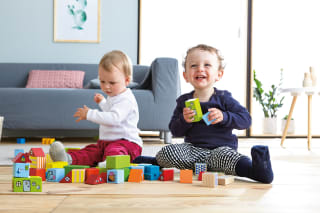
Duplo and Lego: The colorful bricks are now available in an almost endless variety. That's precisely what makes them so valuable for the development of visual perception: big and small, square, rectangular or half-round, in many colors and endlessly combinable - Duplo and Lego bricks never get boring.
Memory: Many children understand the principle of Memory from about three years old and play it with great enthusiasm. The motifs on the cards combine colors and shapes; memorizing and recognizing effectively trains visual perception. As a nice side effect, it's a social game that is even more fun with three or four people.
Playdough: Not all parents appreciate playdough because it often ends up in the carpet or dries out on the craft table. However, playdough is also wonderfully suited to teach your child different shapes and size relationships. Creating certain figures themselves is a challenge for many children with great learning benefits.
Preschool workbooks: Preschool workbooks, which can be bought for example at the stationery store, offer various playful exercises for visual perception, for example mazes where the correct path must be drawn through, or tasks where missing or extra objects must be found.
Alternatives for everyday life
You can also promote your child's visual perception in everyday life "on the side".
Make time: 15 to 30 minutes of playing together daily is enough – take this time to consciously play a round with your child.
"I spy with my little eye": On train or car rides, a favorite is the game where objects of a certain color have to be found.
After eating you can squeeze in a round of 'What's missing?': Your child must close their eyes and you remove an object from the table, e.g. the drinking cup. Your child may open their eyes and has to guess what's missing.
Nature in order: While walking you can collect various items like stones, sticks, leaves and sort them together – by color, shape or size; for older children also by brightness or texture.