Why is good sleep so important for children?
Sleep quality matters: Naturally, sufficient sleep is fundamentally important not only for children but for people of all ages. For children, however, sleep has special significance because they are in the midst of physical development. And: Not only the length, but the type of sleep is decisive.
Growing during the deep sleep phase: The night's sleep follows a repeating pattern of light sleep, deep sleep, and dream-sleep phases. During the deep sleep phase the body is deeply relaxed and all metabolic processes are slowed down. This is when the body regenerates and in children it also grows. Sleep deprivation or frequent disturbances of the deep sleep phase can even trigger growth disorders.
Sleep makes you smart: During sleep learned things and experiences are processed. Sleep researchers assume that the brain links what has been learned with known knowledge during sleep and thus consolidates it. This is another reason why good sleep is so important for physical and mental development.
Sleep keeps you healthy: Children who sleep enough are better protected against infections because the immune system has enough time to regenerate and strengthen. In addition, the defenses work at full speed at night when the body downregulates its functions and can target pathogens more effectively.
Off to bed: When should children go to bed at each age?
Bedtime is the apple of discord in many families: while younger children react with protest screams or refuse to fall asleep, older ones begin to beg or negotiate: 'Just ten more minutes!' But when is the right bedtime for children and how much sleep do children need at different ages? There is no standard answer to this question: the right approach is usually a compromise between what your child needs and what best fits with family life:
One- to three-year-olds need around 12 hours of sleep daily, three- to six-year-olds about one hour less. Depending on when your child has to get up and whether they nap, you can calculate the right bedtime this way.
Sleep before 3 a.m. is important – by then the body regenerates and releases growth hormones. Very late bedtimes therefore cannot necessarily be compensated by sleeping in for a long time.
Too much sleep makes children listless and sluggish – with too little sleep, many children do not appear tired but rather very active and almost hyperactive.
Regardless of when your child goes to bed, bedtime should vary as little as possible so that the sleep-wake rhythm remains regular.
'I'm not tired yet!' - When children don't want to fall asleep
Battle to fall asleep: Brush teeth, read aloud, cuddle a bit more and then off to bed. But the child is awake and stays awake. If you leave the room, it gets up or starts calling out. You actually still have a hundred things to do or are simply looking forward to your own bed. But first the nightly battle to fall asleep must be fought.
Difficulty falling asleep: This or something similar happens in many families. There are children who vehemently resist going to bed and those who go to bed obediently but cannot fall asleep. The reasons for difficulties falling asleep are varied – perhaps it's the stimuli and experiences of the day that keep buzzing in the child's head, perhaps vague fears trouble them, possibly the midday nap was too long, or the child is already so overtired that they cannot calm down.
Patience and calm help: Regular bedtimes, an orderly, calm sleep environment and loving bedtime rituals help with falling asleep. Sufficient physical activity in the fresh air also makes children tired. But most importantly, don't lose patience if your child cannot or does not want to fall asleep: do not assume bad intent, but look together for ways to calm down.
Here you can find more about children's difficulties falling asleep.
Bad dreams - How can parents help with nightmares?
Occasional nightmares are normal: Almost all children sometimes have bad dreams – usually it's a sign that they're processing experiences or dealing with their fears during sleep.
Always respond: If a child cries and calls at night, you should absolutely always respond, go to their bed and comfort them. That way they know they are 'safe' and can calm down more quickly after a nightmare.
Nighttime helpers: A nightlight and the favorite cuddly toy are familiar friends that can bring your child back to reality after a nightmare.
Avoid sensory overload before bedtime: Strong impressions or wild roughhousing before bedtime can promote nightmares because the mind no longer has the opportunity to process what happened while awake. So it's better to avoid TV, computer and rough play in the evening.
Alleviate fear: Take your child's fears seriously, whether it's fear of monsters or ghosts or fear of the nightmare itself. Sometimes a dreamcatcher, a homemade monster weapon or a spray bottle with 'dream spray' for good dreams can help.
Night terror as an extreme form: Persistent nightly screaming without actually waking up is not a nightmare but a special sleep disorder that occurs occasionally in 2-6 year olds. Night terrors (pavor nocturnus) are disconcerting for parents but harmless and usually pass quickly.
Find out more about nightmares and how parents can deal with them here
Why does my child wet the bed at night?
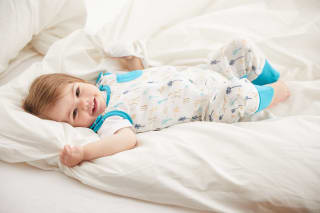
Finally no more diaper! For many parents it's a milestone when their child becomes dry. The transition at night usually doesn't work immediately; especially in the first time after becoming dry children relatively often wet the bed at night. This is because the brain does not yet recognize the bladder signals quickly enough during deep sleep: the child only wakes up when the bed is already wet. If a child has particularly deep sleep, night-time accidents can still occur even if they have been dry during the day for a long time.
Facts about bedwetting:
The technical term for regular bedwetting without obvious organic causes is enuresis nocturna.
One only speaks of enuresis from the age of five onwards – before that, bedwetting in children is relatively normal and no cause for concern.
A distinction is made between primary enuresis, when a child has never been completely dry, and secondary enuresis, when a child begins bedwetting again after more than six months.
Boys are about twice as likely to be affected by bedwetting as girls. In most cases, the bedwetting resolves on its own.
The less fuss parents make about the small 'accidents', the sooner the dry nights will succeed.
Other reasons for bedwetting:
In rare cases, children's bedwetting has an organic cause, for example triggered by an illness. The pediatrician is most likely to say whether this possibility exists for your child and whether treatment is necessary.
Especially in older children or in cases of suddenly recurring bedwetting, psychological stress can be the cause, triggered for example by stress, conflicts at school or in the family, or your child's feeling of being overwhelmed. Here too you should ask the pediatrician for help to clarify possible causes and, if necessary, obtain a referral to a specialist.
How you as parents should best respond to bedwetting and how you can support your child in becoming dry can be found here.
Does my child need a nap?
For most adults, a relaxed nap after lunch is a great idea. But children are not always enthusiastic about the idea of lying down for a midday nap. Experts and sleep researchers agree that the midday nap is beneficial for toddlers and supports their development – but up to what age should children sleep in the afternoon? In general, the midday hour is recommended for children up to the age of four. Especially with the start of kindergarten and the many new impressions that come with it, many children have an increased need to take a small break in the afternoon. On the other hand, you should not force your child to sleep if they do not want to: perhaps you can instead introduce a quiet time in which they occupy themselves calmly or retreat to their cuddly corner. Children's need for sleep is individual – some stop napping already at two years old, others still like to take a nap during elementary school.
Discover more articles on parenting & psychology










Image credits:
Boy sleeping with stuffed animal in bed © photophonie - stock.adobe.com