Our tips on washing, drying and ironing
The right Care and washing of your clothing may not always be easy. The Care instructions and wash symbols are, however, important when it comes to preserving fabrics and colors for a long time. On our site we have some tips on washing, drying and ironing compiled.
Tip: Our care label with the respective wash symbols and care instructions is usually located in the left side seam.
Clothing care symbols
Washing
These are the most important washing symbols:

Do not wash (e.g. shoes)

Normal wash cycle

Gentle cycle (easy-care, delicate cycle)
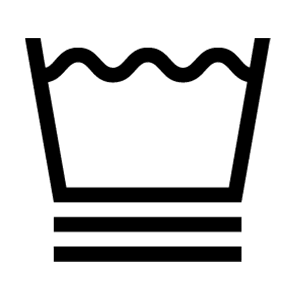
Delicate cycle
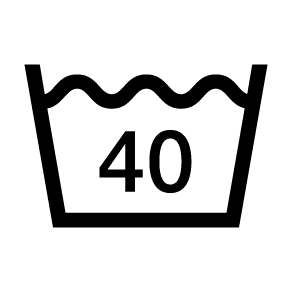
40°C in the normal wash cycle

Except for the hand-wash symbol
The numbers in the wash tub correspond to the maximum wash temperatures, which must not be exceeded. The bar beneath the wash tub calls for a gentler treatment of the laundry, i.e. a gentle wash cycle. It indicates wash cycles that are suitable, for example, for easy-care and mechanically sensitive items. The double bar denotes wash cycles with further reduced mechanical action, e.g. for wool.
Important for functional clothing is that you don't use any fabric softener and switch to a special detergent instead. Zippers and Velcro fastenings should always be properly closed before the wash to avoid unpleasant surprises. Down jackets should also not be air-dried but put in the tumble dryer.
Tips for washing:
separate colored clothing into light and dark colors beforehand (prevents color transfer)
pre-treat difficult stains
Empty pockets beforehand, close zippers and wash inside out. This prevents unpleasant surprises, like tissue remnants on clothing or pulled threads from open zippers.
Wash lingerie etc. in laundry bags
Following the care symbols and the detergent dosage instructions achieves the best possible washing result
Our guiding principle for washing:
The wash program colored laundry uses delicate detergent (for dark laundry, use detergent without optical brighteners) and can be used for e.g. jeans, sweaters, shirts and jackets. Usually these items are washed at 30° to 40°C washed.
With the wash program hot wash the laundry is washed at 40° to 60°C with universal detergent washed. This includes, e.g., bed linen, underwear and towels.
Also for boil wash is universal detergent used, but the laundry is washed at 95°C washed. This includes, for example, bedding and underwear.
The wash program delicates is given a delicate detergent added and the laundry is washed at 30° to 40°C washed. Laundry for this program could include sports textiles, underwear, blouses, shirts and T-shirts.
Wool has its own wash program and also its own own detergent. Items made from this material should either be washed cold or at a maximum of 30°C.
In addition, we have some energy-saving tips for you:
Always fill the washing machine, but do not overload it! (Rule of thumb: the drum should be filled so that you can still place your hand upright between the laundry and the drum rim)
Proper spinning shortens drying time in the dryer
30°C is generally sufficient, except for heavily soiled items
For bedding/towels, 60°C is usually fine to achieve a good washing result
Drying
On A circle inside a square is the symbol for the tumble dryer. If an empty square is shown, the garment should be dried outdoors. The dots indicate the drying level of the tumble dryer.

Do not tumble dry

Gentle Drying

Normal Drying
Tips for drying:
Do not tumble-dry delicate items, such as silk.
Fill the dryer fully, but do not overload it.
Do not overdry laundry (only put damp/wet laundry into the dryer).
Remove clothing immediately after the cycle ends (reduces wrinkling).
Remove lint from the dryer after use! (Dryers usually have several lint filters! All must be cleaned regularly)
If possible, air-dry; use the dryer only when necessary.
Ironing
The small iron symbolizes whether you may iron the garment or not, because not every material withstands its heat. The dots indicate the temperature ranges for dial irons.

Do not iron

Iron at low temperature

Iron at medium temperature

Iron at high temperature
Ironing tips:
After the wash/dryer cycle is finished, we recommend hanging the laundry up immediately
This prevents creasing and thus reduces the need to iron
The temperature of the iron should be set as indicated on the garment's care label
More care symbols on the care label

Chlorine/oxygen bleaching agents

Dry cleaning (professional cleaning)

Only oxygen bleach allowed

Dry cleaning not allowed

Do not bleach
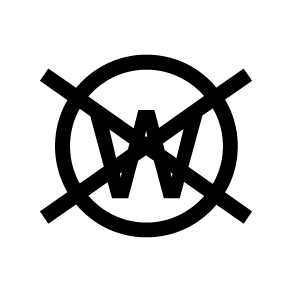
No wet cleaning
Facts about materials
Cotton
Cottonbelongs to natural fibers. It is very resistant to frequent washing and higher temperatures. This material should not be rubbed strongly during hand washing. Colored garments should be separated by color intensity. Knitwear should be reshaped after washing and dried flat.
Elastane
Elastane belongs to the category of chemical fibers and is classified into the subgroup of synthetic fibers. Since the fibers are heat-sensitive , clothing should up to 40°C washed and up to 120°C be ironed. In addition, drying in direct sunlight is not suitable. The material has a high elasticity. Swimwear should be rinsed promptly, as chlorine or sea salt attacks the fibers.
Viscose
Viscose also belongs to the group of chemical fibers but to the subgroup of fibers of plant origin. They consist of chemical fibers spun from cellulose. For viscose it is recommended to always use the gentle wash cycle and gentle detergent to use, at a temperature up to 40°C. To avoid the possible formation of water spots and heavy creasing, garments made of viscose should be put into the dryer immediately after washing and ironed after drying.
What are chemical fibers and their main groups
Chemical fibers are artificially produced fibers. Unlike natural fibers, they can be freely manufactured in composition and structure. This gives the fibers special properties and makes them versatile. Among chemical fibers, a distinction is made between synthetic fibers, chemical fibers obtained from cellulose, and fibers of inorganic origin and rubber threads derived from latex.
Plant-based fibers
The basic substance for chemical fibers from natural polymers is cellulose. Cellulose is produced using chemical processes. An example of such a fiber is viscose.
Synthetic fibers
Here the spinning mass is produced from individual polymers in a chemical reaction. Examples are polyester and elastane.
What does the energy label on a washing machine mean?
If you inform yourself about the appliances before buying and know the information on the energy label, you can save real money after the purchase and protect the environment.
The actual water/electricity consumption naturally depends on the frequency of use.

Brand
Model
7 bars for color coding of energy efficiency
Energy efficiency class
Annual electricity consumption (in kilowatt-hours for 220 washes)
Noise level in decibels when washing in the standard 60°C cotton program at full load
Noise level in decibels when spinning in the standard 60°C cotton program at full load
Spin performance class
Maximum load in kilograms
EU regulation number
Annual water consumption for 220 washes