Friedrich Fröbel – Founder of the Kindergarten
Behind the term Fröbel kindergarten stands the namesake Friedrich Wilhelm August Fröbel (1782–1852), who is regarded as the founder of the kindergarten. As an educator and pupil of Pestalozzi, he recognized the importance of early childhood for a child's development. In 1840 the first 'General German Kindergarten' was established. With the founding of the kindergarten, a childcare institution for children emerged for the first time that followed an educational model focused on learning and upbringing rather than serving as a mere custodial facility.
Fröbel Kindergartens – Concept and Practice
In Germany, but also worldwide, there are many kindergartens named after the educator Fröbel that continue his pedagogy. The largest operator is FRÖBEL e.V., a non-profit association based in Berlin. Nationwide, FRÖBEL operates approximately 150 kindergartens, after-school care centers and nurseries distributed across the country. In addition, there are other initiatives and associations that run kindergartens according to Fröbel pedagogy.
The goal: Fröbel recognized that children should be supported especially in early childhood, as this stage of life makes a significant contribution to development. The aim of his pedagogy and work was to educate children to become free, thinking and self-active individuals. Fröbel kindergartens take up this goal and accompany and support children along this path. Overall, they pursue a holistic educational approach aimed at expressing inner aspects such as thoughts and feelings and internalizing outer aspects like experiences and perceptions.
Pedagogical mission: A central role of the Fröbel kindergarten is self-experience. In groups and alone, children learn best by trying things out, observing and experimenting. Fröbel pedagogy assumes that education is only possible from within itself. Education therefore cannot be imposed from the outside, but must be intrinsically motivated. What is learned is consolidated through repetition.
Participation: Fröbel kindergartens operate according to the principle of activity pedagogy, i.e. children are not lectured but are encouraged to help shape things themselves and to discover new things through trying them out of their own free will. In this way, children learn not only to become aware of themselves, but also to respect other people and their will.
Children's rights: Fröbel himself, as well as Fröbel kindergartens, regard children as full members of society who, regardless of gender, origin, culture, or mental or physical constitution, have the right to education.
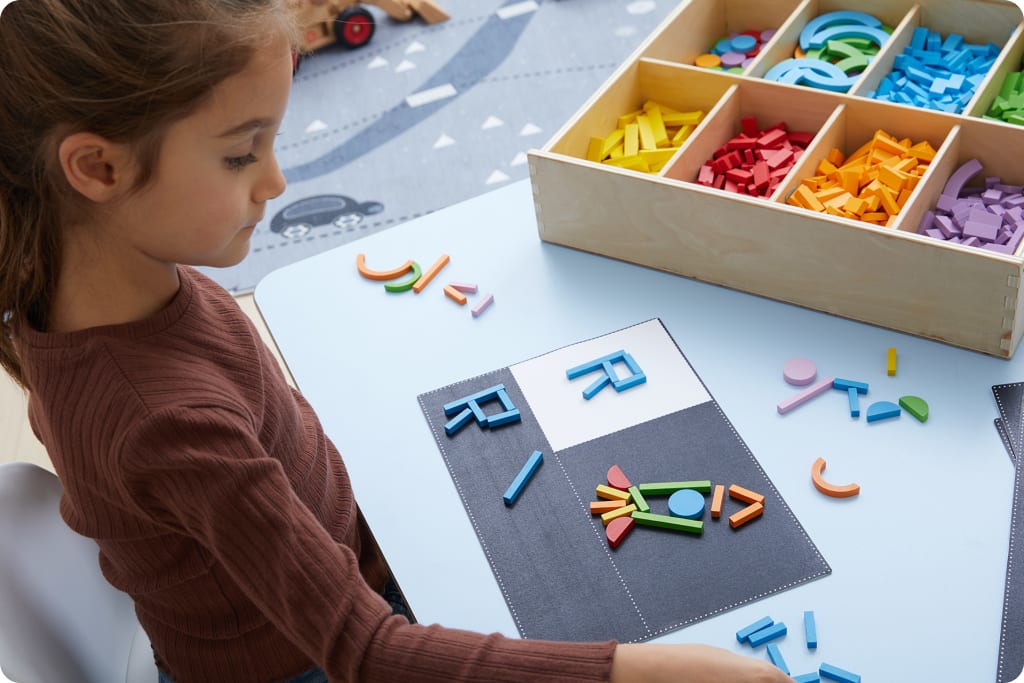
Holistic education: In order for children to be able to develop freely, Fröbel pedagogy pursues a holistic education that takes all areas of learning into account. This includes giving children the opportunity to engage, for example, with the following areas: Music, Nature, Culture & Society, Building & Construction, Painting & Drawing, Imaginative and role-play games.
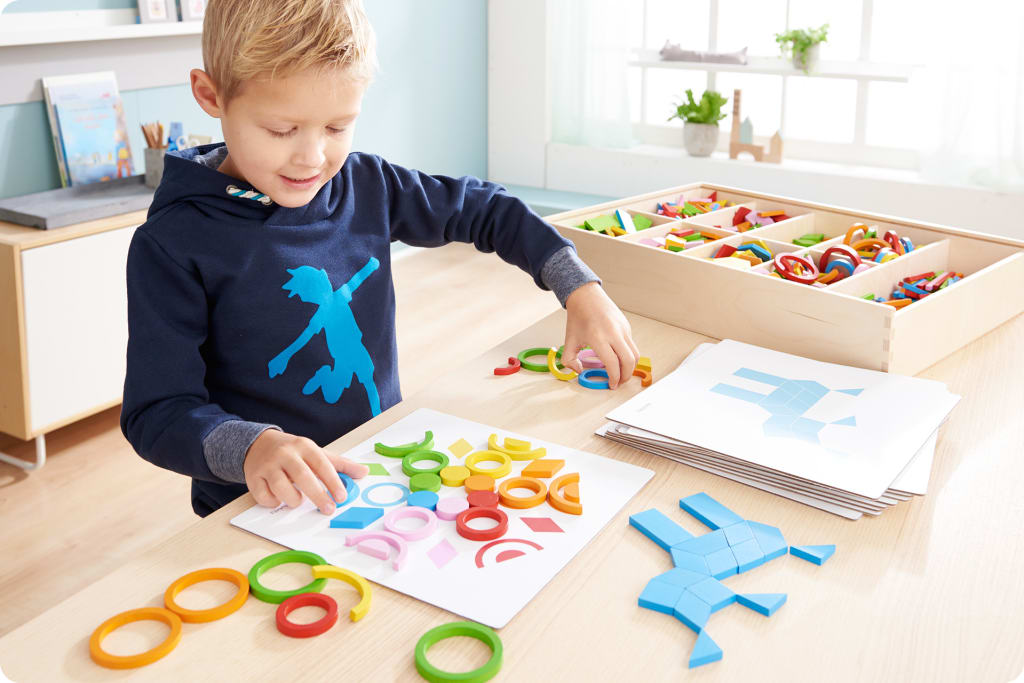
Play: According to Fröbel, play is one of the most important elements of development. Here children can express themselves, experiment and acquire knowledge about their world. For this reason, Fröbel developed play materials that are still used today. The play materials consist of an interlocking system of play gifts, now also known as Fröbel gifts, and activities. These activity materials give children the opportunity to develop senses and skills.
Language development: Language and language development play an essential role in Fröbel kindergartens. Language support is provided alongside activities: while playing, observing and discovering, educators comment on what is happening. As a result, even young children are exposed to a broad vocabulary and can practice in short dialogues. Language development is further supported by reading stories, picture books or fairy tales aloud.
Parental involvement: The concept of a Froebel kindergarten works only with the consent and cooperation of the parents or other important caregivers. Parents and educators exchange information about the child's development at regular intervals. If the child is present, one should not speak about the child, but with the child.
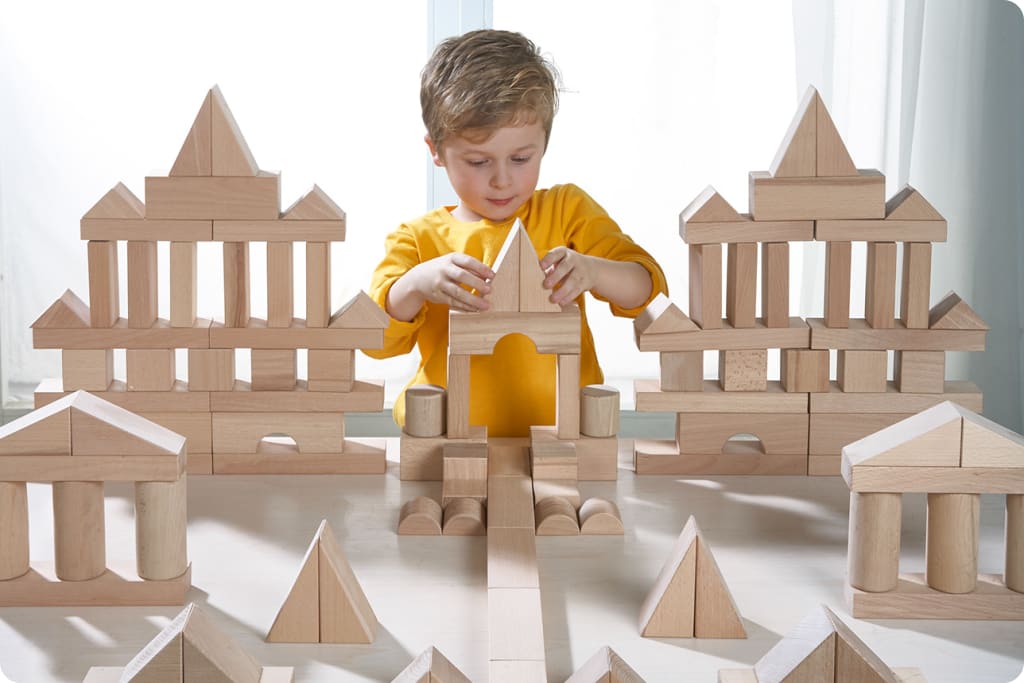
Friedrich Froebel's play and learning materials
Froebel's gifts are still popular with children and parents today and are available in various versions. Essentially, the gifts consist of basic geometric shapes such as spheres, rollers and cylinders. The principle behind them is that the gifts are made available as the child grows older. Each set contains building blocks the child already knows, as well as new shapes that arise from dividing the familiar figures. The increasingly smaller building blocks allow for progressively more differentiated play. In this way the world and its underlying principles should become accessible to the child.