Planning, execution and organization of a scavenger hunt
Ob im Wald, in der Nachbarschaft oder im Haus: mit Rätseln, Schatzkarten oder versteckten Hinweisen – die Gestaltungsmöglichkeiten einer Schnitzeljagd sind vielfältig und geben jedem Kind die Möglichkeit, sich selbst als Schatzjäger:in zu erfahren.
The scavenger hunt – a highlight at every kids' birthday partySchatzsuche zu Hause oder an der frischen Luft sind die kleinen Gäste gleichermaßen gefordert und lernen, gemeinsam an einem Strang zu ziehen, um die kniffligen Aufgaben zu meistern und Hindernisse im Team zu überwinden. Neben der Zusammenarbeit in der Gruppe bieten die Aufgaben und Rätsel selbst auch einen Lernfaktor für Kinder: Von Zahlen- und Rechenrätseln über Wortspiele und Wissensfragen bis hin zu Rechercheaufgaben habt ihr bei einer Schnitzeljagd zahlreiche Möglichkeiten, diese kindgerecht zu gestalten. Dabei ist der Spaßfaktor garantiert!
Unser Tipp: Sucht euch ein schönes Motto für euren Kindergeburtstag aus und gestaltet die Schnitzeljagd passend dazu. Ideal sind Themen, die für Kinder Spannung und Abenteuer bedeuten, wie Pirat:innen, Ritter und Mittelalter, altes Ägypten oder Dschungel. Kleine Abenteurer:innen tauchen besonders gerne in Fantasiewelten ein – und euch als Eltern kann das Motto helfen, geeignete Rätsel und Aufgaben zu entwickeln!
What age is a treasure hunt suitable for?
A treasure hunt is fun at any age, and even children from kindergarten age are thrilled when they solve tricky puzzles together with their friends. Adapt the difficulty of the tasks, the sequence of events and the overall design of the hunt to the age group of your kids.
Ideas for children up to 4 years
With younger kids it’s important that accompanying adults support them both when solving the puzzles and while they hunt through the neighbourhood or the woods. At this age, picture puzzles or directional arrows are recommended — experiences that are more sensory than intellectual. Also limit the number of puzzles or stations to about five, as children this age cannot concentrate for very long. Suitable activities include search games or small tasks such as the 'find-the-pot' game (Topfschlagen) or feeling and smelling objects.
Ideas for children aged 5 to 6
At this age the puzzles and tasks for the treasure hunt can already be a bit more challenging. Good examples are counting or knowledge quizzes that let your children explore their surroundings playfully: through questions aimed at identifying garden plants or the creatures living in a flowerbed, <LINK>(Natur erleben) children experience nature with all their senses.
Ideas for children aged 7 to 10
At school age children already have broader knowledge and are able to solve trickier word, logic and number puzzles or research tasks. Always keep the approximate knowledge level of your little adventurers in mind and design the treasure-hunt tasks so that every child can take part in solving the puzzles.
Ways to design a treasure hunt
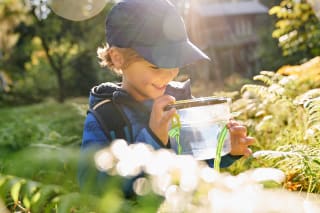
There are countless ways you can design a treasure hunt for your kids. Start by focusing on the route of the hunt. This is mainly about cleverly placing arrows, symbols or other clues. If you like, you can also weave street names or other local spots into your puzzles.
The treasure hunt becomes particularly exciting when some tasks and riddles relate to the immediate surroundings, for example identifying plants or animals (in the woods) or finding out the year a church was built (city rally). Discovering familiar and unfamiliar places makes a hunt so thrilling!
How large should the group be?
From a group size of ten children it’s advisable to split the group into two groups of five to seven children each. Groups that are too large make teamwork harder, so not every child may get involved in solving the puzzles.
If you divide into two or more groups you can also turn the treasure hunt into a little competition. But make sure that every child receives a small reward treasure at the end of the hunt!
Create tasks and set the route
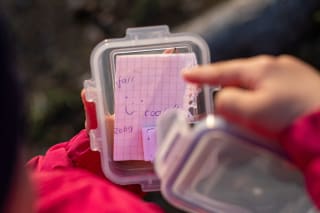
When developing puzzle tasks there is only one rule: they should be imaginative and exciting. Let your creativity run free! An overarching theme like pirates is a great help when designing the treasure hunt.
Besides general knowledge questions on the theme, you can come up with little extras — for a pirate theme, for example, hide a clue in a message in a bottle or inside a small model ship.
You can often incorporate the characteristics of a location wonderfully into the tasks, for example in the woods or at the zoo. There the children can learn about plants or insects in the woods or the zoo animals through the puzzles.
If you want to put the emphasis on an adventurous route, package the stations and directions of your route into riddles and find good hiding places for clues and signposts. Also, working with secret codes is popular with almost all children.
Our tip: Place clues in slightly harder-to-reach spots too, such as in a tree or on a wall. To get to the clue, the children have to work together to find ways to overcome the obstacle – that strengthens their social skills.
Decide duration and number of tasks
For kindergarten children, five stations are usually enough for the treasure hunt. For schoolchildren you can go up to ten stations or more — after all, the treasure hunt should remain a challenge!
Make sure the route is challenging, yet clear and age-appropriate. A total duration of 30–60 minutes is usually ideal, puzzles included.
Goal of the treasure hunt: the treasure
At the end of a successful treasure hunt, of course a treasure awaits the little explorers.
Children can reach the goal in many different ways. You can either lead them from station to station by clues that guide them from station to station to the treasure or the puzzles may form a kind of “solution word”, which points to the spot where the treasure is buried. Working with a treasure map designed to match the theme can be especially exciting. The children quickly feel like real pirates or jungle explorers.
If you want to make the treasure chest yourself, cover a shoebox generously with gold foil for a real pirate’s haul, for example.
And the treasure itself? A tried-and-tested option is, of course, chocolate gold coins. If you want to offer something a bit more special to the little treasure hunters, you can include small party favours. At HABA you’ll find lots of things that bring children joy, from colourful pencils to finger monsters and tattoos!
Scavenger hunt in the forest
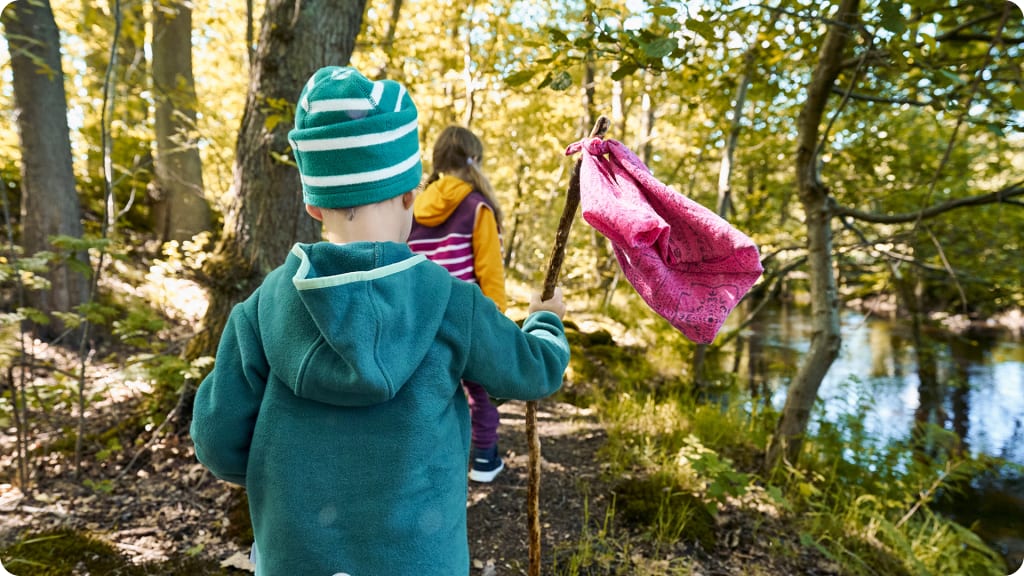
The forest is particularly suitable for a scavenger hunt! Here the children not only have enough space to romp around in the fresh air, the forest also offers numerous opportunities, through fun Waldrallye zum Kindergeburtstag mit kreativen Aufgabento learn about nature and its inhabitants. ausreichend Platz zum Toben an der frischen Luft, er bietet auch zahlreiche Möglichkeiten, etwas über die Natur und ihre Bewohner zu lernen – zum Beispiel durch lustige Waldspiele.
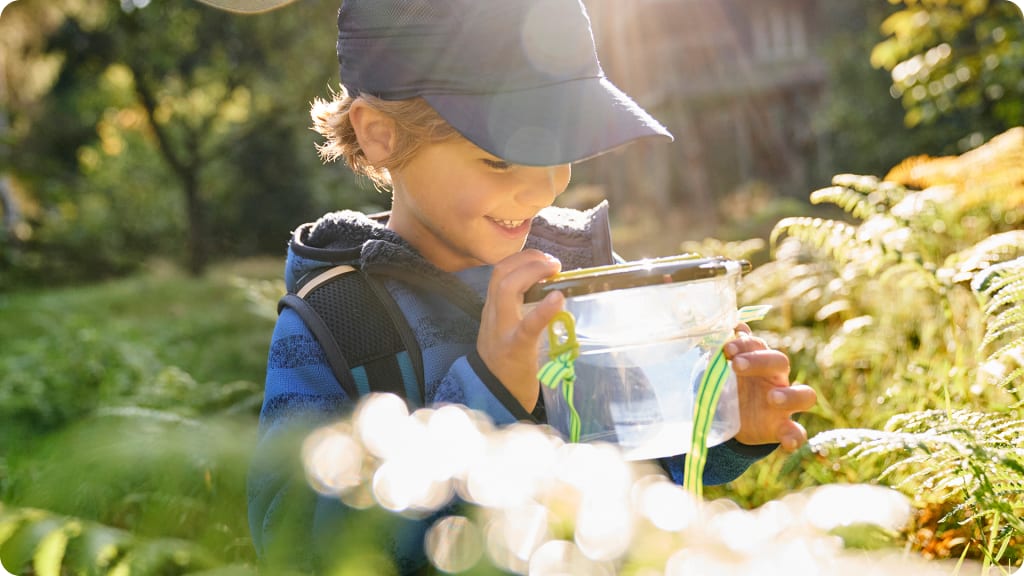
In a playful way, children discover the plant and animal kingdom on a scavenger hunt in the forest and feel like real nature researchers. Of course, a very special "researcher's kit" must not be missing, such as erschließen Kinder bei einer Waldschatzsuche das Pflanzen- und Tierreichor ganz besondere „Forscher:innen-Ausrüstung“ . The forest also offers an incomparably mysterious, fairy-tale atmosphere with numerous possibilities to hide clues, in the branches, in small niches or tree hollows.Becherlupen oder Pflanzen- oder Insektenbestimmungskarten. Der Wald bietet zudem eine unvergleichbar geheimnisvolle, märchenhafte Atmosphäre mit zahlreichen Möglichkeiten zum Verstecken von Hinweisen, im Geäst, in kleinen Nischen oder Baumhöhlen. Das macht die Schatzsuche im Wald zu etwas ganz Besonderem! Ihr sucht nach konkreten Aufgaben für eine Schnitzeljagd im Wald? Dann lest weiter:
A chaperone
Ideas for tasks in the forestverschiedene Bäume. Sucht drei unterschiedliche Blätter und findet heraus, wie die Bäume heißen, zu denen sie gehören.“ (Ihr könnt mit einem Pflanzenbestimmungsbuch arbeiten)
2. „Wie viele Beine hat eigentlich eine Ameise?" Untersucht sie mithilfe einer Becherlupe, um ganz sicher zu sein. Seid dabei ganz vorsichtig und lasst die Ameise danach wieder frei.“
3. „Schaut euch genau um: Ganz in der Nähe findet ihr einen Strauch mit essbaren Früchten. Dort liegt der nächste Hinweis versteckt. Welche Früchte sind es? Vorsicht! Obwohl sie essbar sind, solltet ihr sie nicht anrühren. Wisst ihr, warum?“
4. „Welche Waldtiere kennt ihr?" Schreibt so viele auf wie möglich! Wenn ihr 10 gefunden habt, erhaltet ihr den nächsten Hinweis.“
5. „Seht ihr die Löcher im Baum? Sie stammen von einem ganz besonderen Vogel, der mit seinem Schnabel Insekten aus den Baumstämmen holt. Kennt ihr seinen Namen? Hinweis: Eine Begleitperson sollte darauf achten, dass die Schatzjäger:innen stets in der Nähe von offiziellen Spazier- und Wanderwegen bleiben. Außerdem solltet ihr im Sinne des Natur- und Umweltschutzes im Vorfeld bestimmte Verhaltensregeln mit den Kindern erarbeiten, beispielsweise, keinen Müll zu hinterlassen und Pflanzen und Tiere nicht zu stören.
Scavenger hunt as a city rally
Not everyone has a forest nearby – City ralliescan be just as exciting and varied, after all there is for city kids also here in nature eine Menge zu entdecken! Und eine a lot to discover! Die Spuren der Geschichte lassen sich wunderbar mit den Rätseln verbinden, indem ihr beispielsweise nach historischen Persönlichkeiten fragt, die in einem Denkmal verewigt sind oder einer Straße ihren Namen geben. Für die Recherche können Hinweistafeln (beispielsweise in Kirchen, historischen Gebäuden, an Denkmälern) genutzt oder auch Passant:innen befragt werden („Wissen Sie, wer der Mann auf dem Denkmal ist?“).
It is of course important, especially to provide younger children with accompanying persons. In the city, kids can get lost just as easily as in the forest; in addition, there are the dangers of road trafficdangers of road traffic.. In der Stadt können sich Kinder ebenso leicht verlaufen wie im Wald. Hinzu kommen hier die Gefahren des Straßenverkehrs. Ab neun oder zehn Jahren können Kinder eventuell auch schon alleine auf die Reise gehen, wobei ihr die Strecke besser auf die unmittelbare Nachbarschaft oder die umliegenden Häuserblocks beschränken solltet.
From nine or ten years old, children may perhaps already be able to go on the journey alone, whereby you should better limit the route to the immediate neighborhood or the surrounding blocks.
A city contains an incredible amount of history! The traces of history can be wonderfully linked with the riddles by, for example, asking about historical personalities who are immortalized in a monument or give a street their name. For research, information boards (for example in churches, historic buildings, at monuments) can be used or passersby can be asked (“Do you know who the man on the monument is?”). super mit eine Schatzkarte arbeiten und zum Beispiel folgende Aufgaben stellen:
Also in the city there are hiding places of all kinds for clues and signposts. Here, as in the forest, you can work well with a treasure map.„Wann wurde die Kirche erbaut? Sucht in und um die Kirche herum nach der Antwort.“ (Bei historischen Bauwerken gibt es oft Hinweistafeln, die Informationen über das Bauwerk und seine Geschichte liefern.)
Ideas for tasks in the cityberühmten Komponisten aus Österreich benannt ist. Lauft hier zur Nummer 45–23.“ (Mozartstraße 22)
3. „In welchem Vorgarten wächst ein Pflaumenbaum? Hier findet ihr den nächsten Hinweis am Gartenzaun.“
Scavenger hunt in the houseZeichen einer Echsenart trägt. Welcher ist es? Dort verbirgt sich der nächste Hinweis.“ (Apotheke)
A scavenger hunt can be organized a little more easily in the house or apartment. However, pay attention here that the treasure hunt remains exciting! In a smaller space clues are of course also easier to find, which is why the hiding places may be somewhat more difficult and exotic. Ideally they are so specific that your children can really only find them with the help of the riddles.
In the house, the variant of a scavenger hunt is suitable in which your kids go through various puzzle stations and, in the process, solution words
Es gibt unzählige Möglichkeiten, wie ihr selbst eine Schnitzeljagd für eure Kids gestalten könnt. Wir von HABA unterstützen euch bei der Organisation mit einer Schritt-für-Schritt-Anleitung:
Schritt 1: Motto festlegen & Einladungen rausschicken
Die Planung eurer Schatzsuche zum Kindergeburtstag geht leichter von der Hand, wenn ihr ein Motto festgelegt habt. Wie wäre es zum Beispiel mit einem Pirat:innen- oder Dinosaurier-Motto? Gestaltet und verteilt etwa zwei bis drei Wochen vor dem Kindergergeburtstag die Einladungen. Unser Tipp: Nutzt unsere gratis Vorlagen für Einladungskarten mit Pirat:innen- oder Dino-Motiv!
Schritt 2: Dauer & Aufgabenanzahl bestimmen
Bei Kindern im Kindergartenalter reichen fünf Stationen für die Schnitzeljagd zum Kindergeburtstag vollkommen aus. Bei Schulkindern dürfen es ruhig auch mal zehn Stationen oder mehr sein – schließlich soll die Schnitzeljagd eine Herausforderung bleiben!
Achtet darauf, dass die Streckenführung anspruchsvoll, aber eindeutig und altersgemäß ist. Ein Gesamtzeitaufwand von 30 bis 60 Minuten ist meist ideal, das Lösen der Rätsel mit eingerechnet.
Schritt 3: Die Route planen
Konzentriert euch danach auf die Route der Schatzsuche. Hierbei geht es vor allem darum, Pfeile, Symbole oder andere Hinweisen geschickt anzubringen – ob zu Hause oder im Freien. Wenn ihr mögt, verpackt auch Straßennamen oder andere Plätze in der Nachbarschaft in eure Rätsel.
Tipp: Die Schnitzeljagd für Kinder wird besonders spannend, wenn manche Aufgaben und Rätsel mit der unmittelbaren Umgebung in Verbindung stehen, es beispielsweise um die Bestimmung von Pflanzen oder Tieren (im Wald) oder das Erbauungsdatum einer Kirche (Stadt-Ralley) geht. Die Entdeckung bekannter und unbekannter Orte macht eure Schatzsuche richtig aufregend!
Schritt 4: Aufgaben erstellen & Streckenführung festlegen
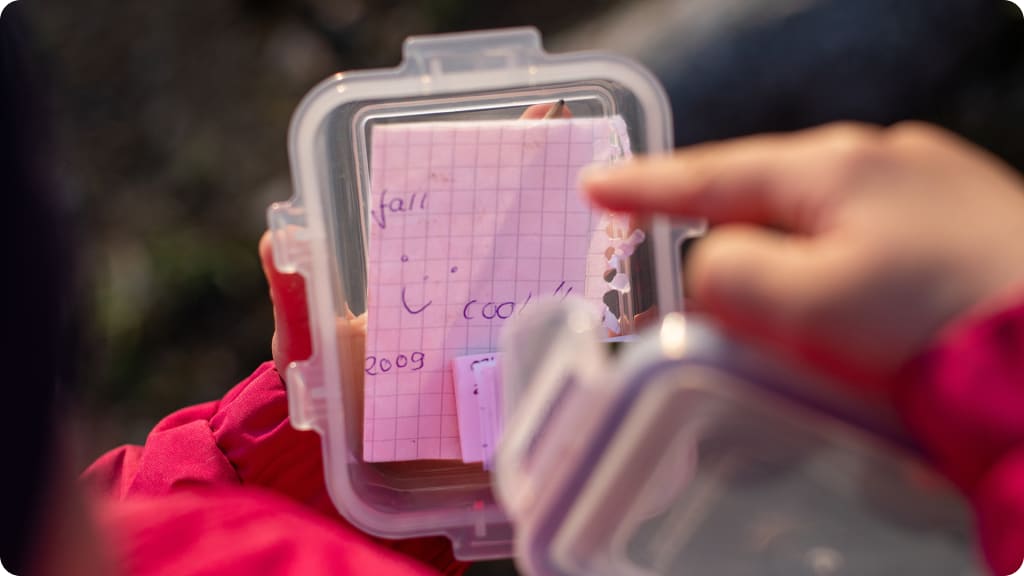
Bei der Entwicklung der Rätselaufgaben gibt es nur eine Regel: Fantasiereich und spannend sollten sie sein. Also lasst eurer Kreativität freien Lauf! Neben allgemeinen Wissensfragen zum Motto könnt ihr euch kleine Besonderheiten einfallen lassen. Beim Motto „Pirat:in“ könnt ihr beispielsweise einen Hinweis in einer Flaschenpost verstecken oder in einem kleinen Modellschiff.
Oft lassen sich auch die Charakteristika eines Ortes wunderbar in die Aufgaben mit einbinden, beispielsweise im Wald oder im Zoo. Dort können die Kinder anhand der Rätsel spielerisch etwas über die Pflanzen oder Insekten im Wald oder die Zootiere lernen.
Wenn ihr den Schwerpunkt auf eine abenteuerliche Streckenführung legen wollt, verpackt die Stationen und Wegrichtungen eurer Route in Rätsel und findet gute Verstecke für Hinweise und Wegweiser. Außerdem kommen Geheimschriften bei vielen Kindern gut an.
Unser Tipp: Bringt Hinweise auch an etwas schwieriger erreichbaren Stellen an, wie in einem Baum oder auf einer Mauer. Um an den Tipp zu gelangen, müssen die Kinder gemeinsam nach Möglichkeiten suchen, wie sie das Hindernis bewältigen – das stärkt ihre soziale Kompetenz.
Step 5: Fill the treasure chest
At the end of a successful scavenger hunt awaits, of course, a treasure for the little explorers! The children can reach the goal in many different ways. Either you guide them from station to station with clues to the treasure or the puzzles form a kind of 'solution word', which points to the place where the treasure is hidden. Working with a work with a treasure map be, which is designed to match the theme is. Here, the children quickly feel like real pirates or jungle explorers. If you make the treasure chest yourself, for a real treasure, for example, cover a shoebox with plenty of gold foil.
And what can you put into the treasure chest as treasure? A tried-and-true option here is of course chocolate gold coins, with which the treasure seekers can treat themselves after the successful tour. If you want to offer the little treasure hunters something extra, you can small gifts hide in the treasure chest. In our Terra Kids range there are, for example, stickers or stamps, with which the children can directly leave their mark on the treasure map can. This way they also hold the perfect equipment for the next treasure hunt for a child's birthday party or another occasion in their hands!
Step 6: Celebrate the scavenger hunt in style
What do you do after your scavenger hunt with the kids? How about a a campfire to round off the special day together? At HABA you'll find great ideas for your campfire with kids – and with our Terra Kids Adventure Fire Steel, grill skewer and kids' pocket knife you are perfectly equipped for it.
Organize a Photo Treasure Hunt with Find the Code
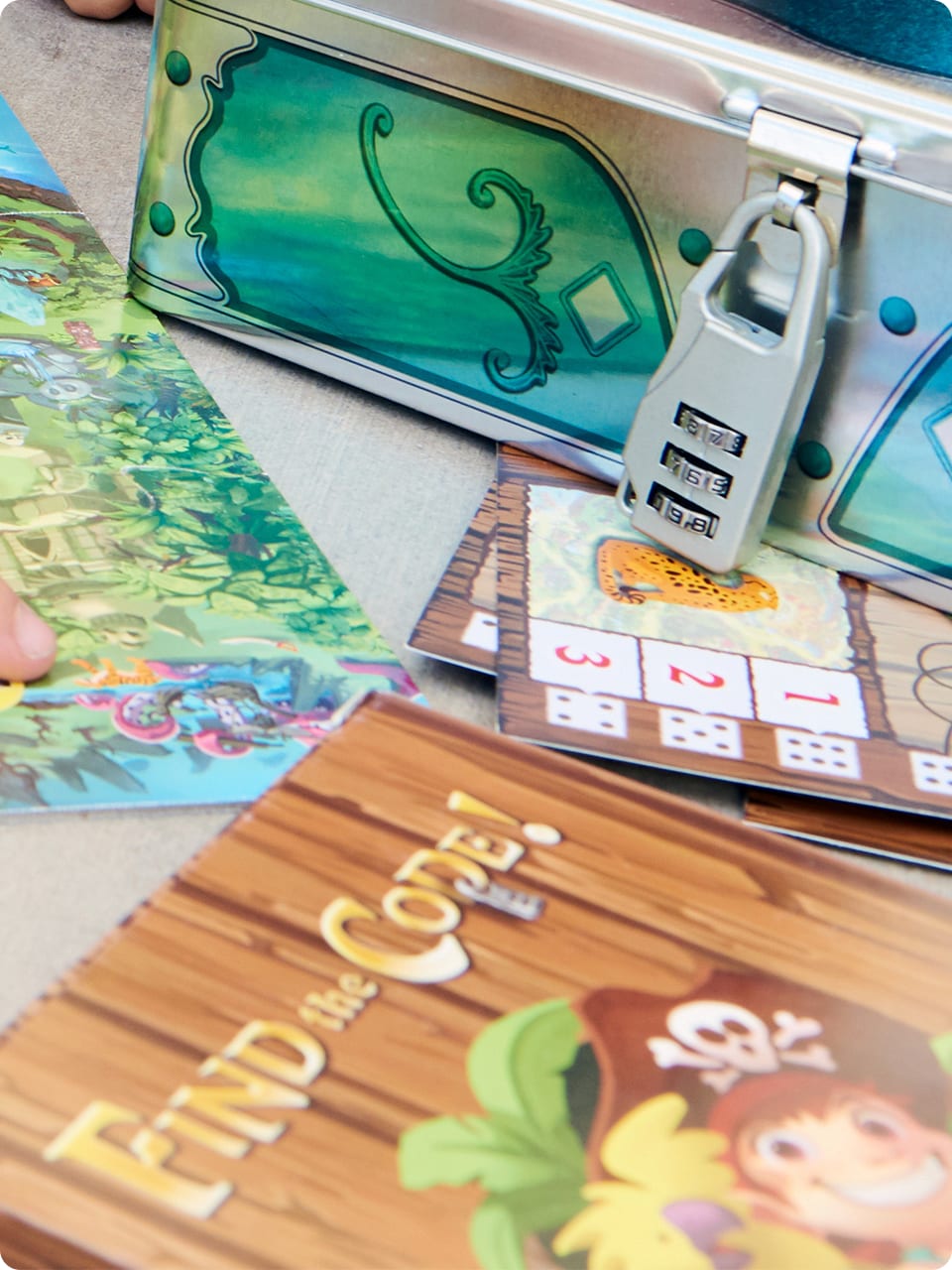
The photo treasure hunt is a popular scavenger hunt variant for children. For this you prepare photos of places that will be found and explored by your adventurers. For the photo treasure hunt you need:
a camera or a phone with a camera,
a printer
as well as as many envelopes or small bags,as you have scavenger hunt stations.
If you have little pirate fans at home, you can combine your photo treasure hunt with our ready-made Find the Code treasure hunt! connect. It contains pre-made puzzles in 3 different difficulty levels and a individually fillable treasure chest for your little explorers.
How to organize a Find the Code! photo treasure hunt in 8 steps:
1. Decide on an area for the treasure hunt – e.g., in the house, in the garden, on the playground.
2. Photograph 9 places or objects in the chosen area and print them out as photos.
3. Think about, in which order the adventurers should find the places.
4. The photo of the first location you place together with the selected puzzle card and the game figure into the puzzle box of 'Find the Code'.
5. Put the remaining photos each together with a puzzle piece into an envelope. Attention: In the ninth envelope there is only one puzzle piece and no photo!
6. At each location you hide the envelope with the photo of the next location. Example: In the puzzle box, next to the puzzle card and the game figure, there is a photo of the doormat. Under the doormat lies an envelope with the first puzzle piece and a photo of the shoe cabinet. In the shoe cabinet there is an envelope with the second puzzle piece and a photo of the bathtub, …
7. Read to the children the exciting story to set the mood from the instructions aloud, or come up with a new story. Then hand the children the closed treasure chest and the puzzle box.
8. Start the photo treasure hunt with these words: “First set out to search for the place that is shown in the photo in the puzzle box. You will find another photo there as well as one of the puzzle pieces. Follow that photo too. This way you will gradually find all 9 puzzle pieces.”