How does my child learn media literacy?

Hardly any buzzword is mentioned as often in discussions about parenting and education issues as media literacy. In an increasingly media-rich everyday life, children should learn to use media offerings independently, critically and responsibly. But how do you develop media literacy in children? And how do I avoid the daily arguments about phone, TV, and Internet use?
What is media literacy?
The term media literacy emerged in the 1990s. That's not surprising, given that around that time mobile phones and the Internet began their triumphant advance. Media literacy does not exclusively refer to digital media. The term more generally denotes the ability to to use media appropriately and competently. This includes books, newspapers, and radio, and at least in this respect media literacy has been taught in schools for generations.
The Internet as a new focus of media literacy
The Internet poses new challenges for parents and educators: How should children use a medium competently, which is constantly available, practically infinite and almost uncontrollable? Clear agreements and openness play an important role here – read more here about how to teach children media literacy.
The fascination of television: How to avoid arguments about TV time

Who hasn't once turned off the TV abruptly and sent the sulking child to bed? Or endured the tantrum that inevitably follows the interruption of the favourite show?Television fascinates children and is the trigger for countless discussions in everyday family life.
From what age is TV OK for children?Since the Internet and television are now consumed almost equally, there are hardly any recommendations left for the appropriate age to watch TV. Experts advise that children should begin using screens no earlier than at two years old. Most toddler programs on TV are comprehensible to children from about age three.
How long should children be allowed to watch TV? These recommendations are also only rough guidelines in the age of the Internet. In general, preschool children should spend a maximum of half an hour per day in front of a screen. Elementary school children from around eight years old about 45 minutes, and children from ten years about an hour a day. For detailed information on how long children should watch TV, read here.
TV rules help prevent arguments: If there are fixed rules for TV consumption, the potential for conflict in the family is much lower. In addition to the duration of TV viewing, certain TV times can also be included, for example if a family member wants to watch their favourite show without there being arguments about the program.
Generation Smartphone – Children and mobile phones
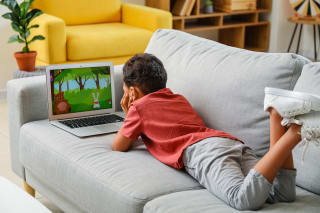
Children growing up today have smartphones all around them: Parents, educators, and older siblings use their phones constantly, and so many children can operate a touchscreen before they say their first word. Although there's still a long way to go until their first own mobile phone, the discussion about the mobile phone begins earlier and earlier in many families. And not infrequently, parents are torn between 'Is that really necessary?' and 'Isn't it safer if my child has a phone with them?'
5 tips for the first mobile phone
Earliest in primary school: Many third- and fourth-graders already have a phone, but it is not yet really necessary.
Smartphone from around age 12: From this age, children can use a smartphone responsibly. A smartphone is also becoming increasingly important for children's social relationships.
Start with a used one: Give your child your old smartphone; it saves money and you know all the important functions.
Activate safety settings: Almost all operating systems offer parental control settings. Activate these and, if necessary, install child-friendly search engines, etc.
Show interest: Try to stay up to date even if you yourselves have little interest in smartphone trends. That way you can more easily keep track of how your child uses the smartphone.
Tablets – support or overload?
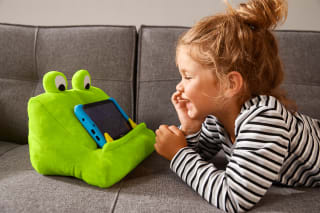
Tablets seem to many parents to be an ideal interactive toy for children:
Even very young children engage with them with fascination and display remarkable dexterity. The manageability of tablets, intuitive operation via touchscreen or speech recognition and not least the steadily growing range of children's films, music, and interactive learning games are equally tempting for children and parents: after all, parents often use the tablet as a temporary 'babysitter' when they want to make a phone call in peace or quickly take a shower.
A tablet of their own?
Many elementary school children use a tablet at home for homework or entertainment. A tablet of their own is not necessarily required at this age and would increasingly make it difficult for parents to monitor usage.
Tablets are everyday items in many families:
Children's curiosity about tablets is therefore unsurprising. On the one hand they see them daily with parents or siblings; on the other hand children are fascinated by anything that can produce sounds, music, and images. With a tablet they can even actively control this content. That quickly makes tablets a favourite toy.
Don't leave children alone with the tablet:
Neither tablet nor smartphone is suitable as a 'babysitter'. There is nothing wrong with letting a child play with the tablet for a while if they show interest in it. Adults should, however, guide them in operating it and selecting content and in this way set a good example for sensible usage patterns and times. Read more here about whether tablets are suitable for toddlers.
Tips for media education for children

Be a good role model:
Use media yourself in a reflective and critical way so that your child can learn from you.
Talk about media:
Talk with your child not just about how to operate media devices and media content, but also explain the dangers that exist, for example, on the Internet.
Clear rules:
Set firm rules about which media may be used when and for how long - if necessary with a written family agreement.
Be prepared for resistance:
You will have to live with occasional arguments and frustration, as with other parenting processes.
Media do not replace family time:
It is tempting to allow children more TV and Internet when you have little time for them. Try to find other activities for your child so that media do not become a substitute for family time.
Media education – for the most part at home

Children learn how to deal with media for the most part from their parents and siblings. Internet, computer games, films and music are all around them and are perceived not as 'media' but as a natural part of everyday life. That is why it is so important that parents and other caregivers also use media consciously and sensibly: parents who are occupied with their phone at dinner or who constantly leave the TV running in the background can hardly expect their children to voluntarily limit their to voluntarily restrict their media consumption.
FAQ on media education for your children
How can I recognize a media addiction?
When is it okay for children to watch TV?
How long are children allowed to watch TV?
Discover more articles on parenting & psychology










Image credits
Boy and girl are lying on the couch and playing on the laptop. © LIGHTFIELD STUDIOS - stock.adobe.com
Boy is lying on the floor and playing with a mobile phone © Alena Ozerova - stock.adobe.com
Boy is lying on the couch and watching a movie on the laptop © Pixel-Shot - stock.adobe.com
Mom is sitting on the couch with the laptop and children are playing around on it © opolja - stock.adobe.com
Father and daughter are sitting at the laptop © JenkoAtaman - stock.adobe.com