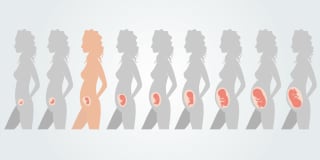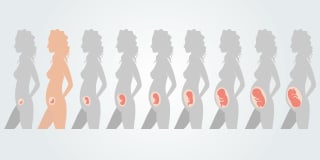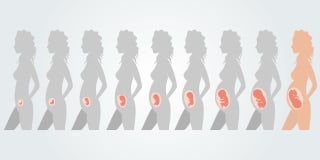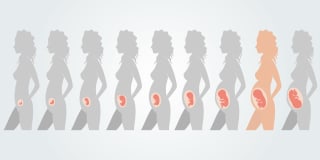









Pregnancy progression at a glance:
1st - 5th week of pregnancy
Because only from the second week of a cycle can an egg be fertilized. With the missed period in the fifth week of pregnancy, the pregnancy becomes physically noticeable for the first time.
6th week of pregnancy – your baby's heart is already beating
Many women have not yet noticed the pregnancy at this point, but in the uterus the embryo's organs are already beginning to form. The foundations for the eyes and even the beginnings of arms and legs are visible – and the tiny heart has already begun to beat. Some women now feel a pulling in the lower abdomen. This is because the uterus grows to almost double its size in a short time to make room for the embryo.
7th week of pregnancy - First pregnancy symptoms appear
Not all women suffer from typical pregnancy symptoms such as nausea or food cravings. If they do, these often appear from the 7th week of pregnancy. Regardless, the embryo is growing at a rapid pace – so far the large head is most noticeable. In addition to the maternity record, in which the course of the pregnancy is documented, a comprehensive blood test is usually carried out now.
8th week of pregnancy – your body is in high-performance mode
The embryo in your belly is only about 15 mm long, but its human features are already clearly recognizable, even though the head still appears much too large in proportion to the body. Already in the 8th week of pregnancy the spine and internal organs are developing. About two liters more blood are already flowing in the mother's circulation; heart and kidneys are in high-performance mode – this makes many expectant mothers very tired at first.
9th week of pregnancy – the first ultrasound images
From the 9th week onwards the first of the three ultrasound examinations in the course of the pregnancy is due. Many parents can hardly wait to see their baby for the first time. Almost more important, however, is the examination in which the doctor checks precisely whether the embryo is developing healthily. The typical pregnancy symptoms are now fully developed – fortunately an end is in sight.
10th week of pregnancy - Embryo becomes fetus
From the 10th week the embryo is referred to as a fetus. The child growing in your belly now measures about 3.5 cm and all organs are developed. Hands and feet are already visible on the ultrasound. The doctor will now look very closely to detect possible malformations or hereditary diseases as early as possible.
11th week of pregnancy – your baby's skeleton begins to form
In the 11th week of pregnancy the fetus's cartilage slowly turns into solid bone, its muscles develop and the central nervous system becomes increasingly differentiated. With a bit of luck, the constant fatigue and discomfort of the first months will slowly ease – soon the first trimester is over.
12th week of pregnancy – the magical milestone
With the 12th week of pregnancy the likelihood of a miscarriage drops significantly. At the latest now the baby news is announced. The baby now weighs about 10 grams and already shows first facial expressions and gestures; its sense of balance is also developing. Most women can breathe a sigh of relief now – complaints such as nausea and tiredness noticeably decrease.
13th week of pregnancy - On to the second trimester
From week 13 onwards it usually becomes a bit calmer for baby and mother: all physical structures are present, and the fetus grows and thrives. The final body proportions gradually take shape, while gestures and facial expressions continue to develop. Many women also notice around the 13th week of pregnancy that their belly is slowly starting to round out.
14th week of pregnancy - The belly slowly becomes rounder
From the 14th week of pregnancy the pregnancy also becomes slowly visible from the outside. The baby is now about 7 cm long and is covered with fine down over its entire body. It can already suck and swallow and repeatedly performs these vital reflexes in the womb. Many women continue to experience mood swings or frequent tiredness, yet the fourth month of pregnancy is overall a very restful time for most.
15th week of pregnancy – boy or girl?
In the 15th week of pregnancy the baby's neck is fully developed, it can turn its head and perceive sounds and tactile stimuli from the outside. The baby's internal organs also continue to develop in size and function. On the ultrasound the baby's sex is now clearly visible – and many women not only buy baby clothes but also their first maternity outfits.
16th week of pregnancy – was that already a fetal movement?
By the end of the fourth month of pregnancy the fetus is about 10 cm long and up to 100 g in weight. Body proportions are largely correct and the metabolic system including the urinary system is fully developed. Especially women who have already had a child may sometimes feel tentative fetal movements as early as the 16th week of pregnancy.
17th week of pregnancy - Routine slowly sets in
From the fifth month of pregnancy the main task for the baby is to grow and gain weight. It develops a layer of fat and its movements become stronger and more coordinated – the woman may now already feel a slight "fluttering" in the lower abdomen. It is particularly impressive when expectant parents hear their baby's heartbeat for the first time during the examination in the 17th week of pregnancy.
18th week of pregnancy - the baby practices breathing in and out
The baby still has plenty of space in the amniotic sac and uses it to train its muscles and coordination. Growth slows down slightly, but the central nervous system develops and it practices breathing movements in the amniotic fluid. The expectant mother is not yet particularly physically impaired, but her belly continues to grow steadily.
19th week of pregnancy - time for the second ultrasound examination
At the end of the fifth or the beginning of the sixth month the second of the three ultrasound appointments in the pregnancy is due. Compared to the first ultrasound image, the baby's face and limbs are now clearly visible and, if it has not already happened, expectant parents will by now see for the first time whether their baby is a boy or a girl.
20th week of pregnancy - finally halfway
By the 20th week the first half of the pregnancy is over and by now mother and baby have already become acquainted: the kicks against the abdominal wall are getting stronger. The fetus now has the full number of nerve cells and is very active. Due to the upward shift of the uterus many pregnant women now experience heartburn and more frequent urination.
21st week of pregnancy – sensory perception develops
With the second half of pregnancy the so-called concretization phase of the fetus begins. Your baby's face and facial expressions continue to differentiate, as do the senses. The mother's belly and breasts grow noticeably – the pregnancy can no longer be hidden.
22nd week of pregnancy – in full motion
In the 22nd week of pregnancy your baby already has its final proportions but is still very thin. Now muscle and fat layers begin to develop. This increases the mother's magnesium needs, so additional magnesium supplements are often prescribed.
23rd week of pregnancy - your baby is training muscles and reflexes
In the 23rd week of pregnancy the fetus is theoretically already viable – with the help of modern medicine, preemies born this week have good chances. In the womb your baby continues to gain weight and moves increasingly coordinated. The lungs are also developing.
24th week of pregnancy – end of the second trimester
By the end of the sixth month the first practice contractions may already be noticeable – this is usually not a cause for concern. In the 24th week of pregnancy the baby increasingly responds to familiar voices and learns them. Its sense of taste also becomes more refined – your baby practices it by swallowing amniotic fluid.
25th week of pregnancy - the belly grows relentlessly
When the seventh month of pregnancy begins, it slowly becomes uncomfortable for most women: the fetus continues to gain muscle and fat and constantly practices its movements and reflexes. Its lungs also continue to develop. With the growing belly many women now experience back pain.
26th week of pregnancy - your baby opens its eyes
In the 26th week of pregnancy the baby opens its eyes in the womb for the first time. Its nostrils also open and your child practices breathing by inhaling and exhaling amniotic fluid. It is now becoming increasingly receptive to sounds and touches from outside: many women 'answer' kicks and nudges by contacting the baby through touching the belly.
27th week of pregnancy – the senses continue to develop
With the end of the 7th month of pregnancy the birth draws nearer and with it all the organizational questions – e.g., whether the baby should be born in hospital, at home or in a birthing center. The baby remains very active and its sensory perception is increasingly developing.
28th week of pregnancy – from now on check-ups take place every two weeks
In the 28th week of pregnancy the pregnancy enters the home stretch. Many women now start a childbirth preparation course, and from now on prenatal check-ups are every two weeks. Meanwhile the baby's immune system begins to work independently and the lungs and bronchial system also develop – prerequisites for independent breathing.
29th week of pregnancy – your baby is 'complete'
The eighth month of pregnancy begins and your baby's organs are largely developed. From now on your baby will gain about 250 g per week. The head also grows again from the 29th week: it is slowly getting tight in the mother's belly. For the woman this shows as shortness of breath, frequent need to urinate, and back or joint pain.
30th week of pregnancy - your baby's skin smooths out
In the last two months of pregnancy growth and preparation for birth take center stage: your baby develops a layer of fat that plumps up the skin and makes it smoother. From week 30 it also slowly adopts the typical fetal position in which the arms are folded in front of the body.
31st week of pregnancy – activity decreases
Not only does the expectant mother take things noticeably more slowly in the 31st week, the baby also restricts its movements – inevitably, because there is now little space left in the uterus. However, its lungs are fully developed and the surface protein surfactant, which prevents the collapsing of the air sacs, is increasingly produced.
32nd week of pregnancy - your baby may already be in starting position
By the end of the eighth month many babies already turn into birth position and lie head down; the mother often feels this as kicks into the diaphragm. The baby continues to gain weight and develop its protective layer of fat, while the woman should now be building up energy for the birth.
33rd week of pregnancy - skeleton and skull continue to harden
In the 33rd week of pregnancy the baby's skeleton is mostly developed, but the skull bones remain loosely connected until after birth. The ninth month of pregnancy begins – it is quite possible that your baby has already lowered its head into the pelvis to be in the correct position for birth.
34th week of pregnancy – the last working week for expectant moms
Sitting or standing at work every day may already have become quite exhausting: after the 34th week of pregnancy maternity leave begins and the woman can calmly prepare for birth. Babies born as early as the 34th week usually have no problems – the lungs and the insulating layer of fat are now largely developed.
35th week of pregnancy – time to fill energy reserves
In the final weeks before birth the most important thing for mother and child is to build up extra energy reserves. The baby continues to grow and is now viable outside the womb without medical assistance. For the mother the final preparations now begin: the baby's room, the hospital bag and paperwork.
36th week of pregnancy - already lightening contractions?
The pregnancy is in the final phase and prenatal check-ups with the doctor now take place weekly. Many women feel lightening contractions in the 36th week, during which the baby's head drops into the pelvis, as well as practice contractions. Overall it becomes quieter in the belly – the baby has hardly any room left to kick.
37th week of pregnancy – the tenth and final month
Technically a pregnancy lasts ten rather than nine months – and the tenth month has now begun. The protective vernix and the soft downy hair over the baby's body disappear, while the hair on the head grows. Many parents can hardly wait now – the baby itself spends these last weeks mainly sleeping.
38th week of pregnancy – the 3000 g mark has been reached
In the 38th week of pregnancy your baby weighs around 3000 grams and is ready for birth in every respect. A planned cesarean section is usually performed now, but many normal births also begin up to two weeks before the due date. Many women now become increasingly restless, sleep poorly and have vivid dreams.
39th week of pregnancy – the great waiting
At the end of the tenth month the mother and baby are primarily waiting for the birth, yet the baby continues to grow steadily and still gains about 250 g per week. The amniotic fluid is now decreasing, while the baby releases increased hormones in preparation for birth.
40th week of pregnancy: due date – or continue waiting?
Even though many expectant mothers eagerly await the calculated due date, the baby in the vast majority of cases is born before or after the due date. The woman should sleep a lot now to conserve energy for the birth – most women in the 40th week are reluctant to go far from home anyway.
41st and 42nd week of pregnancy. When the baby keeps you waiting
Relatively many babies are not born until one or two weeks after the due date. This is burdensome for the mother because the large belly and impatience torment her. As long as the baby is healthy and there is sufficient amniotic fluid, a 'post-term' pregnancy does not usually cause problems. At the end of the 42nd week the birth is generally induced by a doctor.