




Family account or separate accounts – what works for us?

Who pays what? Managing the household is a central issue in family finances. About four out of five married couples have a joint household account; among unmarried couples it is just under half. But even couples with separate accounts usually agree on at least a fair distribution of the monthly fixed costs. The rest is a matter of trust and willingness to talk: every family must determine individually which type of household management works for them. This also includes addressing concerns or dissatisfaction and, if necessary, looking for alternatives.
What options are there for managing accounts?
Family account:
The salary / salaries are deposited into a joint account from which all incurred costs are paid. Any money left over can, depending on the agreement, be spent by either partner or, for example, deposited as a reserve into a savings account.
Separate accounts:
Both parents have separate accounts into which their salary or a monthly household allowance is deposited. Depending on the level of income, monthly fixed costs, living expenses and extras are paid from these roughly in equal shares by the partners.
Separate accounts plus family account:
For many two-income families this option is the most convenient: both parents pay a portion of their salary into the family account, from which all fixed costs and living expenses are paid. The money remaining in the separate accounts can be used for personal items, gifts or extras.
Cost distribution should be clearly defined
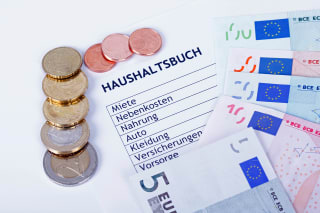
Regardless of whether there is a family account, separate accounts, or both, it should be clearly defined which fixed costs are paid from which account. This works best with standing orders, but specific monthly fixed amounts can also be set for groceries, clothing or entertainment.
Clearly defined: How household management works without disputes
Fixed pocket money amounts:
The amount of pocket money should not vary with the child's behavior. A fixed, age-appropriate weekly amount is best suited for learning how to handle money. It also spares you endless discussions about the amount. In our article about appropriate pocket money amounts you can find out how much pocket money your child should receive.
Use a household budget:
At first it takes some work to create a household budget or ledger, but it's worth it. If you have all the month's income and expenses at a glance, financial decisions become much easier and there is less arguing about money. You can download a household budget to print here or use a ledger or software.
What does a child cost?

At first many parents resist even thinking about this question. Who would want to associate their child with a rational cost calculation? But it cannot be denied: children cost a lot of money, and from birth onwards.
The Federal Statistical Office surveyed and evaluated the current consumption data from parents. According to this analysis, a child costs its parents from birth to the age of 18 on average 130,000 euros.
Toys, food, clothing – and what else? Small children don't need much, do they? That's what many people without children say. And indeed, children from birth to primary school age cost less than older children – but still around 6,200 euros per year.
This also includes the costs for initial equipment and children's furniture as well as childcare costs. Not included is the loss of earnings that parents probably have in the first years: the actual loss is therefore even greater.
Children between 6 and 12 years cost about 7,200 euros per year, and between 12 and 18 years costs add up to 8,200 euros. Not to forget the years after that: many children today continue to live and eat with their parents for free after the age of 18.
Education, insurance and additional costs also add up. Those who have children know that food, clothing and toys alone are not enough: hobbies cost money, as do liability, travel or supplementary dental insurance. In addition, many parents contribute to their children's education costs, pay for tutoring and not least cover the costs for electricity, water and heating.
Overall, therefore, quite a bit more is likely to add up than 130,000 euros – all the better, then, that a cost-benefit calculation simply doesn't work for children.
Should I pay my child for help around the house?
Money must be earned and good work deserves a reward. Of course parents want their children to learn to value money. But is it okay to pay them for helping with household chores? Shouldn't that actually be a matter of course?
Educators recommend not to pay extra for everyday tasks like setting the table or unloading the dishwasher, but to regard them as a normal contribution to family life. However, if your child asks for an advance on pocket money or is saving for a particular item, you can offer them the chance to earn a little extra by doing additional jobs such as mowing the lawn or washing the car.
Providing for the family – what do I need to consider?
A family means a lot of responsibility, both day-to-day and in the long term. You may occasionally wonder what else is in store for you and how you can protect yourself and your family. Nobody likes to think about the worst-case scenario, but it makes sense to have made provisions.
Family protection:
A family liability insurance is absolutely indispensable. In addition, you should consider an occupational disability insurance for one or both parents, as payments from the statutory pension insurance usually do not cover the need. The same applies to a term life insurance that secures survivors in the event of an emergency.
Education fund:
Up to the age of 18 a child costs its parents around 130,000 euros. But that's not all, because often parents finance at least part of their children's education. Be it the costs for a degree or rent and living expenses during the years of training. So it all adds up. Many parents therefore start early to set money aside for their children's education. Whether with an investment fund or classically with a savings account depends mainly on how flexibly you want to contribute.
Retirement provision:
The statutory pension will hardly be enough for many of today's parents to live on. Therefore an individual private pension solution is highly recommended, and not only for working parents: in particular mothers who stayed at home for many years to raise their children are often at risk of old-age poverty despite the 'mother's pension'. You can get non-binding advice on possible retirement provision models, for example, from your bank, from an insurance broker or partly also through your employer. Here you can read more about the risk of old-age poverty for mothers.
Further financial provision for the child:
The driver's license, the first car or an apartment of their own — at some point your child should be able to afford the things they want. Often a savings account for the child is opened at birth or a building savings contract is taken out. But long-term investment contracts are also an option. It is important that you consider in advance when your child should have access to the savings and whether you want to specify the use (e.g. for the driving license).
Tips for handling money in the family
Create a financial structure:
A household budget or ledger helps to keep track of finances and can reveal saving opportunities. With the monthly numbers in front of you, it is also easier to save specifically for something, such as a holiday.
Set basic rules:
Partners should make themselves aware of their approach to money. If one parent spends money impulsively and the other is very frugal, arguments can arise quickly. Better: discuss expenditures and, if necessary, set an upper limit.
Give pocket money:
Children should receive a small amount of pocket money early so they learn to handle money.
Learning to appreciate work:
Children should learn that you have to do something to earn money. Therefore it makes sense that, from a certain age, they can do small extra tasks (in addition to the usual household duties) for pay, for example.
Don't forget coverage:
In addition to the usual insurances, you should also inform yourself about suitable retirement provision models. This applies especially to parents who are at home or work part-time.
Openness and honesty:
Your child doesn't need to know exactly down to the euro what you earn. But you should always be honest about money matters and be able to tell your child when there is no money for something.
Read more articles on this topic







Image credits
Throwing coins into a piggy bank © JenkoAtaman - stock.adobe.com
Checking off rows in a table © Andrey Popov - stock.adobe.com
Ideas for household budgeting and money © Klaus Eppele - stock.adobe.com
Baby in front of a piggy bank © Tierney - stock.adobe.com