What to know about baby laughter
When do babies learn to laugh?
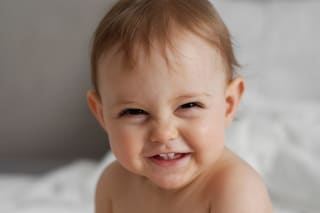
Even in the womb babies turn the corners of their mouths upward – smiling is therefore innate. Even blind children, who have never seen a smile, use this facial expression to express joy or recognition. Already shortly after birth you can look forward to these special moments, even if at first it is not a conscious movement but a reflex: the so-called angel smile. It often occurs unconsciously in babies during sleep.
At five to eight weeks your baby mainly smiles when it recognizes your face and can distinguish it from others. Your baby, of course, knows you, the parents, especially well. At the age of four to five months a real laugh and giggling occurs. Your baby laughs out of joy and from recognizing beloved things and people. In the following months you can elicit a laugh from babies by gently tickling them and making funny gestures – but that does not work with everyone, rather especially with caregivers. Because even now the little ones laugh deliberately and thus show how comfortable they feel. At around one year children begin to be proud of themselves and discover funny things in their environment – this also often leads to a delightful laugh.
Why is laughter important for babies?
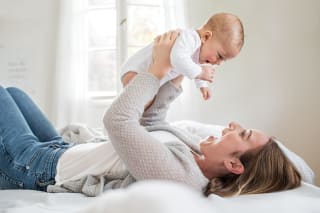
The angel smile, i.e. the unconscious reflex in newborns, appears through gentle touches or during sleep. During this time new neurological connections are formed in your baby's brain – it unconsciously learns small movements. The sweet smile is therefore an important developmental step.
The same applies to the conscious smile after a few months. With a smile on their face babies show that they are comfortable and that they are doing well. They also use it to bind their caregivers to them and to reward the trust you have shown. Happiness hormones are also released in mom and dad as a result. In later Your baby's developmental stages laughter is a sign that it is developing its own sense of humor.
Pure joy: With these tips you'll make your baby laugh
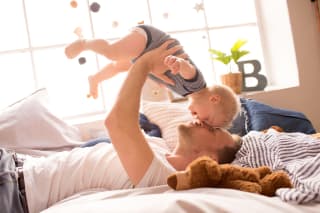
Once you've heard that spontaneous, gurgling baby laugh, you just can't get enough of it. The best and most effective way to make a baby laugh: Laugh yourself. This has the positive side effect that your own mood improves and sleepless nights and restless days quickly fade into oblivion. With the following tips you're sure to coax one or two smiles out of your baby - give it a try right away!
Tickle sensitive spots: Under the arms, on the feet or on the rolls of baby fat - a classic that always works.
Give kisses: Best with loud kiss noises and on the neck - that's what little ones like most.
Toss into the air: If your baby is already big and strong enough, they will enjoy the brief feeling of free fall.
Almost "let go": The free-fall trick also works the other way around: pretend you're dropping your little one.
Blow raspberries on the belly: The funny sounds and ticklish feeling almost always lead to loud gurgling.
Make funny noises: Lip pops, fart and smacking noises and the like are especially appealing to babies. Babies also love deliberate sneezing.
Change your voice: Little ones love high or low voices, for example when singing or telling stories.
Play peekaboo: Hide behind a blanket and pop up again shouting 'peekaboo'.
Use hand puppets: Funny animals or characters that you move with your hands always provide great entertainment.
Let your fingers take a walk: Sing a children's song and let your index and middle fingers walk over your baby's body.
Clap your hands: Show your baby how great you can clap.
Pull faces: Stick out your tongue, widen your eyes, chatter your teeth - with funny facial expressions you can sometimes coax a sweet baby laugh.
Light rocking: Place your baby on a mattress and sit next to them. Bounce lightly up and down to create a rocking motion; your baby will surely reward you with a smile.
Play chase: As soon as your baby crawls, they love crawling away and being chased by you.
Tickle with your hair: Long hair is an advantage here, because little babies love being tickled with mom's or dad's hair.
Interesting facts about baby laughter
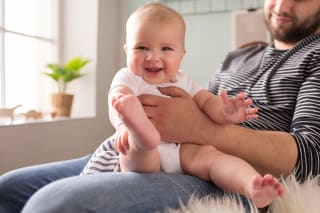
Smiling connects: Science suggests that babies' reflex smile is a nonverbal bonding attempt of newborn infants. By smiling at their caregivers, they express: "Stay with me".
Babies always smile honestly. Only from kindergarten age do children develop a "diplomatic smile" to make contact or handle conflict situations.
Laughter is healthy. It strengthens social cohesion, improves blood circulation, releases endorphins and is an effective workout for the facial muscles. This also applies to the very young
Humans are the only species that can smile and laugh. Although primates also contort their mouths, this is usually more of a threat display. Only human lip and facial muscles are anatomically shaped differently, making a pronounced laugh possible — and that even in the womb.
Laughter relaxes, dispels tiredness and strengthens the immune system. Children laugh about 300 times a day, most adults only manage 15 to 20 times. Simply put: If you make your baby laugh, it also boosts your own mood and health.
Discover more articles on parenting & psychology






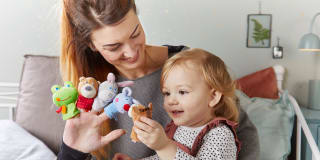

Image credits
Laughing baby sitting on a bed © gpointstudio - stock.adobe.com