What are fine motor skills in children?
Fine motor skills refer to all small movements that a child can perform deliberately and in a coordinated way with the hands, feet and face. These are primarily very fine and precise movements, which require dexterity, concentration and precise control of individual muscles. Examples of fine motor skills include:
Drawing and writing,
making faces
or eating with cutlery.
The Gross motor skills on the other hand include the somewhat larger movements that the child performs with the whole body, such as
balancing,
climbing
or hopping.
Fine motor skills are not present in children from the start, but develop over time. Even the first 24 months of life there are many advances – in each child at their own pace. You as parents can also contribute and the motor development of your baby with playful exercises.
Why are fine motor skills so important for children?
Starting with targeted grasping and holding are a essential foundation for many activities and movements, that children and adults need in daily life. Through fine motor skills your child gains a sense of their own body and learns to perform even the most delicate movements themselves. This also benefits further development.
Well-developed fine motor skills also help, for example, with language development or facial expressions and gestures. It also promotes the independence of your child, so that it can, for example, dress and undress itself or tie its shoes. This boosts self-confidence and provides a more positive self-image.
By the latest in school, an age-appropriate fine motor skills is important when it comes to writing, drawing and crafts is. If the fine motor movements are already trained and encouraged early , the child has no difficulty holding a pen and writing. This makes it feel much more comfortable among peers at school.
Development of fine motor skills by age
As with walking- or learning to speak there is also no timetable for the development of fine motor skills.Every child has their own pace and that's fine. But there are indicators and average ages
, at which most children can perform certain fine motor movements. These can serve as a guide.But don't worry if your child lags a little behind this ‘schedule’ – some children simply need more time than others. If you want to support your child playfully in their fine motor development you should ensure that the games are age-appropriate
so as not to overwhelm your child. Only then will your child enjoy the games.
When should my child be able to do what and how can I encourage it?
NewbornsIn newborns the grasp reflex is not yet present

3 months:
At the age of three months, babies can control their hands a little. Individual fingers are put into the mouth and can be moved individually. A grasping ball is an exciting way to practice grasping.
4 months:
Babies can now intentionally reach for objects. These are explored with the hands but also with the mouth. Eye and hand now work together. In the following months the movements become increasingly purposeful.
6 months:
Babies now use the flat pincer grasp to pick up smaller objects.Teething rings in various shapes and colors not only train targeted grasping, but also help with teething.
9 months:
The index finger can be used independently to point at things.
12 months:
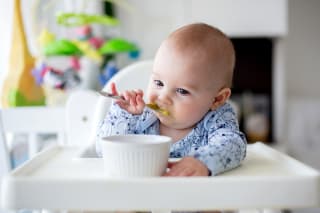
At about one year, small objects can be held and examined with the pincer grip. In the fist grip the baby tries to eat with a spoon
18 months:
Fine motor skills are now developed enough that toddlers can unwrap candies themselves. When playing with mud, the little ones train their finger muscles.
2 years:
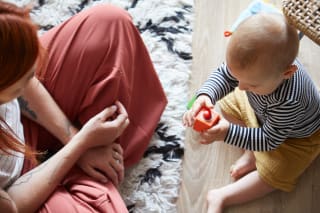
Slowly but surely it becomes clear that the child prefers one hand.With a fishing game you can practice slow and targeted movements
.
3 years:When handling scissors, children learn to use their strength carefully
. When crafting, they can let their imagination run free.:
4 yearsSome children still have difficulty concentrating on several things at once. In the egg-and-spoon race in the garden they have to focus on walking straight and at the same time not letting the egg fall off the spoon – a great game for the children's birthday party
!:
5 years
Most children can now perform various movements with both hands. When painting, they also paint representational objects, as children can better estimate their strength and their spatial imagination has further developed.:
6 years
How to support your child's fine motor skills: Tips & play ideas
In the development of fine motor skills, every child has their own pace of learning, which you cannot influence. Try to to stay calm if your child takes a little longer, to learn something new.
By the way: Boys often lag slightly behind girls in fine motor development. So if the same-age girl in the neighborhood is already a bit further along than your son, that's completely fine.
Grasping: At the mealtimes it's quite easy to encourage the child to reach for objects: With small pieces of finger food, it can choose for itself what to eat next and deliberately reach for it. Putting food on the spoon is another step in motor development. In other situations, toddlers can also be easily encouraged to practice their fine motor skills. A colorful grasping toy placed out of the child's reach encourages the child to reach for it.
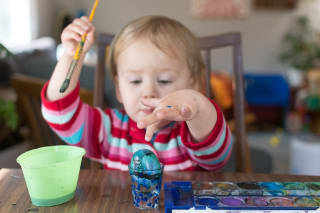
Painting: Free painting, scribbling, or coloring in coloring books promotes fine motor skills and develops the precise and coordinated handling of different writing utensils. A great alternative to classic painting is painting with the feet. This trains the fine motor skills of the toes - and is fun for adults too!
Threading: The child should thread small beads onto a string. The Threading requires patience and dexterity. At the same time, beautiful necklaces or bracelets are created that your child can wear later or proudly give you. Encourage your little one to create their own little work of art, which you can show off as jewelry.
Puzzle: A puzzle promotes the eye-hand coordination and your child's concentration. When a large overall picture comes together at the end, your child will be very proud and satisfied. As a family, you can also tackle a larger puzzle together.
Stacking building blocks: Building blocks are already very popular with toddlers – here the blocks are industriously stacked into structures that may topple over more often at first. With a bit of practice, the child quickly makes progress. The stacking of the building blocks also trains eye-hand coordination and your child develops a sense of the right amount of force to use.
Motor skills toys: With games and stimuli you give your child the opportunity to to try out and train their fine motor skills in a playful way. Make sure the toys are age-appropriate. At HABA you will find motor and learning toys for babies as well as insertion games, that promote creativity and fine motor skills.
Finger games: Finger games are a wonderful combination of movement and rhymes in simple language. They are also easy for small children to understand and encourage enthusiastic participation.
Nature: In the fresh air, fine motor skills can be promoted in particularly varied ways. In nature, children learn, how to grasp objects with their hands, how to use their fingers and how much force they need for different activities.
Discover more articles on parenting & psychology







Image credits
Dad talks to his son and cuddles with him © dusanpetkovic1 - Adobestock
Baby sits in a high chair and eats puree from a bowl with a spoon © Tomsickova - Adobestock
Toddler paints an egg with watercolors for Easter © Julia Beatty - Adobestock