What is everyday life with a baby and a dog like?
When the first baby joins the family, it usually takes some time for all family members to get used to each other. This is especially true for dogs, who until then often received most of the attention. To prevent the change from causing additional stress during the first exciting months, you can support your dog in the new situation.
During pregnancy:
Occasionally make contact with friends who have children to accustom your dog to interacting with children.
Introduce him to the baby items such as the crib, changing table and stroller – and teach him that they are off-limits.
When the baby arrives:
Provide your dog with his familiar retreat such as a basket or blanket – it should also later be off-limits to the baby.
Include your dog in the baby's everyday life from the very start – shared cuddle times, walks with the baby, feeding while you are holding the baby.
Give your dog a few extra cuddles, so he doesn't feel neglected.
Hang in there – how you can support your child during teething
The excitement about the first teeth is great – but it comes at a price. Not all children have problems with teething, but almost all react to the change. Some are more tearful than usual, have no appetite, or wake up more often at night. Others seem listless, run a slight fever, have flushed cheeks, or get diarrhea. No question, teething can be painful and distressing for both children and parents. However, you can try to make this time easier for your baby.
Early childhood support - What's necessary and what's too much?
The optimal support of our children has become a societal mantra that increasingly puts parents under pressure. Many parents wonder whether they should perhaps provide more support to their child.
It may sound unremarkable, but the best support you can give your child is Love and attention. That way you contribute more and more positively to their personality development than any support program could.
However, that does not mean that you should generally forgo early childhood support: It there are many great and worthwhile baby classes and playgroups for toddlers. These activities are even more enjoyable when you don't emphasize the supposed learning effect, but the time spent together and the enjoyment of new experiences.
Playing with other children
When is it time for the baby playgroup?
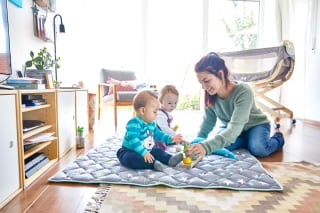
Children need other children. Although not all babies or toddlers show the same interest in other children, regular contact with peers is a good preparation for nursery and kindergarten. Even children who have siblings benefit from occasionally getting out of the familiar family circle and meeting new faces. For parents, playgroups are a welcome opportunity to get out of the house again and make new contacts.
The term 'Krabbelgruppe' is to be understood more as a generic term. Your baby does not have to be able to crawl to take part in such a playgroup. As a rule, such groups are offered from around six months, e.g. run by the city, non-profit organizations, and maternity hospitals. However, many mothers also meet earlier in privately organized groups if they know each other from the neighborhood or from antenatal classes.
Other activities for babies and their parents
In addition to traditional playgroups, there are other groups and courses that may be suitable in the baby's first year, e.g.:
Breastfeeding groups
PEKiP courses
Baby massage courses
Baby swimming
Baby music courses
Constantly tired?
Tips for small rest breaks in everyday life with a baby
Shared midday nap: In the first months your baby sleeps a lot during the day – take the opportunity to get some rest yourself.
Movement: Not a rest break in the strict sense, but getting active in the fresh air gives you new energy to get through the day.
Eat in peace: A balanced meal quickly replenishes your energy reserves. But only if there is enough time and leisure to eat. A fruit salad or a vegetable soup can be prepared easily – and when the baby is asleep, you can consciously enjoy them without distraction.
Sleep in occasionally: Treat yourselves to a mini break now and then: Mom or Dad can occasionally stay away overnight and really sleep in, while the other parent stays at home with the baby.
Well connected
To get through everyday life with a baby and toddler, you sometimes need a little support. This applies, on the one hand, to the banalities of daily life like shopping or picking up from daycare.
Even more important, however, is to be able to exchange ideas now and then and to occasionally get support when you're unsure. A well functioning network of family, friends, and/or other mothers is worth its weight in gold. Often baby classes, the postnatal course, or the first playgroup bring new contacts with like-minded mothers.
Flashpoints - Fundamental disputes in parenting
An African proverb says that it takes a whole village to raise a child. Sometimes it is already more than enough when family members and acquaintances contribute to raising the child. The "classics" of childrearing regularly spark discussions, especially between younger and older generations.
You can't prevent advice and sharp remarks on these topics. But you can save a lot of energy by staying calm and not engaging in discussions. Trust in your abilities as a mother or father — your child also benefits from this self-confidence.