Children's shoes: Why the right shoe size is so important
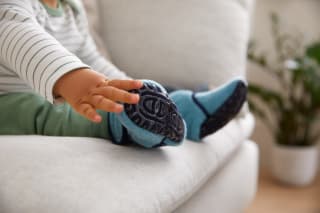
Children's feet continue to develop until the age of 16, and especially in the first developmental stages of babies very quickly. For example, your children's feet can, from the age of three, grow by up to 1.5 millimeters per month. That's roughly two to three different shoe sizes that you would need to allow for and plan during this time. You should especially keep the following in mind:
Especially in the first years of life, children's feet still soft and malleable, which is why they adapt to the shoe. This can lead to health problems such as deformities, hip and back complaints, postural defects, as well as headaches. If the shoe is too large, the child's foot has no support. If the shoe is too small, the pressure damages the shape of the foot.
To prevent this, choosing the right footwear is even more important. But that is not always easy. Because especially with babies and toddlers, the nerve cells are not yet fully developed, so they have an even immature pressure perception to have, which makes it difficult for them to indicate precisely whether a shoe fits well or not.
You also can't rely on size charts alone, because the EU sizes are not standardized. Shoe sizes from different manufacturers therefore often vary. Thus they only provide orientation and only become truly useful when you know your child's exact foot length.
Precisely measuring children's feet – particularly length and width – is generally the best method, to be able to choose suitable footwear. So that you can always accommodate your offspring's foot growth and always have the right pair of shoes at home, it is regular measurement of the feet indispensable. For babies and toddlers up to three years, it makes sense to check children's shoe sizes every six to eight weeks. For children from three years, you then only need to measure the shoe size every three to four months.
What to pay attention to when it comes to children's shoe sizes
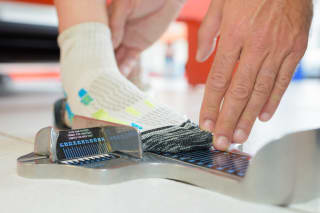
Obtain appropriate footwear in the following order: measure the feet, consult a size chart, and only then, if necessary, seek professional advice from specialists.Our tip: Occasionally it is even recommended to have your children's shoe size measured by professionals using the WMS system.
Children's shoes must neither too small nor too big and not too stiff or too heavy be.
Always prefer healthy shoes to fashionable ones. They should have neither an extremely low toe profile nor a too-narrow toe space.
Do not rely solely on your children's feedback when measuring their feet, as they do not really perceive pressure during the first years of life.
From the third year, children's feet grow by up to 1.5 millimeters, which is why about 12 to 17 millimeters should always be added when buying shoes.
Measure your children's shoe sizes at regular intervals. For babies and toddlers up to three years, every six to eight weeks, and for children from three years, every three to four months.
Children's shoe sizes from different manufacturers usually differ.Our tip: Measure your children's feet in centimeters and then refer to the size charts.
A template or a special measuring device in a specialist shop are the most helpful measuring methods for children's shoe sizes.
The following measurements are relevant for calculating the shoe size: inner shoe length and width, instep width, and available toe room.
If one foot is longer than the other, use that one as a reference.
Always measure your children's shoe sizes while standing so that the feet have sufficient space in the shoe when walking.
Buy no socks that are too tight, because they can also impair foot health.
Always schedule your shoe shopping for the afternoon, because the feet expand throughout the day and this way the shoe with the perfect fit can be found – even under greater load. Before trying them on, let the kids walk barefoot for a few minutes.
What shoe size is appropriate for babies?
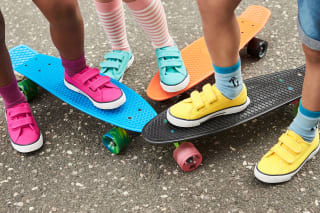
Generally, the size for baby shoes starts at 16. Shoes in this size should even fit right after birth and accompany you until the third month of life. However, this is also the age when your babies do not need shoes at all. The following further baby shoe sizes from 17 to 23, which are then suitable for children up to one year.
Usually the question of the right shoe size only arises when it's about your children's first shoes. This of course depends on whether and when babies actually need (walking) shoes and what to look for in them.
In principle, children's shoes are only recommended when your babies learn to walk and want to independently explore the outside world beyond their home environment. Shoes then provide a protection from cold and injuries, which can be associated with walking on the street.
To help you find the right baby shoes, it is especially important for your smallest ones to measure the correct foot length in centimeters to measure. This can then usually be converted into the appropriate baby shoe size using a shoe size calculator.
Which children's shoe sizes are normal at which age?
Your children's growth and that of their little feet progresses individually. For exactly that reason, the question of which children's shoe size is normal for which age, cannot be answered in general.
Age generally doesn't say much about which size is suitable for the little runners, because even the shoe sizes are not always uniform – certainly not the size of different body parts.
Even if size charts often contain an approximate age indication, that doesn't mean the shoe sizes actually fit your children. Therefore you should only refer to shoe size charts when you have measured the exact foot length of your little ones and want to determine where you can place them.
It also helps to involve trained staff and have the measured values double-checked. That way you're always on the safe side when measuring your children's correct shoe size.
Overview of measurement methods for children's feet
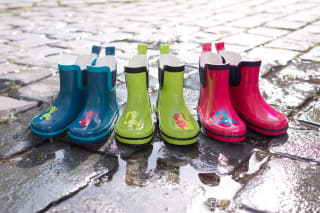
You want to measure your children's feet to be certain about their current shoe size but don't know where to start? No problem, because HABA has picked out for you the essential tips and the most reliable measurement methods that you can easily apply yourself.
“We can tell if the shoes fit when there is room for two fingers at the toe!” – More or less you've surely heard of the finger test or, more specifically, the thumb test. But by now it's clear that this is not the most reliable measurement method. In general, a distinction is made between older and newer methods, which at first creates an unclear starting situation. So that you also keep an overview and know, which measurement methods you can use without problems, HABA has prepared a small summary for you here.
The WMS measuring device (good)
WMS measuring devices are used especially in specialist shops. WMS stands for Width Measurement System. Children's shoes that are labeled with the WMS sticker are marked, indicate high quality – especially in terms of fit. The measurement method is considered the safest and most reliable, because foot measurement not only calculates the shoe length but also thewidth specification is included. That means, using the method you find out how narrow or wide your children's feet are, so you can make your shoe selection accordingly. However, it is important to know that the method is not intended for independent use and rather can only be performed by trained professionals.
Foot measuring tray & insole measuring device (good)
As an alternative to the WMS measuring device, a foot measuring tray or an insole measuring device can be used. Here it is true that an exact measurement of width is not possible, however you can stilldetermine the shoe size reliably. For that, measure your children's feet while standing. The legs should be straightened and the measuring tray should fit snugly against the heel and sole. Up to children's shoe size 26, different sizes can be read here. Measure both sides ideally, because often one foot is larger than the other and that one counts for the final shoe size.
Thumb test (poor)
The simple thumb press on the front of the shoe or behind the heel is probably the most popular measurement method, but by no means the most reliable. While a finger's width of space in the shoe can be determined, which corresponds to the additional 12 to 17 millimeters and is useful for the right children's shoe – nevertheless, this cannotdefine either the fit or the exact shoe size precisely to be. Children also tend to pull their toes in during the thumb press. Whether the shoe ultimately fits well or poorly is therefore hardly determinable with the thumb test. Consequently you should avoid the method or only use it if you want to check the toe box space. To prevent your children from pulling in their toes, press them slightly downwards with your hand when measuring.
Holding children's feet against the outer sole (poor)
Comparing children's feet with the shoe's outer sole is anything but effective. Because the external dimensions of the children's shoe say nothing about the important internal dimensions. The fit with regard to foot width is also completely ignored here, which is why the measurement method is considered rather unreliable applies. So sneakers, low shoes and the like can be too tight, even if the allowance was added.
Asking children if it pinches (poor)
Because especially toddlers and babies do not yet have a fully developed nervous system and therefore no meaningful sense of pressure, it is completely pointless to ask them whether the tried-on children's shoes really fit well. The feet adapt to the shape of the shoe, so your little ones believe that the sneakers, low shoes and the like feel comfortable even when the children's shoes themselves are far from ideal for them. The older your kids are, the more they can tell you about how comfortable the shoes are, however you should never rely on it exclusively when measuring.
Removable insoles (good)
Comparing with an insole is by far more recommendable than with the outer sole, because this is about the interior space of the children's shoes. Removable insoles allow you to find out how much room there is at the sides and in the front. Simply take the insole out of the shoe (this only works of course with shoe pairs that offer a removable insole), place your children's feet on it and check exactly to what extent the selected shoes are suitable. In addition to insoles you can also make a template yourself. For that, measure your kids' foot lengths and orient yourself to the longer foot. Add 1,5 centimeters and cut these out of cardboard to take them to the shoe purchase. When inserting into the desired shoe this must neither slip nor show bulges. This is how you determine the perfectly fitting shoes. But keep in mind that you should replace the insole regularly, because children's feet don't stop growing.
Measuring children's feet and determining shoe size: Here's how!
Now you have learned some practical tips for measuring your kids' feet. Time to put it into practice. Under the guidance of the following measurement methods you can measure the feet of your babies and toddlers as well as older kids completely comfortably and quickly. Try it out and find out your little ones' shoe size.
Determining baby shoe sizes
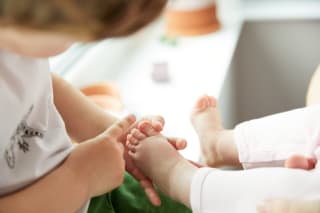
Delicate baby feet can only be measured with sufficient support from you parents. Because even if your babies can possibly stand by themselves, it is usually still a wobbly affair, which is why you should support them.
And this is how you measure the sweet baby feet:
Place your baby barefoot on a white sheet of paper.
Outline one foot first with a pen. It's best to press it lightly down with your hand so that the toes and the foot are stretched and rest upright on the paper. Then repeat the same with the other foot.
Now measure the foot length by placing a ruler or tape measure from the drawn heel to the big toe.
If one baby foot is longer than the other, base the shoe size on the larger foot.
It's important to include a certain allowance for the baby feet. For this, add 1,2 to 1,7 centimeters (which corresponds to the minimum allowance of 12 millimeters) to the measured foot length. The following formula can be used for this: (Foot length in cm + 1,5) x 1,5 = Shoe size An example: (9,7 cm + 1,5) x 1,5 = 16,8
To be on the safe side, it is advisable to occasionally have your babies' foot size checked by trained staff in the respective shoe store.
Determining shoe sizes for toddlers and older children
The foot length, which represents the distance from the toe to the heel, can best be measured using a template. For this you can download our measuring template, cut it out and, if necessary, glue it onto cardboard to use it directly.
To measure your kids' little feet, proceed as follows:
First, print out the template in the correct scale.
Check whether you have printed the true-to-scale template by placing a tape measure or ruler on the printout.
If the size of the template is correct, glue it to the floor so it doesn't slip away.
Now you can start measuring. Place one foot at a time on the printed template. It's best if your kids wear socks, as these also require space in the shoe.
Place the feet so that the heel rests on the lower mark. To achieve the best stance, the other foot should be exactly parallel to the foot being measured first. This also ensures the weight is evenly distributed.
Gently stroke the toes so they relax.
Now all you need to do is read off the foot length by seeing at what level the longest toe tips are.
So that the shoe can be used for several months, add 1,2 to 1,7 centimeters (which corresponds to the minimum allowance of 12 millimeters) to the measured foot length. You can remember the following formula for this: (Foot length in cm + 1,5) x 1,5 = Shoe size An example:(14,1 cm + 1,2) x 1, 5 = 22,95 (Shoe size 23)
With the determined shoe size you can now go shoe shopping. Refer to a shoe size chart, but also check whether the shoes actually run true. Because depending on the manufacturer, a size 23 is not always exactly a 23.
If you want to determine the shoe size first in a shoe store, you can usually use a measuring device provided there.
Here's how to proceed:
Place your child on the measuring gauge. The heels must rest against the stop.
Now take the slider and pull it up to the longest toe.
Sizes can vary depending on the foot. Always use your kids' larger foot as a guide.
To be able to use the shoes for as long as possible, add another 1,2 centimeters of allowance.
The children's shoe size determined this way now serves as the basis for your shoe search. Good luck!
Our tip: Have the shoe size still regularly double-checked by a specialist. This way you are sure that you have measured everything correctly.
What you should pay attention to when buying children's shoes
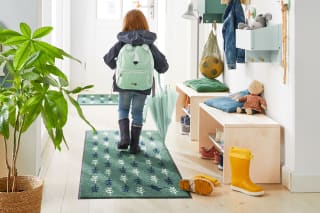
Once you have determined your little ones' children's shoe size, nothing stands in the way of buying shoes. To really get the best children's shoes, it is important, to keep various criteria in mind by which you can check the quality of low shoes, sandals, winter shoes and other footwear.
Basically, the material plays an important role. Ideally, children's shoes are made of natural materials.
This is particularly advantageous for closed footwear, because natural materials adapt to the delicate children's feet and thus provide for a comfortable wearing experience They provide. If low shoes and boots are, for example, made of harder material, they squeeze children's feet into an unnatural shape, which in turn has a negative effect on physical health.
Also the breathability should not be overlooked when buying shoes. Shoes whose footbed is made of leather are well suited. This helps prevent the formation of sweat. Natural materials are generally better than synthetic, because they promote air circulation inside the shoe interior.
Be especially careful with rubber boots. The rule here is: Natural rubber is better than PVC (polyvinyl chloride). Because rubber boots made of PVC often contain concerning harmful substances and also air exchange and thus breathability are very severely limited.
Otherwise: Include your children in the decision. Even if, due to an underdeveloped sense of pressure, they cannot say much about the right children's shoe size, they may at least their opinion on the design of the shoes express.
Buying baby shoes: These tips you should keep in mind
If your babies are at the walking age and want to explore environments beyond their own home, it's time: you should buy the first shoes for your babies. But what to look for when buying walking shoes and the like? We are happy to help you find the right pair and provide you with an overview of the quality criteria.
Baby shoes should be made of a soft upper material, that provides your kids with enough freedom of movement.
First walking shoes made of cotton or linen are especially popular in summer because they are very breathable and thus reduce sweating.
Flexible and non-slip soles are required because they promote natural foot movement and the development of motor skills.
The first shoes should generally only have a light weight to protect the back and spine.
Non-toxic soft and breathable materials are a must. Thus footwear that is awarded the WMS seal or the Oeko-Tex Standard 100 is considered particularly good.
Regularly check the baby feet for pressure points, redness or blisters. If such occur, the shoes are definitely unsuitable.
The fastening of baby shoes should be child-safe. Prefer simple fastenings such as Velcro or zippers to laces, because the latter can come undone more easily and therefore pose a risk of injury.