Diapering and Dressing
It only takes a moment: changing diapers, a fresh bodysuit, a romper and a little hat. Nevertheless, parents, especially in the beginning, often have the feeling that half the day consists only of diapering and dressing. No wonder: in the first months babies easily need 8-12 fresh diapers a day. Taking clothes off and on again, cleaning and changing takes a bit of practice, and there is also the uncertainty about whether the baby is dressed warmly enough or too warm, whether it needs a hat or another pair of socks. We have compiled the most important information on diapering and dressing for you and added a few tried-and-tested practical tips on top: this way you can face the challenges at the changing table a bit more calmly.
Dressing your baby – practical everyday tips
Especially at first, dressing and undressing babies isn't that easy. The arms and legs are still so small and uncontrolled and it's not uncommon for babies to react to changing with loud protests and wriggling. Over time, child and parents equally get used to the daily dressing routine - we have a few tips to make your daily routine a little easier:
Baby-appropriate clothing: Your child feels most comfortable in soft, loosely cut clothing that doesn't constrict and lets the skin breathe. Natural materials prevent body heat from building up.
Dress in multiple layers: The onion-look has two advantages: on the one hand the thin layers of air between the individual garments act like insulation and prevent chilling or overheating. On the other hand, you can simply remove a garment from your child if it should get too warm.
Bodysuits and rompers: One-piece garments are especially comfortable for your baby because they don't shift or constrict. Especially in the early days, bodysuits and rompers with side snap fastenings are perfect because they don't have to be pulled over the head.
Functionality: Little bows and buttons look cute, but are quite impractical for everyday life. Snap fasteners and elastic cuffs are an unbeatable team when it comes to quick, easy dressing.
Small tricks for daily dressing
Calm and relaxed: Hectic or restless behavior while changing clothes makes your baby nervous. Try to stay calm, even when you're in a hurry. Talk to your baby and maintain physical contact.
Dressing rituals: Ganz gleich, whether you wind up the music box, sing a little song or always begin changing with the same phrase – rituals help your child orient themselves and become calmer.
Distraction: A mobile or a colorful poster above the changing table is an eye-catcher that draws your baby's attention and makes changing easier.
Quickly and without interruption: Most babies are not enthusiastic about dressing. Try to get the dressing done quickly and try not to be interrupted if possible.
Out and about: Dressed appropriately for any weather
Going for a walk outdoors is part of the daily routine for most parents, but especially in transitional seasons many are unsure whether their children are dressed appropriately. The idea that babies should always be dressed very warmly is now outdated. Although babies cannot retain their body heat as well as adults, they also have less ability to regulate temperature and overheat more quickly. If you're unsure about the right baby clothing, occasionally feel the back of your baby's neck: if the skin feels warm but not hot or sweaty, your baby is very likely dressed appropriately for the weather.
What should my baby wear in winter?
Several layers of light clothing: long-sleeve bodysuit and tights, romper or pants and sweater, optionally a cardigan
Snowsuit or a lined jacket and winter pants/footmuff
Warm wool socks or soft, lined baby shoes
The hat should reach the nape of the neck and also cover the ears
Mittens, attached as part of the snowsuit or separate – preferably not finger gloves yet
What should my baby wear in summer?
Light cotton bodysuit, long- or short-sleeved
If necessary, a cotton undershirt and light cotton pants or a thin romper
Baby socks or barefoot
Sun hat that also covers the ears – preferably tie-on
If it's very hot, sometimes without any clothing
Avoid sweating and overheating – tips for summer
Peaceful sleep: No one sleeps well when it's hot – in babies high temperatures can even cause overheating during sleep. Try to keep the bedroom as cool as possible, e.g. by darkening the room or hanging damp cloths. If it's still very hot, it's better to skip the pajamas and/or sleeping bag.
Car journeys: If possible plan longer car journeys in the morning or early evening, as the heat in the car and especially in the car seat can strain many babies. A terry or fabric cover for the car seat prevents heavy sweating, as does a sunshade for the window.
No sun in the first year: Fresh air yes – but in the first year of life your baby should be exposed to direct sun as little as possible. A sunshade for the stroller and a light, portable sun umbrella are invaluable in summer.
Preferably spend midday hours indoors: Schedule walks, errands and appointments during the hot months preferably in the morning or early evening. During the midday heat it's then time to recharge in the cooler home.
Avoid fans and air conditioning: Babies are sensitive to drafts and catch colds quickly. This applies both to car air conditioning and to fans in rooms or sleeping areas – better to avoid them.
You can find more information in the article How do I protect my baby from too much sun and heat in summer?
How do you change a baby properly?
There are detailed and easy-to-understand guides on how to change a baby – for example here in the HABA magazine in the article How do I change my baby properly. Until you have the necessary routine for daily diaper changes or whenever you are unsure, such step-by-step guides with pictures are a good help. In everyday life you will probably quickly find that changing diapers is often pure improvisation: you are out and there is no changing table in sight. Your child challenges you during the diaper change with sudden twists or wild kicking. And all too often a new diaper becomes necessary at exactly the moment when you actually have to leave for a scheduled appointment. Whenever things need to be done quickly or you have to improvise, a few basic to-dos help:
Change diapers as close to the ground as possible without a changing table - on the carpet, on the car's back seat, etc.
A diaper bag becomes too bulky for many parents at some point. One or two diapers, a foldable changing mat and a travel pack of wet wipes, however, fit into any handbag or the glove compartment
Even when it's urgent: handle your child gently and with the necessary calm while changing, and try to stick to any rituals
Screaming, wriggling and "warm showers" during changing happen again and again - your baby doesn't do this to annoy you
Sore skin and diaper dermatitis – what can I do?
Once changed too late or after eating something acidic, the skin on the baby's bottom becomes red and sensitive or shows small pimples in the diaper area. Almost every baby deals with diaper rash now and then. If the skin's pH value changes, for example due to prolonged contact with urine, the skin reacts irritated – with thin baby skin this unfortunately happens particularly quickly.
Diaper dermatitis can have various causes
Diapers are not changed often enough, so moisture attacks the skin's protective barrier
The skin has not been sufficiently cleaned during changing, so residues of stool and urine irritate the skin
The diaper fits too tightly, preventing any air exchange at the skin
Your child has diarrhea
Some children are more prone to soreness when they are teething
For your baby the diaper rash is unpleasant but usually harmless. If the pustules are red and raised, ooze pus, or spread to your baby's mouth, it may be a yeast infection. Yeast infections are usually more persistent than dermatitis – in this case your pediatrician will give you a prescription for an antifungal ointment.
How can I get diaper rash under control quickly?
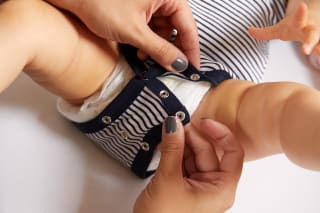
Change the diapers frequently and, if possible, always immediately when they are soiled
Allow plenty of air to the skin – ideally your baby spends some time each day without a diaper
Clean the irritated skin gently but very thoroughly, preferably with a washcloth and warm water
The skin in the diaper area should be completely dry before you put on a fresh diaper
Gently cream the sore areas with healing ointment or petroleum jelly, and if necessary with a baby-safe zinc-containing ointment
Checklist for daily diaper changing and dressing
Plan the necessary time – and any possible mishaps –
Better to change more often
Wash hands before and after changing
Have diapers, cloths/wet wipes and clothing within reach
Healthy baby skin does not need cream
When taking off, pull undershirts and sweaters over the back of the head; when putting on, pull them over the face
Allow some "diaper-free" time during changing
Prefer several thin layers of clothing
Prefer natural materials
If in doubt, check the temperature at the back of your baby's neck
When out and about, have spare diapers and a change of clothes with you