What is a household budget?
Put simply, a household budget compares a family's monthly income and expenses. The difference between these two amounts shows how balanced the family's finances are. If monthly outgoings are higher than income, measures should be taken to reduce expenses. For example, you can check whether you can save on telephone or insurance contracts. If income is higher than expenses, the surplus is available for discretionary use. In that case you must decide whether to save the surplus, set it aside for special expenses, or spend it as you wish.
Household ledgers as software & print
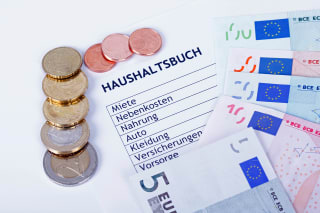
Household budget for families A household budget gives you a good overview of your family's finances. If the family's income and expenses fluctuate month to month, for example for self-employed people, it is probably more sensible to keep a household ledger. There are household ledgers both in print and as free downloadable software. The software has the advantage that it automatically cross-checks all entered figures and you can see at a glance how much you have available in any given month.
What you should consider when creating a household budget
Complete data:
It is important that you enter ALL income and ALL expenses. Annual fees, e.g. for insurance, must be converted to a monthly amount. Seemingly small, irregular expenses such as hairdresser visits also belong in the household budget. Here you should also try to convert the costs to a monthly average.
Current data:
Give the household budget a date and check the entries regularly to ensure they are still valid. Perhaps the fees for the sports club have changed, or insurance premiums have risen. The easiest way to update is using an interactive spreadsheet on a PC, but you can also work on paper or in a household book.
Check entitlement to benefits:
Perhaps, in addition to child benefit, you are also entitled to child supplements, housing benefit, parental allowance or other state benefits? Find out, for example, at the family counselling centre or the office for social services about the eligibility requirements, or use one of the online calculators for state supplementary benefits.
Plan for surplus:
If money is left over at the end of the month, you should think about how to use it. You can set aside an 'emergency fund' for unexpected repairs or similar expenses, or you can spend the money on family fun. In that case it is important to keep track of these expenses as well so you don't suddenly end up in the red.
How to keep track: saving tips for the family budget
Pay for purchases in cash:
Whether it's groceries or clothing, when you pay in cash you have the amount you spent directly in your hand and are more aware of the expense than when you pay by card. Also: if you have to go to the cash machine first, you may think twice about impulse purchases.
Review contracts regularly:
Offers from insurers and telephone providers change regularly, and your family situation may also change. Check your contracts regularly and contact providers to see if they can offer a better deal. You can save a lot of money this way.
Keep an eye on 'small amounts':
A takeaway coffee in the morning, an ice cream now and then, a small toy for the children, a quick magazine to pass the time — small amounts of money add up quickly. Think twice before you buy.
Discover more articles about everyday family life












Image credits:
Grandfather and grandchildren saving money © JenkoAtaman - stock.adobe.com
Household budget book © Klaus Eppele - stock.adobe.com

The missing Easter egg
We invite you into Paul's springtime world, where he wants to find the lost Easter eggs with your help. Together with the cat Kira and Paul, you will experience an unforgettable Easter adventure!