Eating by gut feeling – children can do it
Infants & babies
If you breastfed your baby after birth, you know the signals: smacking lips, sucking the thumb, turning the head and eventually crying mean hunger – your child wants to be breastfed. At some point your baby turns its head away from the breast – now it is full. Children therefore already know from the start what their body needs and when it's had enough.
Toddlers from 3 years old
From about three years old your child can already make quite clear with words, whether it is hungry or not. After a few refused offers, whether it shouldn't be another spoon of yogurt or a piece of bread, you can trust that your child is full.
What to do when the child says: "I don't want to"?

If your child absolutely refuses to eat the pasta or the bread, you should not force it. When hunger comes, your child will signal and the cheese sandwich from before will already be ready.
Forcing to finish the plate – better not
For a long time the assumption was widespread that children should finish their plate, so they wouldn't suffer from hunger. Since it's hard to look into the little person and feel their hunger themselves, parents decided which portion the child should eat.
Of course you still have to estimate roughly how much food your child needs. But if it is full and there is still something on the plate, you should not force it to finish it. Phrases like: "one more bite for Mommy" or "otherwise it will rain tomorrow" are not good arguments. This way your child eventually unlearns, to trust their sense of fullness and may develop a disturbed relationship with food.
Don't play with food: Is that still relevant?
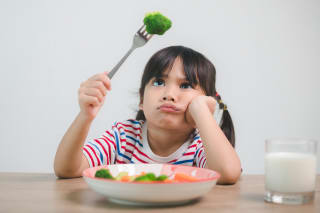
By sticking their fingers into the mashed potatoes, nibbling one apple then the other, or opening a yogurt without really eating it, your child discovers their environment and their food. It first has to learn that one apple tastes the same or similar to another. Even if it is at first against table manners is, you can give your child the chance to explore their environment.
Additionally, your child cannot eat properly with knife and fork from the start and will come up with other, creative ways to get food to their mouth. As long as part of it arrives there, you can let your child do it calmly and offer your help. You will also quickly notice if your child is only playing with the food because they don't feel like eating it. If the carrots are just pushed back and forth on the plate, across the table or flung onto the floor, you should explain to them that this goes too far.
Relaxed at the dining table: Our 5 tips

1. Try smaller portions and offer seconds
Get used to putting a smaller amount on your child's plate at first. That way they can decide after the first plate whether they want more or not. In this way you don't put your child under pressure and you won't have to throw away food that was played with or that has already gone cold. This way you also set an example and teach your child a responsible approach to food.
2. Eat together as a family
When the family sits together at the table, the food tastes much better right away and your child perceives it more consciously. But if the TV or another distraction is running alongside, the meal is just passively shoved into the mouth and you automatically eat more unconsciously. Take this valuable time together as a family as often as possible – then the meal for your children is also linked to a positive experience of the day linked.
3. Do not set conditions
Avoid phrases like "...otherwise there will be no TV". That way your child feels forced and loses the ability to listen to their body's signals. As in other areas of parenting, you know that threats don't help much. Listen to your child and observe them closely in situations where you don't immediately understand them. Because with food, your perspective is initially secondary and your conditions are out of place.
4. Don't let yourself be manipulated
If your child refuses to take a bite, you should not replace the meal with chocolate or chips. Instead, wait until hunger comes. Your child remembers the situation and will insist on sweets instead of vegetables next time as well.
5. Let your child try
Do you suspect that your child is hungry, but just doesn't feel like spinach and rather wants pasta? Offer them to try the spinach at least and eat a small portion. Once you start cooking separately to satisfy the child's whims, it's hard to stop.
Discover more articles about everyday family life










Image credits
Girl sits at the table, in front of a plate with broccoli florets © Suzi Media - stock.adobe.com
Boy with a hat who refuses to eat anything © Linas T - stock.adobe.com
Girl refuses to eat healthy vegetables © FAMILY STOCK - stock.adobe.com
Girl looks unhappy with her meal © very_ulissa - stock.adobe.com