Build an insect house yourself - here's what you should consider
Before you start building insect hotels with your children, you should think about how they work. Depending on the materials and the plant life in your garden, you will attract different insects.
To make your guests feel at home, you should observe these tips about materials:
For the basic frame of your insect hotel, you should use the preferably only seasoned hardwood such as ash, beech, or spruce. Softwood splinters and cracks too quickly. Your animal friends could injure themselves on it.
For the filling material, use cavity-rich (natural) materials, which the insects can easily enter through small drill holes and use for nesting purposes.
Use only dry filling materials. This way you avoid possible fungal infestation.
For wild bees always drill into longitudinal wood and not into end grain; this prevents cracks where parasites could make themselves at home when wet.
Generally, nesting tubes should be smooth (especially the entrance), so the animals do not injure themselves when flying in or crawling out.
Reed and bamboo tubes should only be between five to ten centimeters long and have holes with different diameters from two to ten millimeters have. Avoid chemical fertilizers and wood preservatives.
Always leave a patch of lawn and some deadwood in your garden. This ensures your animal friends have enough food and space to spread in your garden.
If you want to paint your insect hotel colorfully, make sure to use paint without chemicals and insecticides. Generally, it's recommended to keep insect hotels natural. Paint can quickly dry through the hotel and cause fungal infestation.
In addition to the materials used, the site where insect hotels are placed is crucial for the well-being of the little beneficial insects. Therefore, pay attention to an insect-friendly environment with plants they like.
Required materials and tools for your insect hotel DIY project

Besides a whole lot of anticipation, fun and a bit of craft skill, you of course also need the appropriate Material and tools. The choice of material is the most important thing for your construction project. Because only if it is accepted by the insects can it fulfill its purpose and serve as protection and shelter in the long term.
So grab your crafting tools and get started right away.
Exterior facade:
Hardwood (especially ash, beech, oak)
possibly clay
Timber beams
Containers such as tin cans, ceramic cups, mugs or pots
Clay blocks
Paint (optional)
Filling
Straw, wood wool or reed grass
Bricks
Branches & twigs
Egg cartons
hollow plant stems like bamboo, reed or straws
Pine & fir cones
Bark pieces (bark mulch)
Utensils/Tools
Scissors
Drill
Wood glue or acrylic glue
Cable ties
possibly plaster
Screws & nails
Roofing felt nails
Build insect hotels with children easily yourself – DIY instructions for everyone
Now you probably want to get started right away. Grab the materials you need and your crafting tools and you're ready to go. Let your creativity run free and create a beautiful insect hotel.
Build insect hotels from wood - with our insect hotel kit
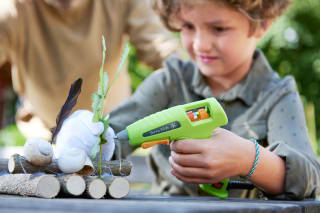
Required materials:
Screwdriver
Natural materials of your choice that you can collect in nature
Craft glue
How to:
Take the individual parts of the kit out and sort them by size so you have a clear overview and can take the right piece as you go.
First take the triangle; this will later serve as the back wall of the insect hotel. Now screw the three blocks in a triangular shape to the outer corners of the back wall.
To attach the outer walls, take the two large boards from the kit and screw them to the blocks attached earlier. Now you have the basic frame fully assembled.
In the next step attach the metal sheet by laying it on the top peak of the roof and then screwing it on as well.
Then screw the long wooden beam to the back wall, which will later serve as a support.
Now it's time for the filling. For this, place the blocks with holes into the space one after another. Do this until the insect hotel is completely filled and nothing falls out.
Now you just need to hang your finished wooden insect hotel in the place of your choice.
Build an insect house without a kit
To help wild bees, wasps or butterflies, you can give them an inviting insect hotel in the garden build. You don't necessarily need a kit for that. With wood, a fruit crate and suitable tools, an attractive home for a variety of insects can be created in no time.
Build insect hotels from cans
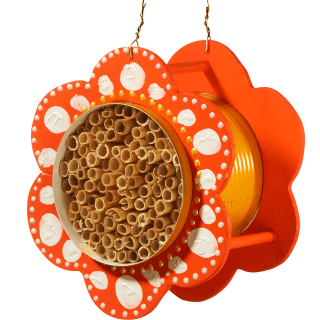
Required materials:
a washed-out tin can (at least ten centimeters high)
sandpaper
garden shears
wool or cotton
To decorate the can:
colored yarn
craft scissors
wooden beads
white and black felt
craft glue/adhesive
nail
wire
Filling material:
hollow reed and bamboo stems
rolls of corrugated cardboard
drilled hardwood (drill holes in the bark with varying diameters from two to ten millimeters and a tube depth of approx. 12 centimeters)
wood wool
fresh straw
thin twigs
dry leaves
pine cones
bricks
snail shells
How to:
First, clean your tin can and remove all paper labels. Then dry it thoroughly.
To prevent both you and the insects from getting hurt on the can, remove the lid and sand the edges smooth with sandpaper. Parents should do this part to avoid children injuring themselves.
Now it's your children's turn. They can do this step entirely on their own: paint your can in the color of your choice and let it dry well. The tin can can also be transformed into an animal itself. To do this, wrap the can, for example, with twine, stick felt onto it, or simply paint the details yourself. For insect legs, use a hammer and nail to punch holes in the can, thread yarn through and tie wooden beads securely.
While you let your tin can dry, prepare the filling material. Use garden shears to cut your desired filling material to the length of your tin can. Tip: Achtet darauf, dass das Füllmaterial glatt und nicht ausgefranst ist, um die Insekten nicht zu verletzen. Füllmaterial wie Pflanzenstängel, die von beiden Seiten offen sind, solltet ihr von einer Seite mit Watte oder Baumwolle verschließen, da sich die Insekten nur in Röhrchen ansiedeln, die an einer Seite geschlossen sind.
Now insert your desired and prepared filling material into the can. The tubes should lie horizontally. Tip: Mischt die Füllmaterialien nicht zu sehr. Verteilt sie lieber auf mehrere Dosen, wenn ihr weitere Insektenhotels plant. Insekten haben unterschiedliche Vorlieben und so werdet ihr ihnen gerecht.
Finally, hang your insect hotel as close as possible to flowering plants, since they are an important food source, especially for bees. Secure it well, because the can should not swing freely. If you have built multiple cans, you can arrange them next to and on top of each other. In such a great hotel setup, every insect will find its favorite spot.
Setting up homemade insect hotels – suitable locations for your animal friends
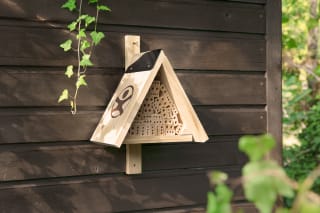
If you have built beautiful insect hotels together with your children, it's time to find the right spot in the garden. There are a few tips you should keep in mind.
The right location: sun yes, but not too much
Ideally, place your insect hotel in a warm location facing south on. A southeast orientation is ideal. Insects need sun to become active. The warmth in spring causes the larvae to start hatching. Also, insect hotels dry faster if their filling has become wet from the rain.
But be careful: sun is good, but the direct, intense sun is deadly for insects and their larvae. Direct exposure to the sun – especially in summer – kills the larvae. They are too weak to hatch and even more so to survive. Therefore choose a sheltered spot for your insect hotels, such as under a tree that only receives morning and/or evening sun.
Height and mounting: This is how the nesting aids hang securely
For mounting of insect nesting aids, there's a rule of thumb that's particularly important: They should be mounted at least attached 50 centimeters above the ground are. Make sure that the nesting aid doesn't sway, but is securely fastened above ground. This ensures that the insects do not come into contact with dogs or vines.
Protection from predators
Against birds, you can with a bird protection net or wire mesh. Choose coarse-meshed variants so that the insects can still easily pass through.
Food sources nearby
It is important that the beneficial insects are provided with sufficient food sources in the surrounding area. If your insects are primarily meant to control pests, place your insect hotels near the infested plants. Otherwise, orchards are also suitable locations.
Insect nesting aids can also be set up on your own balcony. If sufficient food sources are not available, you can plant summer flowers in balcony boxes plant. That way your little friends will be well provided for.
Never move insect hotels
Very important: Once insect hotels have been inhabited, do not move them under any circumstances. This is especially true for winter. Otherwise the larvae of your insects will hatch far too early. They are thrown off their biorhythm, so when temperatures are warmer they think it's spring. As a result, they go looking for food – which is not a good idea in winter, since there is hardly any, and they would sadly starve.
Cleaning and maintaining insect hotels properly
As a rule, you don't need to clean your insect hotels. Gerade, wenn es aus Naturmaterialien besteht. Spinnenweben könnt ihr allerdings regelmäßig entfernen. Vor allem Netze von Kreuzspinnen, die meist direkt vor den Brutröhren hängen.
If you still want to clean the exterior facade of your insect hotel, you should do so only with water. Use no chemically manufactured wood preservatives, as these are often toxic to insects. For protection against weather, especially suitable are linseed oil, beeswax and other natural wood care products. These do not deter the insects, as the scents are perceived as natural by them.
You are best off not cleaning the used tunnels in your insect hotels at all. The insects happily take care of that themselves. Some species also wait up to a year for their offspring, so by cleaning you would only interrupt or even abort the breeding process.
You usually don't need to replace filling materials either. Sollten durch Wind und Wetter dennoch Schäden und Lücken entstanden sein, replace the damaged and missing fillings only in spring.
Why build an insect hotel?
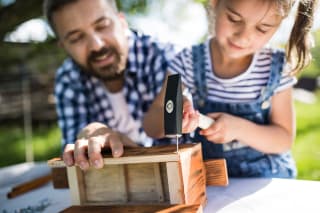
Create nesting aids and shelter for insects
Insect hotels in the garden real eye-catchers, but they have an even greater benefit than you might be aware of. Because: They are a nesting and overwintering aid for various insect species, whose habitats are increasingly being destroyed. So you are offering them a new home and a place where they can live in safety and reproduce. With the building of nesting aids you thus protect them from extinction.
Insect houses for an ecological balance in the garden
But the animal inhabitants of insect hotels also help your garden. Whether wild bees, bumblebees or flies – the little helpers are real pest controllers. They free your plants from pests, pollinate them and thus contribute to ecological balance. In summary: With the construction of insect hotels you create new habitats for insects and make gardening easier for you.
Environmental project with children: get to know native insects
But the building project means much more to your little DIY enthusiasts. At the very least, they are heart and soul involved, when they learn about the importance and function of insect nesting aids - a sustainable crafting idea that promotes both crafting fun and nature conservation. Through such a project, children learn playfully to take responsibility.Along the way, they also learn a lot of new things about nature and native insects/magazine/child-rearing-psychology/physical-development/promoting-fine-motor-skillsfine motor skills are promoted and thus advance child development. Not to forget the pride that fills them when you have finished building the insect hotel and hung it in the garden: you'll surely beam with pride together.
Which insects are the most common guests in insect hotels?
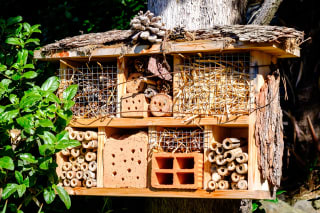
Insect nesting aids are inhabited by a wide variety of insect species. Among the most popular guests are butterflies, ladybugs, bees and various species of wasps. But also less well-known insects such as the green lacewing or the earwig are also among the inhabitants of insect hotels.
All these insects are not only super interesting to observe, but also incredibly useful for the preservation of nature. That's why you need to pay special attention to one thing when building an insect hotel: Depending on the materials, you attract different insects. To give you an overview, we present the most important insect hotel inhabitants and their needs.
Butterflies
Insect hotels are visited by butterflies particularly often in winter. There they find shelter to spend their winter dormancy. Normally they seek out trees or animal constructions for overwintering. If you want these beautiful creatures to move into your insect hotel, you should use thin, flexible and, above all, fresh branches as filling material as filling. In addition, proximity to buddleia and nettles is important to them.
Green lacewings
The little destroyers of aphids count among the extremely practical guests in insect hotels: especially if you are dealing with pests on bushes and shrubs. Green lacewings are particularly attracted to the color red. So if you decide on a red coat of paint or even use bricks as filling material , you will attract these little residents.
Ladybugs
In Germany there are approximately 70 different ladybug species. The best known is probably the red seven-spot ladybug. In general, ladybugs have a big appetite. In addition to about 50 aphids per day, they also eat other pests such as scale insects, spider mites and fungal infections on plants. Ladybugs are invaluable beneficial insects and therefore very welcome guests in insect hotels. Near the nesting aid you should plant elder, jasmine and roses. These plants and flowers ensure that they stay for a longer period and make themselves useful in your garden.
Earwigs
Earwigs use insect hotels as breeding sites and overwintering opportunities. Like green lacewings, they also destroy aphids. Nevertheless, caution is advised with these little residents, because they can themselves become pests . If they do not find enough aphids, the earwig will feed at the brood sites of other insect hotel inhabitants or on healthy plants in your garden. Therefore always keep an eye on whether they have enough food in the immediate vicinity.
Generally: Bring earwigs never together with wild bees in your insect hotels, because when aphids are scarce, these omnivores go for their larvae first.
Wild bees
Wild bees are among the most popular inhabitants of insect hotels. About half of around 560 species – including bumblebees – are threatened with extinction, which is why they gratefully accept your special protection. Whoever wants to build a bee hotel actively supports the preservation of these useful pollinators. Wild bees tend to nest in branches with holes, old wood or masonry. If the wild bee offspring has hatched, the little bees swarm out and pollinate your plants in the immediate vicinity of the insect hotels.
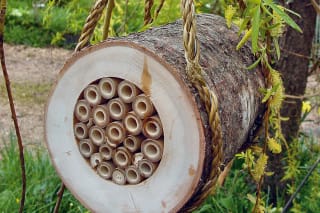
Good to know: Wild bees love bundled reed or bamboo tubes, when they lie horizontally and are closed at the back. Therefore, insect hotels made from cans are also suitable for the little buzzers. If you choose perforated bricks, you should seal them on one side with clay, plaster, cotton wool or wax. If you use wood, it should always stay dry. Beech or oak are best.
Habitat and food for native insects
A feast for the eyes: Turn part of your lawn or a small corner of your garden into a species-rich wildflower meadow: daisies, cornflowers, clover blossoms, widow's flowers and other native plants are a veritable paradise for busy fliers and a delight for you to look at! Seed mixes are available commercially. Don't mow until the flowers have set seed.
From crocuses to asters: A tip for bee lovers: Make sure the buzzers have enough to eat throughout the year. The menu starts in spring with crocuses and pussy willows and ends in autumn with the last asters. Especially outside of summer, bees have difficulty finding food.
A snack garden: A garden where berry plants such as raspberries or currants grow is loved equally by children, bees, bumblebees and butterflies. The insects for the blossoms, the youngsters for the fruits. Fruit trees and shrubs like apple, cherry, pear or plum also attract the busy little fliers during flowering. They enjoy the nectar, pollinate the blossoms and thus ensure a plentiful fruit harvest.
Perennials, shrubs & trees: In perennials, shrubs and trees with single (non-double) flowers, insects find welcome food. Many wild bee species in particular are specialized on certain plants. The more diverse the selection, the better for the bees.
Aromatic herbs: The nectar of the flowers of oregano, lavender, thyme, sage, hyssop, savory and borage is eagerly visited by bees. The herbs thrive just as well in the garden as in a spacious pot on the terrace or a flower box on the balcony.
Frequently asked questions about building insect hotels with children
From what age can children build an insect hotel?
When is the best time to set up insect hotels?
Can insect hotels be painted?
Which wood is best suited for building insect hotels?
More articles about leisure & creativity






Image credits
Child working with father © Halfpoint- stock.adobe.com
Insect house © fottoo - stock.adobe.com