Carving a pumpkin at Halloween – the background of the tradition
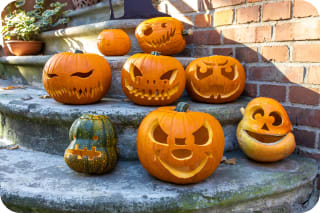
Halloween is long since arrived in Germany – to the delight of all children. On this day, little ghosts, spooky witches or scary vampires roam the streets to go on a candy-collecting spree. But why do we celebrate Halloween at all and what is the story behind the costumes and pumpkin faces?
The origin of the Halloween festival goes back to the Celts back. They settled Ireland, Scotland and northern France over 5.000 years ago. According to the Celts' beliefs, on October 31 of each year the realm of the living mixes with that of the dead. To protect themselves from evil spirits, people dressed up on this day and also offered fruits such as pumpkins.
Useful crafting tools
You don't need much equipment to carve a pumpkin – with the right crafting tools you can hollow out a pumpkin and give it a scary face in no time. At HABA you'll find the right tools to get started right away.
Inspired by the Celts' superstitions and their former offerings, today's popular pumpkin lantern (in American \"Jack O’Lantern\") emerged. It adorns entrances and windowsills as a spooky decoration during the autumn months. Especially for children, it's great fun to carve a scary face out of a pumpkin themselves. And it's not that difficult – we'll show you how to easily transform your own pumpkin into a suitable Halloween decoration.
These pumpkin varieties are suitable for carving

If you want to carve a scary or funny face into a pumpkin, when choosing the pumpkin variety you should pay attention to whether it is edible or not. Not all pumpkins are suitable for consumption. Ideally, choose a variety whose flesh can be used to prepare tasty dishes – that way you can look forward to your delicious pumpkin after the work is done.
The classic Halloween pumpkin is large, orange and has a round shape. Its flesh tastes mildly sweet and is ideal for soups or desserts. The rind of this variety is not very hard and therefore ideal for carving a pumpkin face with your children.
With the butternut squash is a light-colored pumpkin in a pear shape. Its flesh tastes sweet and nutty – ideal for desserts or savory dishes. Because of its smooth skin, it is easy to work with and even children can carve a scary face with little force. The very little ones can help with scooping out the inside using a spoon.
Among the most popular and edible pumpkin varieties include:
classic Halloween pumpkin
Hokkaido
butternut squash
muscat pumpkin
Another popular variety is the Hokkaido pumpkin. You can find it in supermarkets in autumn. Its flavor is robust and slightly bitter, making it ideal for savory dishes. Even the skin is edible. However, the Hokkaido is somewhat firmer, so carving requires a bit more strength. Extra caution is needed when carving.
Muscat pumpkins are, like Halloween pumpkins, very large. Unlike their orange relatives, the skin of this variety is dark green to light brown. The fruity-tangy flesh can even be eaten raw and is suitable for desserts as well as various other dishes.
Materials needed to carve a pumpkin
You and your children are probably already itching to get started and would like to carve your own pumpkin right away. To make sure you're perfectly prepared for the crafting fun, we'll now show you which materials should not be missing when crafting for Halloween.
Materials at a glance:
small sharp knife, utility knife or craft saw
felt-tip pens for drawing the shapes
spoon for scooping out
bowl for collecting the flesh
tealight or candle
surface for carving (e.g. towel or board)
Instructions: How to carve a spooky pumpkin for Halloween
Step 1 - Preparation
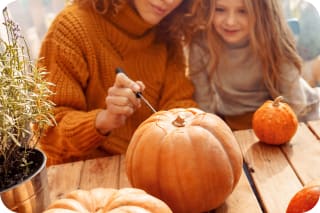
First, gather the craft supplies you need. Place a towel or a board under your work area – that way you have a flat and protected work surface, which makes carving your pumpkin easier and ensures that the floor and table stay clean.
Step 2 - Remove the pumpkin lid
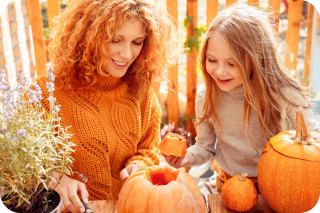
Now let's get started: Take a knife and cut a lid out on the top, around the stem. This can be round or jagged. Our tip: trace your desired shape with a marker and follow it with the knife. Be especially careful when cutting and make sure the lid does not fall into the pumpkin.
Step 3 - Scoop out the flesh
Now it's time to hollow it out. It's important that you remove all seeds, the flesh and the fibers – the best way to do this is with a spoon. Proceed very carefully at this step, because the less material you leave inside, the longer your Halloween lantern will last.
Step 4 - Sketch the face
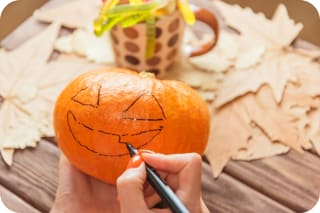
Now comes the most exciting task – you get to give your pumpkin its face. Whether your friend has a funny grin, a scary face or a mysterious other expression it has, is up to your taste. Be creative and use a marker to sketch the mouth, eyes and nose. It's best to use a water-soluble pen so you can wipe off and redraw the face if you're not satisfied. It gets even easier if you first draw a template and cut it out to transfer the outlines to the shell.
Step 5 - Work out the contours with the knife
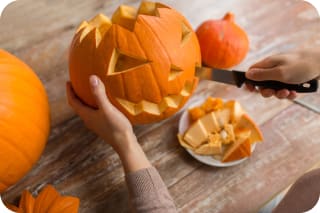
If you like your pumpkin, work with a knife or a small craft saw the contours. Try to score the skin along the pre-drawn lines. If your children are old enough to carve themselves, they may still need help at first. Make sure that especially smaller children are never left to work unsupervised. When the pumpkin looks back at you with its cheeky or friendly face, you'll be almost finished.
Step 6 - Preserve the pumpkin
Since your pumpkin is made of natural materials, it won't last forever. But you can already ensure during carving that the shelf life is extended a bit. As you learned in step 3, it's best to remove as much material from the inside as possible to slow down mold formation. Apply from the outside a special anti-mold spray from the drugstore. This seals the surface and kills bacteria. Ideally spray your pumpkin daily inside and out with the spray – that way you'll enjoy your creation for a long time.
Step 7 - Final steps
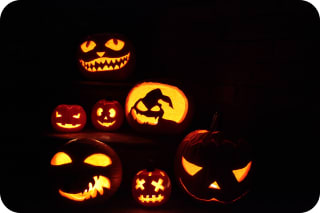
To make your pumpkin lantern shine in the dark, place a tealight or a candle in the middle. Put the lid back on and pick a nice spot for your Halloween decoration. Now you just have to wait for dusk to fall – light the candle and enjoy your self-carved pumpkin.
Recipe ideas: tips for processing the pumpkin flesh
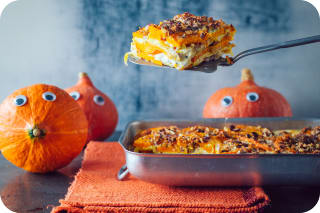
From carving your pumpkins you probably now have a lot of pumpkin flesh left over. It would be a shame to simply throw it away. If the variety of pumpkin you chose is edible, take the opportunity to delicious pumpkin dishes to cook. As inspiration, we now show you 2 simple and tasty recipes that you can cook together with your children can.
Sweet pumpkin soup
Ingredients:
500 g pumpkin
1 liter water
100 g sugar
1 tbsp semolina
3 tbsp lemon juice
1 pinch cinnamon
3 cloves
Remove the seeds from the pumpkin flesh. Set them aside – roasted, pumpkin seeds taste great as a topping for the soup. Put the pumpkin flesh into a pot with 750 ml water and add the cloves and the cinnamon. Let it cook for about 20 minutes, until the pumpkin is soft.
Stir the semolina into the remaining cold water and let it swell a little. Then add this to the pot with the other ingredients. Bring the soup to the boil again and blend everything with an immersion blender. Now you only have to stir in the lemon juice and the sugar and season the soup. Enjoy your meal!
Orange-lemon pumpkin cake
Ingredients:
600 g pumpkin
500 g flour
400 g sugar
250 g soft butter
6 eggs
1 packet baking powder
1 packet vanilla sugar
2 oranges
3 lemons
Put the flesh without seeds into a pot with 100 ml water. Let it simmer covered for about 10 minutes. When the mixture is soft, puree the flesh with an immersion blender until a puree forms.
Take about 400 ml of the puree and put it into a greased and floured bundt pan. Now preheat the oven to about 150 degrees (convection) or gas mark 2.
Put butter, 250 g sugar, vanilla sugar and 1 pinch salt into a mixing bowl and beat the batter with a hand mixer for about 3–4 minutes until creamy.
Fold in the eggs, the flour and the baking powder gradually. Pour the finished batter into the baking pan as well and bake in the oven for about 60 minutes.
After baking, test with a wooden skewer whether the cake is firm inside. Then remove the cake from the oven and let it cool in the pan for about 20 minutes.
In the meantime, squeeze the oranges and lemons so that you get 300 ml of juice. Boil the juice with the remaining 150 g sugar in a pot for about 10 minutes and let the syrup cool briefly.
Carefully remove the cake from the pan, but leave it in the pan for filling with the orange-lemon syrup. Pierce several holes in the base with a wooden skewer and drizzle the entire cake with the syrup you made. Be patient until everything is well cooled – your fruity-sweet pumpkin cake is ready.
Frequently asked questions about carving pumpkins
How long does a carved pumpkin last?
Where can I buy a pumpkin to carve?
When can my child carve a pumpkin on their own?




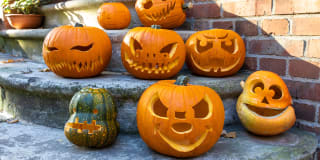





Image credits:
Mother and daughter hold a carved pumpkin in amazement, from which pink smoke rises © Viktoriia - stock.adobe.com
Carved pumpkins on a staircase © Stefan Werner - stock.adobe.com
Girl looks at a pumpkin in her hand © Viktoriia - stock.adobe.com
Mother and daughter carve a pumpkin © Viktoriia - stock.adobe.com
Mother and daughter remove the pumpkin lid © Viktoriia - stock.adobe.com
Pre-drawn face on pumpkin © Viktoriia - stock.adobe.com
Pumpkin is being carved © Syda Productions - stock.adobe.com
Pumpkins with tealights glowing in the dark © Syda Productions - stock.adobe.com
Casserole dish made from pumpkin © JackStock - stock.adobe.com