How can you encourage your baby to crawl?
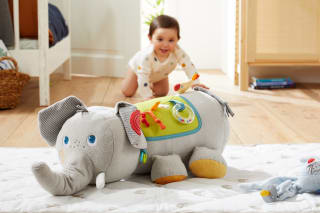
You can't, of course, make your baby crawl if it's not ready yet. But you can certainly create conditions that make learning to crawl easier and more enticing for your baby.
Provide incentives: You can encourage your baby to crawl, by rolling a ball across the floor or placing a toy just out of reach. Children are curious and will try especially hard to reach the toy.
Tip: Crawling rollers also stimulate babies' urge to move in a playful way and support their early development in many ways: They can roll the roller away from themselves, crawl after it and discover many things in the process.
Create optimal conditions: Crawling on slippery floors or in clothing that is too tight/too warm isn't fun. For starters, a carpet, tights or a soft cotton pair of pants with an elastic waistband that allow freedom of movement.
Tip: With crawling shoes, babies are during their first exploratory trips on all fours and their first little steps comfortable, warm and non-slip on the go. Crawling mats provide a perfect base for attempts at crawling which – depending on the features – can be used indoors or outdoors and can be taken anywhere.
Arms open: Sit down on the floor and spread your arms invitingly or call your child, so that it can crawl straight into your arms – this makes crawling a shared goal.
Crawl along: What may seem strange at first glance is, from the baby's perspective, a great thing: Mom and Dad are practically at eye level and demonstrate the movements. In addition, when parents crawl with their baby, they can keep potential hazards well in sight, and the extra movement isn't bad either.
My baby isn't crawling: When should I help my baby learn to crawl?

When babies of the same age are already cheerfully dashing around, but your own child still shows no interest in crawling, many parents feel unsure. In general there is usually no reason to worry. Some babies start as early as 6 months to crawl, others don't start until 10 months when they can already sit up on their own.
It can happen that babies don't crawl at all,but instead move forward by scooting on their bellies or rolling until they pull themselves up and begin to walk.
Motor development progresses individually in all children,therefore the following indications of when a child reaches a particular developmental milestone should be understood only as guidelines.
Overview of developmental stages:

| Scooting | at around 7 months |
| Crawling | at around 8 1/2 months |
| Free standing with help | at around 11 1/2 months |
| Walking independently | at around 13 months |
When and whether your baby crawls is up to them
You can support your baby in learning to crawl, but you should not force anything and definitely shouldn't despair if your baby isn't crawling yet.
When help may be necessary
In rare cases, a blockage in the neck or shoulder area may be the reason a child doesn't crawl. One sign may be that the baby moves in a very atypical way and, for example, rolls along the floor instead of scooting or crawling. Such blockages are often the result of a complicated birth and go unnoticed until a baby becomes more mobile. A visit to an osteopath will clarify whether your baby has a blockage or is simply taking a little more time with crawling.
Tips to encourage crawling: What to pay attention to when your baby starts to crawl
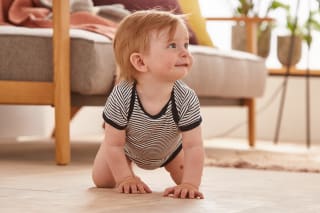
Give time and space:Crawling isn't learned in a day. A baby needs time and quiet,to develop its muscles and gain the necessary coordination skills.
Have confidence:It does little good if you give your child support; in the worst case it can even be harmful if you put them in a crawling position when their muscles are not yet strong enough.Trust your child's abilities and allow them their own pace.
Be there: Don't let your child crawl around the apartment on their own. Even if everything seems childproof, there's still a risk of accidents. Besides, crawling is much more fun when the parents are there to give plenty of praise.
Secure the home: As babies start crawling, everything comes within reach: room doors, cabinet doors, pet food bowls, power outlets, and unfortunately stairs too. Childproof the home in good time,e.g., by securing or removing wobbly shelves and decorations and installing a baby gate on the stairs.
You can find more help and tips on how to best encourage your baby's crawling here:
More articles about leisure & creativity







Image credits
Baby on exercise ball © Westend61 - stock.adobe.com